How can authenticity, integrity, and provenance be protected across different layers of modern computing systems when each layer faces different threats and uses different security mechanisms?
This study presents a protocol-driven systematic review of assurance mechanisms across five layers of the computing stack: application artefacts, media objects, physical-network devices, cryptographic protocols, and micro-architectural implementations.
Following PRISMA 2020, the researchers examined peer-reviewed studies published in Cyber Security and Applications, Volume 4 (2026), available as of 15 September 2026. Nine records were identified, four were excluded during title and abstract screening, and five satisfied all eligibility criteria for inclusion.
Because the included studies examined very different security mechanisms and outcomes, statistical meta-analysis was not appropriate. The researchers therefore used a structured narrative synthesis and evaluated the studies using an eight-domain methodological quality framework.
The five included studies covered Android application repackaging detection, robust audio watermarking, smart-meter identity authentication, anonymous multi-receiver signcryption, and side-channel analysis of cryptographic implementations.
Four of the five studies involved machine-learning-based techniques, while one relied on formal cryptographic security proofs and automated verification.
The reported results showed strong performance across several layers. Audio watermarking achieved a bit-recovery accuracy of up to 99.91%, while the smart-meter authentication framework achieved a spoofing-detection accuracy of 94.18%.
The cryptographic signcryption study reported a total computation cost of 887 milliseconds for ten receivers and achieved transmission costs that increased linearly rather than quadratically with the number of receivers.
At the implementation layer, metaheuristic neural-architecture search enabled recovery of a masked AES key within approximately 60 attack traces under one evaluated configuration, demonstrating how automated optimisation can also strengthen offensive security analysis.
Methodological quality across the five studies ranged from 81.3% to 93.8%, indicating generally moderate-to-high quality, although the review identified weaknesses in areas such as variability reporting and replication.
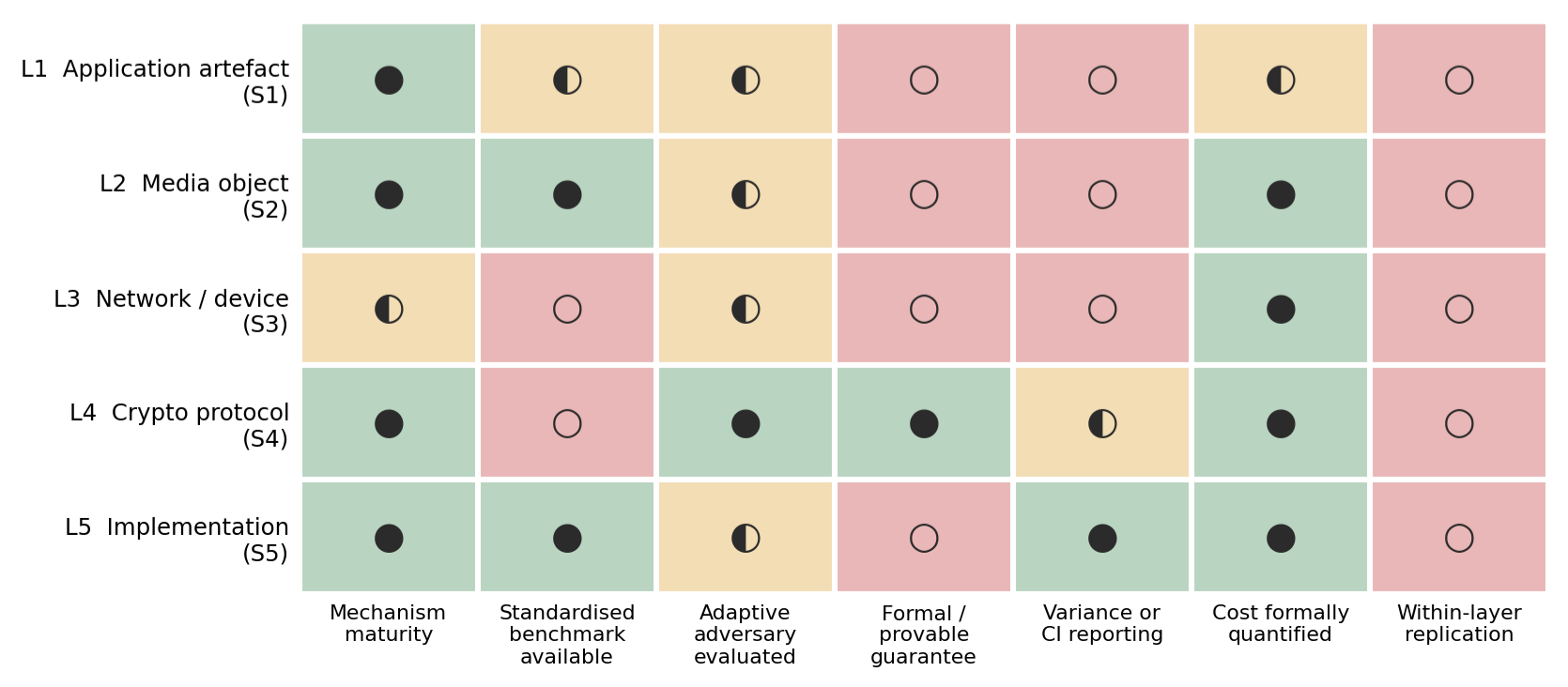
A major cross-layer finding was that the different assurance mechanisms converge on a common invariance principle: effective security representations should remain stable under legitimate or benign transformations while changing sufficiently when an adversary modifies the protected object.
The review also identified a clear difference between empirical and provable assurance. Most of the included studies supported their claims through benchmark performance, whereas the cryptographic protocol study provided formal security reductions and automated verification.
Benchmark maturity also varied substantially across the cyber stack. Established public datasets were available for some media and implementation-layer problems, while network and protocol layers lacked equally mature evaluation infrastructure.
Another important gap involved adaptive adversaries. Although the review documented attacks specifically designed to evade security detectors, none of the included learning-based studies directly evaluated its deployed mechanism against an adversary actively optimising attacks against that particular model.
Overall, the study shows that authenticity, integrity, and provenance assurance across the cyber stack share important structural principles despite relying on very different technologies, datasets, and forms of evidence.
The authors emphasise that the review uses a deliberately bounded evidence base drawn from one journal volume, with only five included studies and no within-layer replication. Its findings are therefore useful for identifying cross-layer patterns and research gaps but should not be interpreted as an exhaustive representation of the entire cybersecurity literature.
📖 Read the full article here:
https://doi.org/10.61298/rans.2026.4.2.416
Published in: Recent Advances in Natural Sciences