Which classical time-series model provides more reliable short-term wind-speed forecasts: ARIMA or exponential smoothing?
This study compares the forecasting performance of autoregressive integrated moving average, ARIMA, and exponential smoothing state-space, ETS, models for short-term wind-speed prediction across twelve meteorological stations in Pakistan.
A naïve forecasting model was also included as a benchmark for comparison.
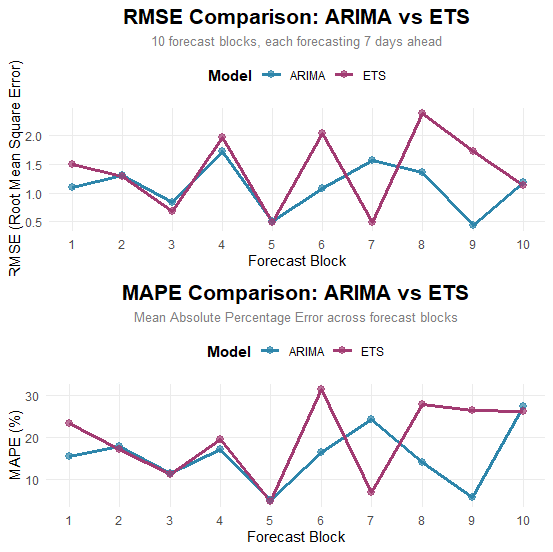
Instead of relying on a single train-test split, the researchers used an expanding-window approach in which the training dataset was progressively increased over ten successive splits.
Each split was used to generate seven-day-ahead wind-speed forecasts, allowing model performance to be evaluated across multiple forecast origins while incorporating newly available observations.
Forecast accuracy was assessed using root mean square error, RMSE, and mean absolute percentage error, MAPE.
The researchers also applied the Diebold–Mariano test to determine whether differences in forecast errors between ARIMA and ETS were statistically meaningful.
The results showed that ARIMA provided better short-term forecasting performance at seven of the twelve stations.
ETS performed better at two stations, while the two models produced comparable results at three stations.
The station-level analysis showed that ARIMA performed better at Chakri, Gwadar, Haripur, Peshawar, Quaid Abad, Quetta, and Sadiq Abad, while ETS performed better at TandoGA and Umerkot. At Bahawalpur, Sanghar, and Sujawal, their performances were broadly similar.
The Diebold–Mariano analysis also supported the overall advantage of ARIMA, with lower forecast loss observed at most stations and statistically significant differences at several locations.
The study further found that ARIMA generally produced narrower prediction intervals than ETS, although ETS sometimes provided better interval coverage.
These findings indicate that ARIMA was the more consistent model overall for the datasets examined, but they also show that no single forecasting method was best at every location.
The authors therefore suggest that model selection may be more effective when performed on a station-by-station basis rather than adopting one model universally.
Overall, the study demonstrates that expanding-window validation provides a more realistic assessment of forecasting performance because models are repeatedly tested as new observations become available.
The findings also suggest that future work could explore hybrid ARIMA–ETS approaches or incorporate additional meteorological variables to further improve wind-speed forecasting accuracy.
📖 Read the full article here:
https://doi.org/10.46481/asr.2026.5.3.610
Published in: African Scientific Reports