How can the movement and absorption of an orally administered drug in the gastrointestinal tract be described mathematically?
This study develops an initial-boundary value model for drug transport in the gastrointestinal lumen by combining Fickian diffusion with a first-order volumetric absorption term representing drug removal into the systemic circulation.
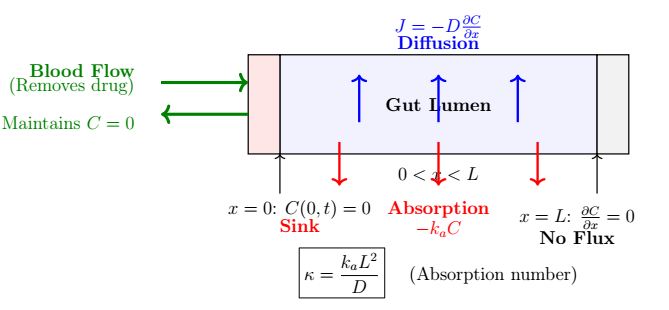
The gastrointestinal lumen is represented as a one-dimensional domain, with drug movement governed by diffusion while absorption is incorporated through a distributed sink term proportional to the local drug concentration.
The model assumes a constant diffusion coefficient, a uniform initial drug concentration, and no-flux boundary conditions at both the gut wall and the luminal center.
Under these assumptions, physiological uptake is not represented as a separate boundary flux. Instead, absorption is treated through an effective volumetric rate constant that accounts for drug removal throughout the modeled lumen.
The governing equation is formulated as a diffusion equation with a first-order absorption term, and the researchers solve the resulting initial-boundary value problem using separation of variables.
The analytical solution shows that the drug concentration remains spatially uniform throughout the lumen and decays exponentially with time according to C(x,t) = C₀e⁻ᵏᵃᵗ.
This spatial uniformity arises because the initial concentration is uniform and both boundaries impose zero diffusive flux, leaving the first-order absorption term as the mechanism governing concentration decay.
The study introduces the dimensionless absorption number κ = kₐL²/D, which compares the characteristic absorption and diffusion time scales.
When κ is much greater than 1, absorption is faster relative to diffusion, whereas κ much less than 1 represents a regime in which diffusion is faster relative to absorption.
For the numerical example used in the study, D = 5 × 10⁻⁶ cm²/s, kₐ = 0.01 s⁻¹, and L = 0.1 cm, giving κ = 20 and indicating an absorption-dominated regime.
The analytical results further show that the fraction of drug remaining in the gastrointestinal tract decays exponentially.
For small absorption numbers, drug elimination is slow, while larger values of κ produce much more rapid reduction in the remaining drug fraction.
The researchers also solved the model numerically using the Crank–Nicolson finite-difference method, which is second-order accurate in both space and time and unconditionally stable for the linear problem considered.
The numerical simulations were performed using 100 spatial subintervals, a spatial step of 0.001 cm, and a time step of 10⁻⁵ s over a 600-second simulation period.
Comparison of the numerical and analytical solutions showed excellent agreement, with maximum absolute errors reported on the order of 10⁻¹⁵ for the chosen parameters.
This agreement validates the analytical solution and demonstrates that the numerical method can provide a useful foundation for more complicated drug-transport models.
Overall, the study provides a mathematically rigorous framework for understanding the interaction between diffusion and first-order absorption in oral drug delivery.
The model can potentially support formulation design, dose optimization, bioequivalence analysis, and strategies intended to enhance drug absorption.
However, the authors note that the model remains highly idealized. It uses a one-dimensional geometry, assumes constant diffusion and first-order absorption, excludes gastrointestinal flow and mixing, and does not account for regional changes in pH, motility, food effects, or the complex geometry of villi and microvilli.
Future extensions could incorporate variable diffusion coefficients, nonlinear absorption kinetics, pH-dependent effects, multi-compartment pharmacokinetics, fractional-order derivatives, and physiological heterogeneity.
📖 Read the full article here:
https://doi.org/10.61298/rans.2026.4.2.404
Published in: Recent Advances in Natural Sciences