Can a more complex hybrid machine-learning model improve facies classification if the evaluation itself is not protected against data leakage?
This study investigates machine learning for facies classification in oil and gas exploration and introduces the Hybrid Explainable Transformer Framework, HETF, designed to combine predictive modelling with explainability and uncertainty estimation.
The framework integrates three parallel branches: a convolutional neural network, CNN, for local patterns; a bidirectional long short-term memory network, BiLSTM, for sequential relationships; and a Transformer for longer-range dependencies.
It also incorporates SHapley Additive exPlanations, SHAP, to interpret model predictions and Monte Carlo Dropout to estimate prediction uncertainty.
The study used 830 labelled samples from two wells in the SEG 2016 facies-classification dataset.
A major focus of the research was correcting data leakage caused by randomly splitting overlapping sliding windows.
To address this problem, the researchers divided the well-log data into depth-contiguous blocks before window construction and used blocked five-fold cross-validation so that overlapping or near-duplicate samples could not appear across training and test sets.
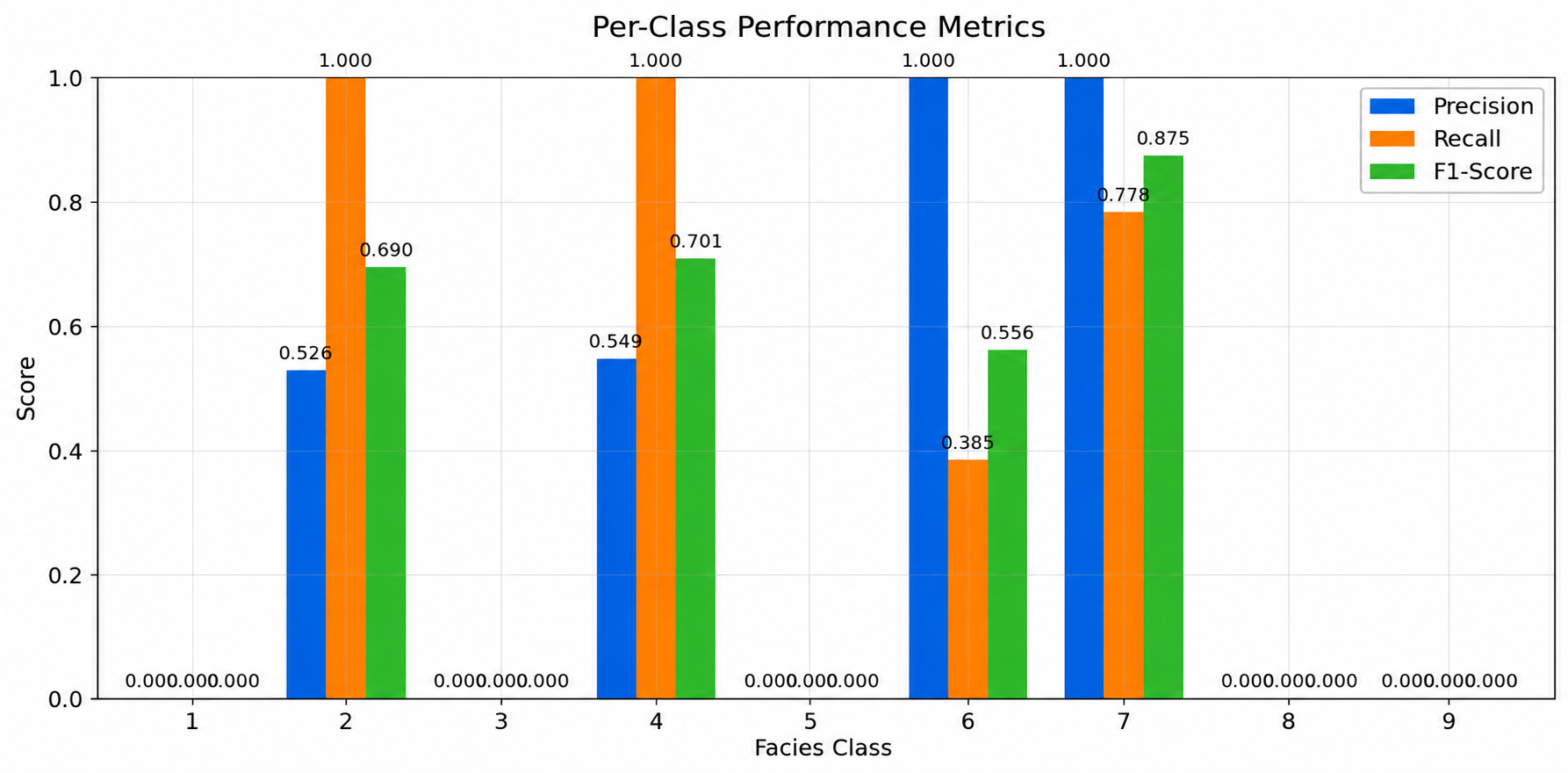
Under repeated leakage-free cross-validation, HETF achieved about 58% mean accuracy and 31% mean macro F1-score, while its training accuracy ranged from 85% to 98%.
The large gap between training and validation performance indicated substantial overfitting, which the study linked mainly to limited examples for several facies classes.
When HETF was compared with simpler models under the same leakage-free evaluation protocol, the full hybrid architecture did not perform best.
In the controlled comparison, the Transformer-only model achieved 76.4% accuracy and 49.2% macro F1, XGBoost achieved 75.2% accuracy and 46.8% macro F1, and Random Forest achieved 72.5% accuracy and 40.8% macro F1, compared with 61.4% accuracy and 38.0% macro F1 for the full HETF.
These results indicate that combining multiple neural-network branches did not justify the added architectural complexity at the scale of the available dataset.
The study therefore provides an important methodological finding: a more complicated model does not automatically produce better facies classification when data are limited.
The explainability analysis also identified deep resistivity, ILD_log10, as the most influential feature, followed by neutron porosity, PHIND, and gamma ray, GR.
Overall, the study emphasizes the importance of leakage-free evaluation, realistic model comparison, explainability, and uncertainty estimation in machine-learning applications for petroleum exploration.
Rather than reporting inflated accuracy from a favourable random split, the researchers prioritize a reproducible evaluation framework that better reflects the limitations of the available data.
The findings suggest that simpler models may currently be more practical for this dataset, while HETF’s main contribution lies in integrating interpretability and uncertainty information into the facies-classification workflow.
Future work is expected to include larger and more diverse datasets, cross-well and multi-basin validation, improved treatment of class imbalance, and further testing of explainable and uncertainty-aware models.
📖 Read the full article here:
https://doi.org/10.46481/jnsps.2027.3420
Published in: Journal of the Nigerian Society of Physical Sciences