How can classical trapezoid-type inequalities be extended to quantum calculus for functions of two variables under stronger forms of convexity?
This study establishes new q-trapezoid-type inequalities for q-differentiable coordinated strongly s-convex functions defined on bidimensional intervals.
The framework combines quantum calculus with coordinated strong s-convexity, a generalized convexity condition applied separately to each coordinate of a function of two variables.
A symmetric modulus convention is adopted for the two coordinates so that the strong s-convexity penalties are treated consistently in both directions.
The researchers begin from a mixed quantum integral identity and derive three principal trapezoid-type estimates using different analytical techniques.
The first estimate is obtained through direct estimation of the mixed q-integral terms under the coordinated strongly s-convex assumptions.
A second family of bounds is developed using the q-Hölder inequality, while another set is obtained through the q-power mean inequality.
These results extend earlier quantum trapezoid-type inequalities developed for coordinated strongly convex functions to the broader class of coordinated strongly s-convex functions, where s lies between 0 and 1.
An important feature of the framework is its connection with classical analysis. When the quantum parameters q₁ and q₂ approach 1 from below, the q-derivatives and q-integrals recover their classical counterparts, and the new quantum inequalities reduce to corresponding classical trapezoid-type inequalities.
The study also provides explicit examples to verify that the required coordinated strong s-convexity assumptions are satisfied rather than simply assuming them.
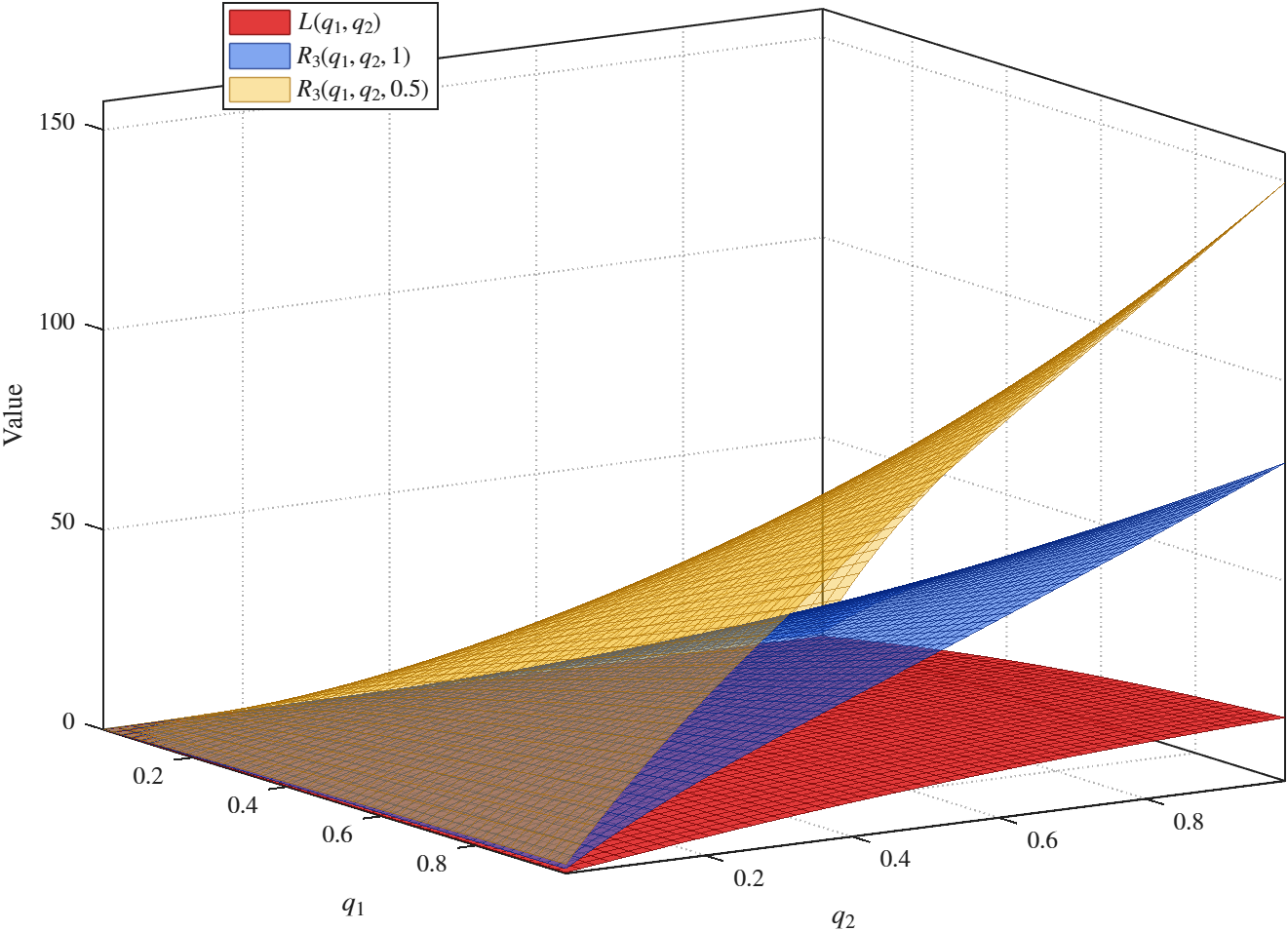
Numerical calculations were then performed on a finite parameter grid to illustrate the theoretical estimates and examine the gaps between the left-hand expressions and the derived upper bounds.
The computations were carried out on a 401 × 401 grid over the parameter region [0.01, 0.99]² for selected values of s.
All tested numerical gaps remained nonnegative. For example, the reported minimum gaps for the three derived bounds were positive for both s = 1 and s = 0.5, supporting the theoretical inequalities across the tested parameter grid.
Graphical illustrations were also used to compare the quantities appearing on the two sides of the inequalities and demonstrate how the derived bounds behave as the quantum parameters vary.
The authors emphasize that these numerical calculations provide finite-grid illustrations rather than proofs over the entire continuous parameter domain; the validity of the inequalities follows from the analytical theorems themselves.
Overall, the study provides a generalized quantum-calculus framework for trapezoid-type inequalities involving coordinated strongly s-convex functions and establishes a direct bridge between the quantum and classical forms of these estimates.
The authors suggest that the same analytical approach could be extended to quantum midpoint-, Simpson-, Ostrowski-, and Hermite–Hadamard-type inequalities and to other generalized classes of convex functions.
📖 Read the full article here:
https://doi.org/10.46481/jnsps.2027.3670
Published in: Journal of the Nigerian Society of Physical Sciences