Researchers at the Korea Advanced Institute of Science and Technology (KAIST) have developed a new approach to improving the lifespan of next-generation lithium batteries, potentially enabling electric vehicles to travel longer distances using smaller and lighter battery packs.
The breakthrough addresses a major limitation of anode-free lithium metal batteries, which offer the possibility of storing more energy in less space but frequently suffer from rapid deterioration during repeated charging and discharging.
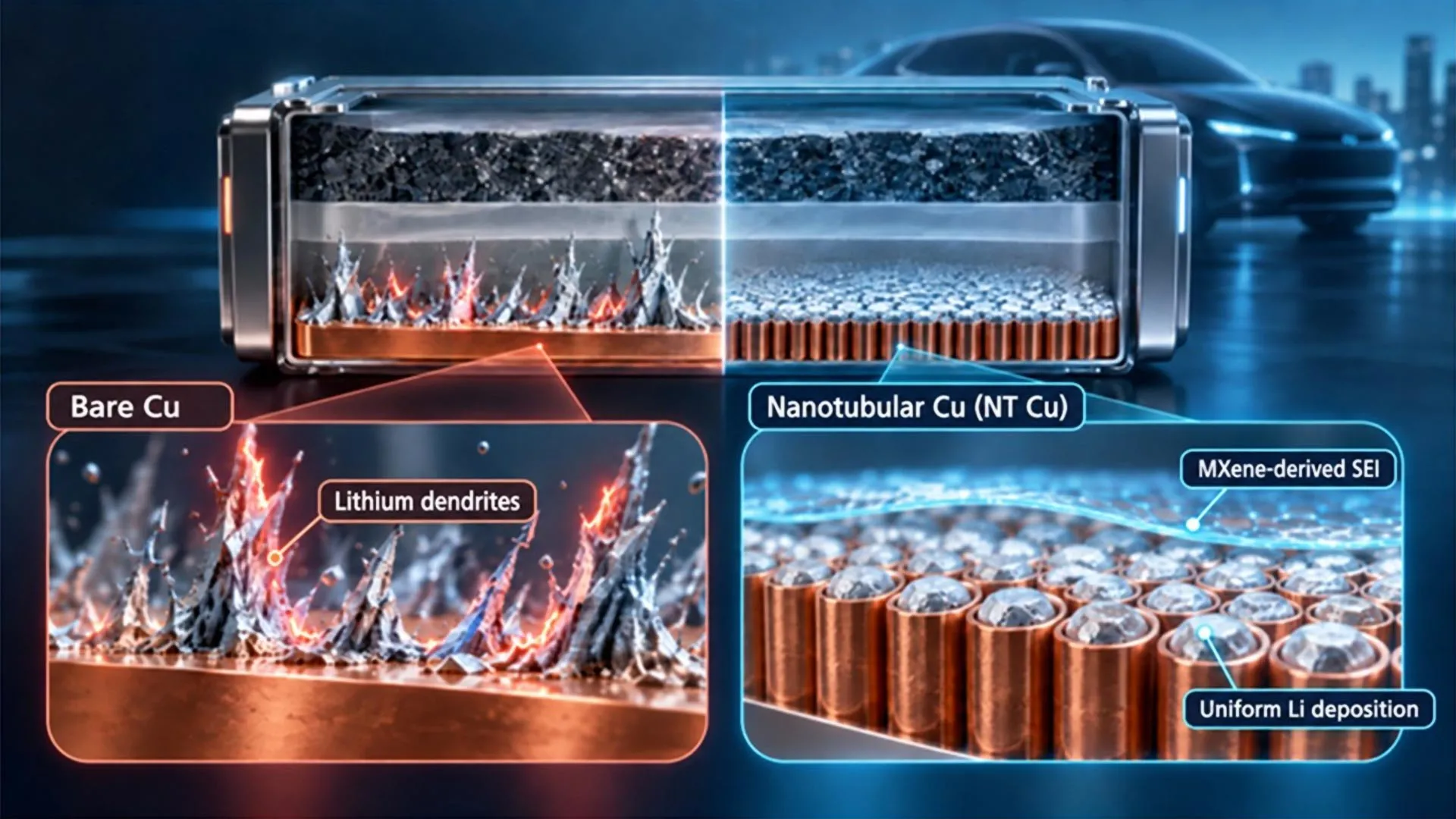
By adapting precision fabrication techniques used in semiconductor manufacturing, the researchers created microscopic structures that encourage lithium to accumulate more uniformly on the battery's copper surface. They also introduced an ultrathin protective coating that promotes the formation of a stable layer capable of reducing unwanted chemical reactions and damaging lithium growth.
The research was led by Professors Jinwoo Lee and Hee-Tae Jung of KAIST's Department of Chemical and Biomolecular Engineering, in collaboration with researchers from Kyungpook National University and the National NanoFab Center.
The findings were published online on 1 September 2026 in Advanced Functional Materials and announced by KAIST on 22 September 2026.
𝐖𝐡𝐲 𝐀𝐧𝐨𝐝𝐞-𝐅𝐫𝐞𝐞 𝐁𝐚𝐭𝐭𝐞𝐫𝐢𝐞𝐬 𝐂𝐨𝐮𝐥𝐝 𝐈𝐦𝐩𝐫𝐨𝐯𝐞 𝐄𝐥𝐞𝐜𝐭𝐫𝐢𝐜 𝐕𝐞𝐡𝐢𝐜𝐥𝐞 𝐑𝐚𝐧𝐠𝐞
Conventional lithium-ion batteries contain an anode made from materials such as graphite, which stores lithium during charging.
Although this design is widely used, the anode material contributes to the battery's overall thickness and weight.
Anode-free batteries use a different arrangement. Instead of incorporating a conventional anode material, they allow lithium to accumulate directly on a thin copper foil during charging.
Removing the graphite-based anode reduces the amount of material required inside the battery, creating an opportunity to increase energy storage within the same physical space.
For electric vehicles, this could mean achieving longer driving ranges without increasing the size or weight of the battery pack.
However, the advantages of anode-free batteries have been difficult to realise because their operating lifespan is often limited by unstable lithium deposition.
𝐓𝐡𝐞 𝐏𝐫𝐨𝐛𝐥𝐞𝐦 𝐨𝐟 𝐋𝐢𝐭𝐡𝐢𝐮𝐦 𝐃𝐞𝐧𝐝𝐫𝐢𝐭𝐞𝐬
One of the main challenges facing anode-free batteries is the uneven accumulation of lithium during repeated charging and discharging.
Rather than spreading uniformly across the copper surface, lithium can form branching or needle-like structures known as dendrites.
These irregular deposits interfere with battery performance and contribute to deterioration over time.
The problem is made worse when the protective layer surrounding the deposited lithium becomes unstable.
Together, uneven lithium deposition and deterioration of the protective layer reduce the battery's ability to operate reliably over repeated charging cycles.
These limitations have remained major obstacles to the commercial development of anode-free lithium metal batteries.
Earlier approaches attempted to address the problem by adding extra lithium to compensate for losses during operation or introducing thicker protective coatings over the electrode.
Although these strategies can help reduce degradation, they also increase the amount of material inside the battery.
The additional weight and thickness undermine the main advantage of anode-free technology: its potential to provide greater energy storage in a compact and lightweight design.
The KAIST researchers therefore investigated a method that could improve battery stability without requiring substantial additional material.
𝐁𝐨𝐫𝐫𝐨𝐰𝐢𝐧𝐠 𝐏𝐫𝐞𝐜𝐢𝐬𝐢𝐨𝐧 𝐌𝐚𝐧𝐮𝐟𝐚𝐜𝐭𝐮𝐫𝐢𝐧𝐠 𝐟𝐫𝐨𝐦 𝐭𝐡𝐞 𝐒𝐞𝐦𝐢𝐜𝐨𝐧𝐝𝐮𝐜𝐭𝐨𝐫 𝐈𝐧𝐝𝐮𝐬𝐭𝐫𝐲
Instead of increasing the amount of lithium or applying a thick protective coating, the research team focused on modifying the copper surface where lithium accumulates.
The scientists adapted a semiconductor fabrication method known as secondary sputtering lithography (SSL), which enables extremely small structures to be manufactured with high precision.
Using this technique, they created an organised arrangement of microscopic tubes across the copper foil.
The purpose of these structures was to provide more evenly distributed locations for lithium deposition.
The researchers compared the concept to dividing a large parking area into individual spaces. Rather than allowing lithium to accumulate unpredictably in certain regions, the patterned surface encourages it to spread more uniformly.
Each microscopic tube measured approximately 300 nanometres in diameter and 150 nanometres in height.
Despite their extremely small dimensions, the structures substantially increased the available surface area of the copper foil.
The modified surface provided approximately four times the surface area of an ordinary flat copper sheet.
This increase created more space for lithium to accumulate, helping to reduce concentrated deposits that can develop into damaging structures.
By controlling the electrode's surface geometry, the researchers improved the conditions for stable lithium deposition without relying on large quantities of additional material.
𝐀𝐧 𝐔𝐥𝐭𝐫𝐚𝐭𝐡𝐢𝐧 𝐌𝐗𝐞𝐧𝐞 𝐂𝐨𝐚𝐭𝐢𝐧𝐠 𝐏𝐫𝐨𝐦𝐨𝐭𝐞𝐬 𝐚 𝐒𝐭𝐚𝐛𝐥𝐞 𝐏𝐫𝐨𝐭𝐞𝐜𝐭𝐢𝐯𝐞 𝐋𝐚𝐲𝐞𝐫
The researchers combined the microscopic copper structures with an additional surface treatment involving MXene, a two-dimensional material.
They applied an MXene coating approximately 10 nanometres thick to the copper foil.
Rather than serving as the final protective barrier itself, the MXene layer was designed to encourage the development of a more stable protective layer during battery operation.
The coating acts as a foundation that supports the formation of a protective interface between the deposited lithium and the surrounding electrolyte.
In the experiments, the researchers used an electrolyte based on lithium hexafluorophosphate (LiPF₆).
The MXene surface promoted the formation of a protective layer containing a high concentration of lithium fluoride (LiF).
This layer helps reduce unwanted chemical reactions between lithium and the electrolyte.
It also restricts the growth of damaging lithium deposits, addressing another important cause of deterioration in anode-free batteries.
The combined approach therefore targets two related problems: uneven lithium accumulation and instability at the electrode surface.
𝐇𝐨𝐰 𝐭𝐡𝐞 𝐑𝐞𝐬𝐞𝐚𝐫𝐜𝐡𝐞𝐫𝐬 𝐄𝐱𝐚𝐦𝐢𝐧𝐞𝐝 𝐭𝐡𝐞 𝐏𝐫𝐨𝐭𝐞𝐜𝐭𝐢𝐯𝐞 𝐋𝐚𝐲𝐞𝐫
To investigate how the protective layer developed, the researchers examined the surfaces and internal cross-sections of the modified electrodes.
During the analysis, they carefully limited the samples' exposure to air.
Their observations confirmed that a nanoscale protective layer formed uniformly along the MXene surface.
The team used several advanced analytical techniques to examine the electrode materials and understand the formation of the protective interface.
These included X-ray photoelectron spectroscopy (XPS), time-of-flight secondary ion mass spectrometry (ToF-SIMS) and transmission electron microscopy (TEM).
Together, these methods provided information about the chemical composition and structure of the electrode surfaces.
The findings helped the researchers explain how the MXene coating supports the development of a stable, lithium-fluoride-rich protective layer.
𝐖𝐡𝐲 𝐭𝐡𝐞 𝐂𝐨𝐦𝐛𝐢𝐧𝐞𝐝 𝐀𝐩𝐩𝐫𝐨𝐚𝐜𝐡 𝐈𝐬 𝐈𝐦𝐩𝐨𝐫𝐭𝐚𝐧𝐭
The significance of the KAIST approach lies in combining precise surface patterning with the controlled formation of a protective interface.
The microscopic tubes increase the copper surface area and encourage lithium to deposit more uniformly.
Meanwhile, the ultrathin MXene coating promotes the formation of a stable protective layer that limits unwanted reactions and suppresses damaging lithium growth.
These improvements address important causes of battery deterioration while keeping the amount of additional material relatively small.
Unlike approaches that depend on extra lithium or thicker protective coatings, the new method seeks to preserve the compact and lightweight characteristics that make anode-free batteries attractive.
Professor Jinwoo Lee explained that the study demonstrates how extremely fine semiconductor manufacturing techniques can create uniform lithium deposition sites and a stable protective layer without changing the main electrolyte formulation or introducing excess lithium.
The findings show how fabrication methods developed for one technological field can be adapted to address challenges in another.
𝐏𝐨𝐭𝐞𝐧𝐭𝐢𝐚𝐥 𝐟𝐨𝐫 𝐋𝐨𝐧𝐠𝐞𝐫-𝐑𝐚𝐧𝐠𝐞 𝐄𝐥𝐞𝐜𝐭𝐫𝐢𝐜 𝐕𝐞𝐡𝐢𝐜𝐥𝐞𝐬
The development could support future electric vehicle batteries that store more energy without requiring larger or heavier battery packs.
Anode-free batteries already offer the possibility of higher energy storage within a smaller volume because they eliminate conventional anode materials.
However, their limited lifespan has restricted progress towards widespread commercial adoption.
By improving the stability of lithium deposition and the protective electrode layer, the KAIST approach addresses two major obstacles to extending battery operating life.
The researchers believe the findings could help accelerate the commercial development of high-energy anode-free batteries.
If successfully developed for practical applications, the technology could contribute to more compact battery systems capable of supporting longer electric vehicle driving ranges.
The reported findings establish a promising materials and electrode-engineering approach, rather than demonstrating a commercially available electric vehicle battery with a specified increase in driving distance.
𝐑𝐞𝐬𝐞𝐚𝐫𝐜𝐡 𝐂𝐨𝐥𝐥𝐚𝐛𝐨𝐫𝐚𝐭𝐢𝐨𝐧 𝐚𝐧𝐝 𝐅𝐮𝐧𝐝𝐢𝐧𝐠
The research was conducted by a collaborative team led by Professor Jinwoo Lee and Professor Hee-Tae Jung of KAIST's Department of Chemical and Biomolecular Engineering.
Researchers from Kyungpook National University and the National NanoFab Center also participated in the project.
Eunji Kim, Hyunju Jung and Jinuk Kim served as co-first authors of the study.
The work received support from the Nano&Material Technology Development Program, administered through the National Research Foundation of Korea and funded by the Ministry of Science and ICT.
Additional funding was provided through the Global Semiconductor Advanced Fab Utilization Project and the Semiconductor–Secondary Battery Interfacing Platform Technology Development Project of the National NanoFab Center.
𝐀 𝐏𝐫𝐨𝐦𝐢𝐬𝐢𝐧𝐠 𝐒𝐭𝐞𝐩 𝐓𝐨𝐰𝐚𝐫𝐝 𝐌𝐨𝐫𝐞 𝐄𝐟𝐟𝐢𝐜𝐢𝐞𝐧𝐭 𝐄𝐕 𝐁𝐚𝐭𝐭𝐞𝐫𝐢𝐞𝐬
The KAIST-led research demonstrates how precision semiconductor manufacturing and nanoscale surface engineering can be combined to improve the stability of anode-free lithium metal batteries.
By creating microscopic tube structures on copper foil, the researchers increased the available deposition surface to approximately four times that of a flat sheet, helping lithium accumulate more evenly.
The addition of an ultrathin MXene coating encouraged the formation of a stable lithium-fluoride-rich protective layer, reducing unwanted reactions and restricting damaging lithium growth.
Together, these advances address key factors responsible for the limited lifespan of anode-free batteries without substantially increasing their weight or thickness.
The findings offer a promising direction for developing smaller, lighter and longer-lasting battery systems, potentially helping future electric vehicles achieve greater driving ranges from more compact energy storage technology.
𝐉𝐨𝐮𝐫𝐧𝐚𝐥 𝐑𝐞𝐟𝐞𝐫𝐞𝐧𝐜𝐞
Eunji Kim, Hyunju Jung, Jinuk Kim, Sung-Jin Chang, Gyungtae Kim, Yun Chang Park, Yoon Kyung Seo, Kyung Jin Park, Sodam Choi, Kwangduck Seo, Hee Han, Su-Ho Cho, Chi Won Ahn, Vy Thuy Nguyen, Hyeyoung Shin, Minji Lim, Hee-Tae Jung, Yonghee Lee and Jinwoo Lee.
“Anion-Interactive Anode Interfaces for Stable Anode-Free Lithium Metal Batteries.”
Advanced Functional Materials, 2026, 36(80).