Can multimodal transformer models become more computationally efficient by activating only the neurons most relevant to the input domain?
This study introduces NEUROBALANCE, a domain-conditioned sparse-activation framework designed to reduce the computational cost of multimodal transformer networks without sacrificing task performance.
Multimodal transformers normally combine a vision encoder, a learnable projector, and a language decoder, but dense models activate every feed-forward neuron at every layer, even when the task does not require the network’s full representational capacity.
NEUROBALANCE addresses this by combining three mechanisms: per-head attention reweighting, sparse feed-forward neuron gating, and an Elastic-Weight-Consolidation-inspired retention regulariser.
All three mechanisms are controlled by a single soft domain embedding derived directly from the input tokens during inference.
The framework was evaluated on two different multimodal transformer backbones, LLaVA-NeXT-7B and InstructBLIP, using three benchmarks: PMC-VQA, PathVQA, and LingoQA.
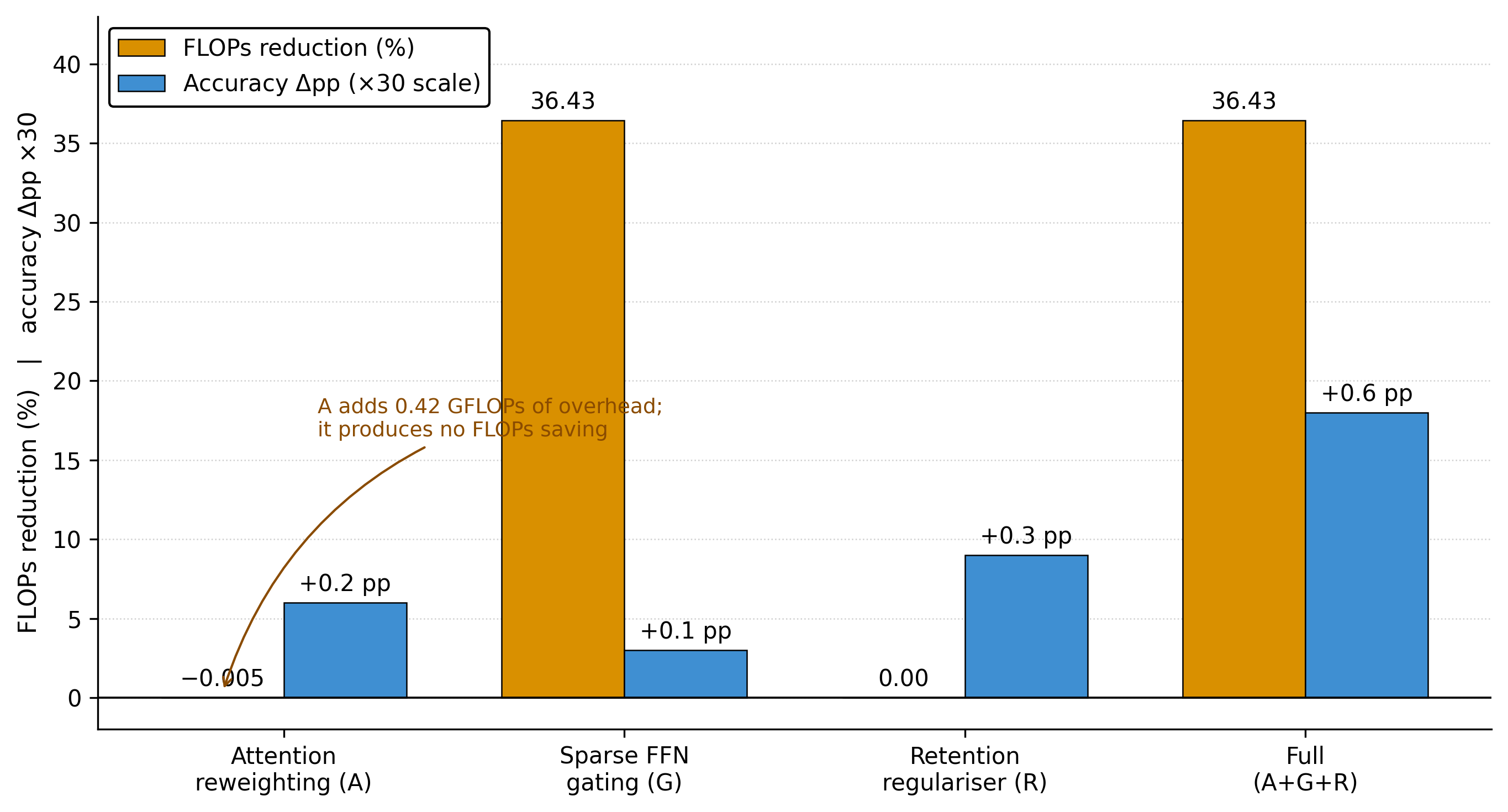
Across the two models, NEUROBALANCE reduced forward-pass computational cost by 36.4% and 36.6%, respectively.
Measured A100 inference latency was also reduced by 32.4% for LLaVA-NeXT and 36.1% for InstructBLIP, while peak memory usage fell by 18.1% and 25.8%.
Importantly, these efficiency gains did not come at the expense of benchmark performance.
Mean accuracy increased slightly by 0.6 percentage points on LLaVA-NeXT and 0.5 percentage points on InstructBLIP, with all benchmark-level differences remaining statistically significant after Holm–Bonferroni adjustment.
The study also assessed energy consumption. Under a conservative estimate based on latency, per-inference energy use fell by at least 32.4%.
When measured GPU power was used for both dense and sparse models, the estimated energy reduction increased to 43.9%.
At the stated global-average grid carbon intensity, this translated to an estimated saving of 58.5 kg of CO₂-equivalent per million inferences.
Further analysis showed that the efficiency gains were consistent across both transformer backbones despite differences in their internal fusion strategies.
This cross-backbone consistency suggests that the savings come from the domain-conditioned architecture itself rather than from characteristics unique to a single model.
The study therefore demonstrates that multimodal transformers can reduce unnecessary computation by selectively activating domain-relevant neurons while maintaining, and in some cases slightly improving, task accuracy.
Overall, NEUROBALANCE presents a possible approach to making multimodal AI systems more computationally efficient, memory-efficient, and energy-efficient without requiring a reduction in model size or precision.
The authors note, however, that broader testing on additional transformer architectures and direct comparisons with other efficiency approaches such as pruning and Mixture-of-Experts remain important areas for future work.
📖 Read the full article here:
https://doi.org/10.46481/jnsps.2027.3599
Published in: Journal of the Nigerian Society of Physical Sciences