Can nuclear magnetic resonance relaxation parameters be used to distinguish rare DNA intermediate structures involved in key biological processes?
This study investigates the statistical behaviour of nuclear magnetic resonance longitudinal, T₁, and transverse, T₂, relaxation times in rare DNA intermediate structures.
Rare DNA intermediates are important because they participate in biological processes such as gene transcription, replication, recombination, and DNA repair.
The researchers examined five rare DNA structures, including three G-quadruplexes, a DNA triplex, and a displacement loop.
Published experimental NMR relaxation data were used as the basis for generating larger datasets. An R script was used to simulate 500 T₁ and T₂ data points for each DNA structure, and the resulting datasets were analysed using non-parametric statistical methods in Wolfram Mathematica.
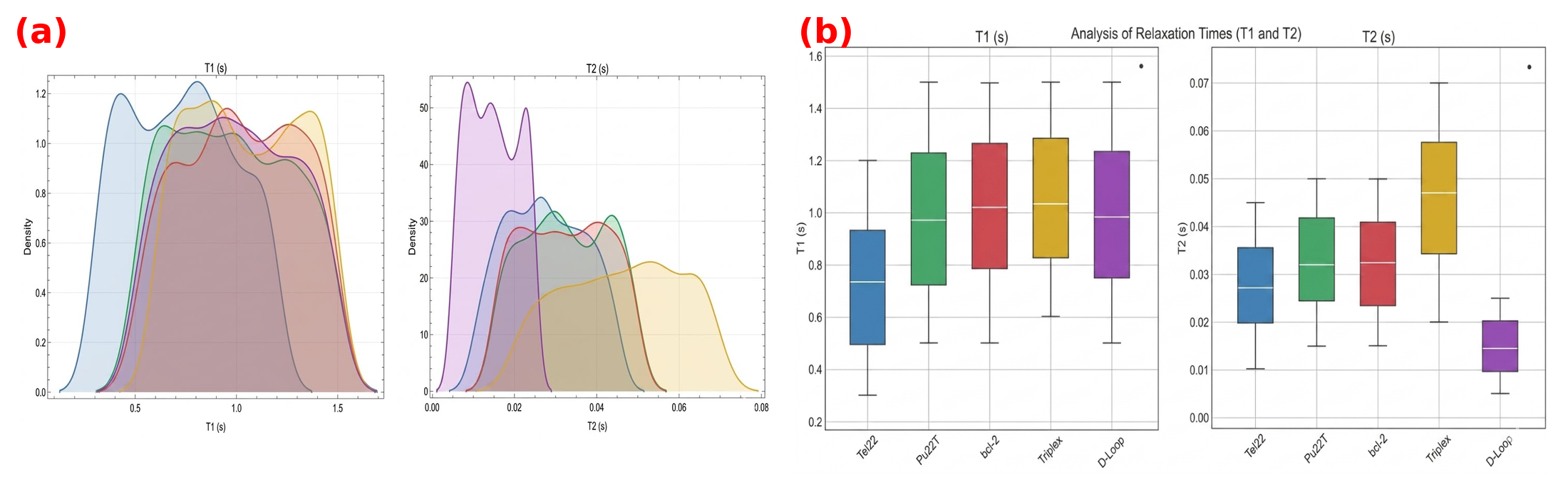
The analysis showed that the T₁ and T₂ relaxation-time datasets for the five DNA structures possessed distinct statistical characteristics.
The results also showed significant differences among the structures for both T₁ and T₂ relaxation times, supporting the possibility of using these parameters to distinguish rare DNA intermediates.
Further pairwise comparisons indicated that some structures were more clearly separated by T₂ than by T₁.
In particular, structurally different DNA intermediates showed stronger differences in transverse relaxation behaviour, while some G-quadruplex structures displayed more similar T₂ profiles.
Effect-size analysis also showed that some structure pairs had large differences in their relaxation characteristics, suggesting that the observed statistical differences were not only significant but also substantial in magnitude.
The study also used density plots, box-and-whisker plots, correlation matrices, and joint T₁–T₂ visualizations to show how relaxation patterns varied among the structures.
These analyses further supported the presence of structure-specific NMR relaxation behaviour and the potential value of combining T₁ and T₂ information when characterizing rare DNA conformations.
Overall, the findings suggest that NMR relaxation parameters can provide useful statistical signatures for differentiating rare DNA intermediate structures.
The approach could therefore contribute to the characterization of DNA structures involved in gene transcription, replication, recombination, and repair.
However, the study relied on simulated datasets generated from published experimental values, so the authors recommend validation with larger experimental datasets before broader genomic applications are considered
📖 Read the full article here:
https://doi.org/10.46481/jnsps.2027.3527
Published in: Journal of the Nigerian Society of Physical Sciences