How can deep learning be used to distinguish visually similar tomato leaf diseases while keeping the classification model relatively compact and efficient?
This study proposes a hybrid deep-learning framework for tomato leaf disease classification using two frozen, ImageNet-pretrained convolutional neural networks: EfficientNetB0 and DenseNet121.
Rather than using a single CNN backbone, the framework combines complementary features from both networks. Global average pooling is applied to the outputs of EfficientNetB0 and DenseNet121, and the resulting feature vectors are concatenated before being passed to a lightweight dense classifier.
The classifier’s learning rate, number of dense units, and dropout rate were selected using a customised population-based honey badger optimisation approach.
The study used a public dataset containing 11,000 tomato leaf images across ten classes, including bacterial spot, early blight, late blight, leaf mould, Septoria leaf spot, spider mites, target spot, tomato yellow leaf curl virus, tomato mosaic virus, and healthy leaves.
Because of computational constraints, a balanced subset of 2,000 images was used for training and tuning, with 1,600 images used for training and 400 for validation. A separate set of 1,000 images was reserved for independent testing.
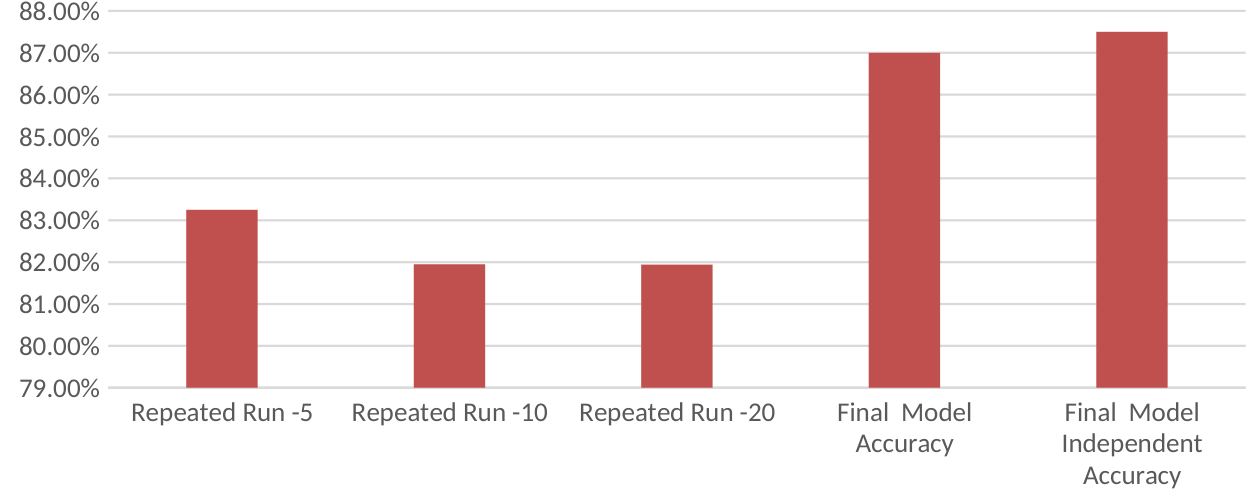
Across 35 repeated training runs on the same fixed training-validation split, the hybrid model achieved a mean validation accuracy of 82.13% with a standard deviation of 1.31 percentage points.
The final model, trained for 15 epochs using the selected hyperparameters, achieved 87.0% accuracy on the validation split.
When evaluated on the independent 1,000-image test set, the model correctly classified 875 images, producing an accuracy of 87.5% with a 95% confidence interval of 85.3%–89.4%.
The independent test also produced macro-averaged precision, recall, and F1-score values of 0.878, 0.875, and 0.875, respectively.
Performance differed by disease class. Tomato Yellow Leaf Curl Virus achieved an F1-score of 0.964, bacterial spot reached 0.938, and tomato mosaic virus achieved 0.929.
Early blight and target spot were more difficult to classify, recording F1-scores of 0.737 and 0.794, respectively, largely because their visual symptoms resemble those of other fungal diseases.
The architecture contains more than 12 million parameters, but only about 935,000 are trainable because the EfficientNetB0 and DenseNet121 feature extractors remain frozen.
Overall, the results show that combining frozen dual-backbone feature extraction with lightweight feature fusion can provide a compact and competitive baseline for automated tomato leaf disease classification.
However, the study does not establish that the customised hyperparameter search outperforms default parameter settings. The same validation split was repeatedly reused during optimisation and evaluation, true cross-validation was not performed, and the batch-size variable did not actually alter the mini-batch size during the search.
The authors also note that only 2,000 of the available 11,000 laboratory-style images were used for training and tuning, no data augmentation was applied, and the model has not yet been evaluated under real field conditions.
📖 Read the full article here:
https://doi.org/10.46481/asr.2026.5.3.616
Published in: African Scientific Reports