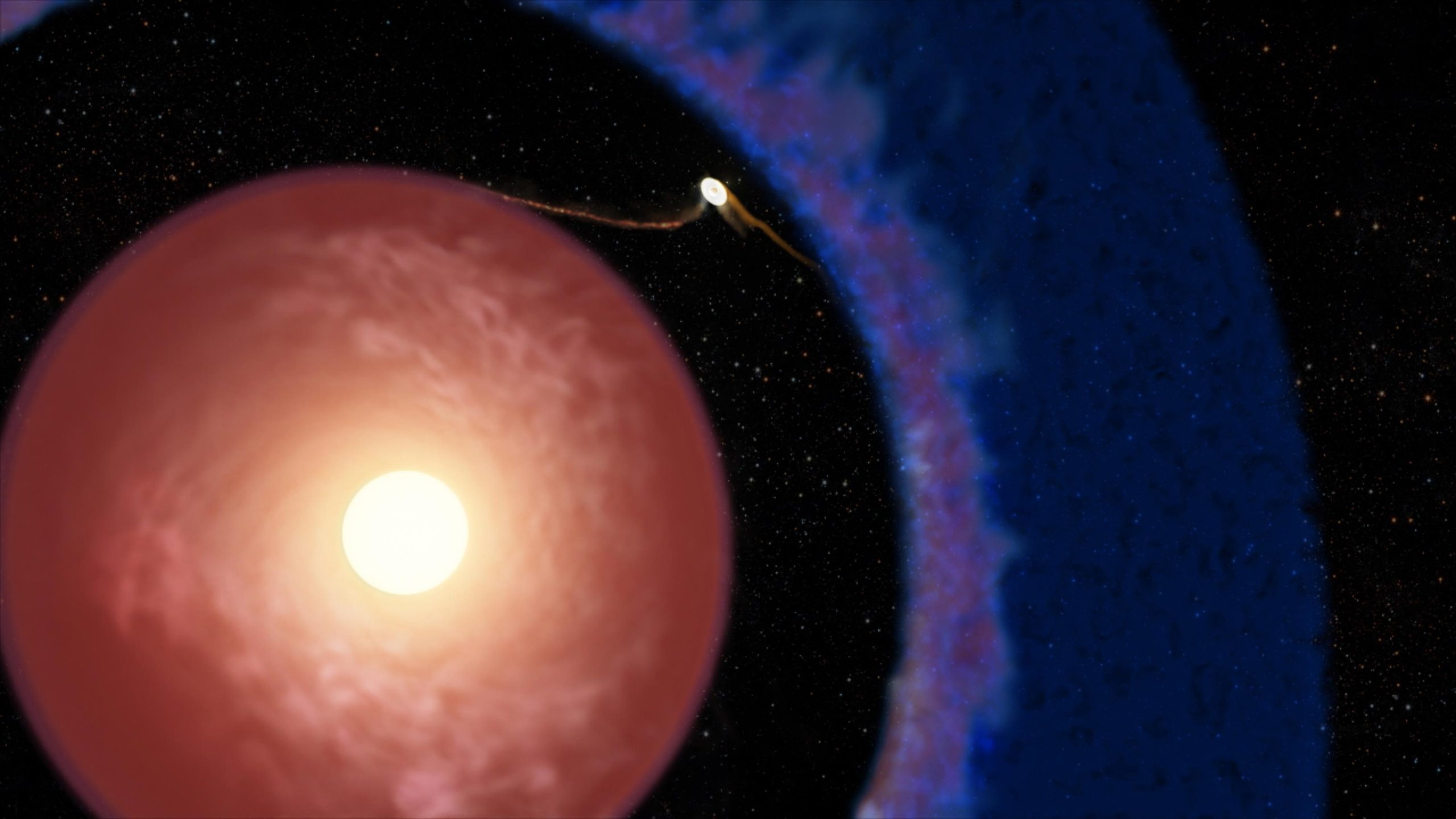
Astronomers have confirmed what may be the clearest glimpse yet of a giant planet being built almost from scratch.
The newly confirmed world, Elias 2-24 b, is less than one million years old and is still embedded within the disk of gas and dust surrounding its young host star.
With roughly the mass of Jupiter, the planet appears to be actively gathering material while orbiting inside a prominent gap in the disk.
Its extraordinary youth presents an important challenge to existing theories of giant-planet formation: according to current models, a planet this massive — especially one forming so far from its star — should have required considerably more time to grow.
The findings were published in The Astrophysical Journal Letters.
A Planet Younger Than Any Previously Confirmed World
Before Elias 2-24 b, the youngest confirmed planets were several million years old.
These included planets orbiting PDS 70 and WISPIT 2, all more than five million years old.
Elias 2-24 b is dramatically younger.
At less than one million years old, it gives astronomers an unusually early snapshot of planetary evolution.
Researchers are effectively observing the system during a period when the planet is still emerging from the same material that produced its star.
Hidden Inside a Planet-Forming Disk
Young stars are commonly surrounded by rotating disks containing gas, dust, ice and rocky material.
These are known as protoplanetary disks.
Over time, material inside the disk can collide and stick together.
Tiny grains become larger particles, larger bodies develop into planetary embryos and eventually planets can emerge.
As young planets grow, they can gravitationally disturb the disk around them and create gaps.
Such gaps have long been considered promising places to search for planets that are still forming.
Elias 2-24 b was found exactly where astronomers expected such a planet to be: inside a gap in its star's disk.
A Jupiter-Mass Planet 450 Light-Years Away
The Elias 2-24 system lies approximately 450 light-years from Earth.
The newly confirmed planet has about the mass of Jupiter.
Its position is particularly remarkable.
The planet orbits roughly 55 times farther from its star than Earth is from the Sun.
That enormous distance is one of the reasons the discovery is so difficult to explain using conventional planet-formation models.
Why Giant Planets Should Take Time to Form
One leading explanation for the formation of giant planets is known as core accretion.
Under this model, a solid planetary core gradually forms through collisions among dust, rocks and other material.
Once the core becomes sufficiently massive, it begins rapidly attracting surrounding gas.
Eventually, this process can produce a gas giant such as Jupiter.
But planet formation is expected to become slower at large distances from a star because orbital motion is slower and material tends to be more widely dispersed.
According to current estimates, building a Jupiter-size planet even around Jupiter's distance from the Sun can take around five million years.
Elias 2-24 b appears to have grown to approximately Jupiter's mass in less than one million years — and at a substantially greater orbital distance.
The Planet Formed Faster Than Expected
This creates a major puzzle.
If the estimated age and mass are correct, some process must have allowed Elias 2-24 b to grow considerably faster than standard models predict.
Lucas Cieza of the Instituto de Estudios Astrofísicos in Chile, a coauthor of the study, said existing models were already challenged by previously known young planets.
Elias 2-24 b makes the discrepancy even more striking.
The discovery suggests that planet-formation models may be missing physical processes capable of accelerating the growth of giant planets.
Why Baby Planets Are So Hard to See
Astronomers have confirmed thousands of exoplanets, but most are mature worlds billions of years old.
Young planets present special observational challenges.
They are born inside dense disks of material that can obscure them from view.
The host star itself is also much brighter than the planet, making the faint planetary light extremely difficult to isolate.
To complicate matters further, young planets at large distances from their stars require long periods to complete an orbit.
That makes some commonly used planet-detection techniques less effective.
Why the Transit Method Often Misses Them
Most confirmed exoplanets have been discovered using the transit method.
Astronomers monitor a star and look for tiny decreases in brightness as a planet crosses in front of it.
This method works particularly well for planets orbiting relatively close to their stars because they transit frequently.
But Elias 2-24 b lies far from its host.
Its orbital period would therefore be much longer.
Its young system is also filled with gas and dust, further complicating the measurements.
Instead, researchers relied on direct imaging.
Blocking the Star to Find the Planet
The observations used a device known as a coronagraph at the W. M. Keck Observatory in Hawaii.
A coronagraph suppresses much of the overwhelming light from a star.
Once that glare is reduced, astronomers can search for extremely faint objects nearby.
Researchers examined archived observations of seven young stars surrounded by disks.
The goal was to search inside gaps and other disk structures for planets that might be creating them.
This strategy led them back to Elias 2-24.
A Mystery That Began Years Earlier
Astronomers had suspected that the system might contain a young planet for nearly a decade.
Earlier observations with the Atacama Large Millimeter/submillimeter Array (ALMA) revealed a prominent gap in the dusty disk surrounding the star.
Such a gap was suggestive but not conclusive.
Later, the Very Large Telescope (VLT) in Chile detected a faint point of light inside that same region.
The location was exactly where astronomers might expect to find a planet carving a pathway through the disk.
But there was a problem.
The candidate appeared too young and too distant from its star to have become so massive according to standard models.
Was It Really a Planet?
A faint object near a star is not automatically a planet.
It could be an unrelated background star aligned by chance.
It might also be an artifact produced during image processing.
To establish that Elias 2-24 b was real, researchers needed to determine whether the source moved with the planetary system in a way consistent with an orbiting world.
That required observations separated by several years.
Old Keck Data Provided the Missing Evidence
Lead researcher Andrea Bernardi, a doctoral candidate at Universidad Diego Portales in Chile, and colleagues searched the Keck Observatory Archive.
They found the faint source in observations taken in 2018 and 2020.
Combining these images with observations from other telescopes allowed the team to track the source over time.
Its movement was consistent with an object gravitationally associated with Elias 2-24 rather than an unrelated background star.
This evidence enabled the researchers to confirm Elias 2-24 b as a planet.
Multiple Telescopes Solved the Puzzle Together
The discovery highlights the importance of combining observations from different astronomical facilities.
ALMA mapped the disk and revealed its structure.
The Very Large Telescope identified a potential planetary source.
Keck archival observations helped show that the object moved consistently with a planet.
No single telescope provided the entire answer.
Together, however, they produced enough evidence to confirm the world.
A Planetary Construction Site
What makes Elias 2-24 b especially scientifically valuable is that the formation process appears to be ongoing.
The planet remains surrounded by the disk from which it formed.
Material from that disk may still be falling onto the planet, increasing its mass.
Astronomers are therefore not simply observing a very young planet after formation has ended.
They may be watching part of the construction process itself.
A Test for Giant-Planet Formation Theories
The planet's properties could help researchers distinguish among competing ideas about how giant planets form.
Core accretion remains one of the leading models.
The location of Elias 2-24 b within a disk gap is consistent with a planet growing and gravitationally clearing surrounding material.
But the speed at which it apparently reached Jupiter-like mass raises questions about whether standard versions of the model are sufficient.
The findings may require researchers to adjust assumptions about how quickly solid cores form, how efficiently gas is captured or how material moves through young planetary disks.
The Early Solar System May Have Looked Similar
Studying young systems also offers indirect clues about our own origins.
The Sun itself formed inside a cloud of gas and dust approximately 4.6 billion years ago.
The young Solar System once possessed a protoplanetary disk in which Earth, Jupiter and the other planets developed.
That early phase disappeared billions of years ago.
Systems such as Elias 2-24 allow astronomers to observe elsewhere in the Galaxy processes that may resemble stages our own planetary system once experienced.
Thousands of Planets, but Few Babies
Astronomers have confirmed roughly 6,000 exoplanets, yet the overwhelming majority are mature planets.
This creates a major observational gap.
Scientists understand a great deal about older planetary systems and can observe many disks surrounding very young stars.
But directly detecting the planets forming inside those disks remains extremely difficult.
Researchers therefore often have to infer planetary formation from the shapes, gaps and rings seen in the surrounding material.
Elias 2-24 b provides something far more direct: the planet itself.
Why More Young Planets Are Needed
One extremely young planet cannot reveal the entire story of planetary formation.
Astronomers need a larger population of young worlds with different masses, orbital distances and host-star properties.
By comparing them, researchers could determine whether Elias 2-24 b is unusual or whether giant planets frequently form faster than current theories predict.
Finding additional examples could therefore transform models of how planetary systems develop.
The Next Generation of Planet Hunting
More powerful astronomical instruments could make these discoveries increasingly common.
Advanced coronagraphs can suppress starlight more effectively, allowing researchers to detect planets that would otherwise disappear in their host stars' glare.
Improved telescopes and image-processing methods could also probe regions much closer to young stars.
This is particularly important because many planets are expected to form closer to their stars than Elias 2-24 b.
A Rare Look at a Planet Before It Is Finished
Most exoplanets observed by astronomers represent completed outcomes of planet formation.
Elias 2-24 b is different.
It offers a glimpse of the process while it is still happening.
The giant world is less than one million years old, sits inside the disk that produced it and appears to be continuing to gather material.
Its existence demonstrates that at least some giant planets can assemble remarkably quickly.
And because it formed at such a large distance from its star, the discovery presents theorists with an even more difficult challenge.
Rewriting the Timeline of Giant-Planet Formation
The importance of Elias 2-24 b goes beyond setting a new age record.
Its rapid formation suggests that astronomers may need to reconsider the timescales and mechanisms involved in constructing giant planets.
The discovery provides researchers with a direct observational target against which planet-formation theories can now be tested.
As astronomers uncover more worlds hidden inside young stellar disks, they may finally begin filling one of the largest gaps in our understanding of planetary evolution.
For now, Elias 2-24 b offers something exceptionally rare: a view of a Jupiter-mass planet before the planetary construction process is finished.
Journal reference
Andrea Bernardi, Alice Zurlo, Lucas A. Cieza, Garreth Ruane, Valentin Christiaens, Anuroop Dasgupta, Greta Guidi, Dimitri Mawet, Dino Mesa, Sebastián Pérez and Jonathan P. Williams. “Searching for Embedded Protoplanets with the Keck/NIRC2 Vortex Coronagraph: Confirmation of a Core-accretion Planet in the Narrow Gap of the Elias 2-24 Disk.” The Astrophysical Journal Letters, 16 September 2026.