How can nonlinear partial differential equations be solved systematically while also accounting for convergence, initial conditions, and truncation errors?
This study develops a double Laplace–Sawi decomposition technique for solving nonlinear partial differential equations by combining the double Laplace–Sawi transform with Adomian polynomials.
The framework introduces explicit exponential-order conditions to guarantee the existence of the Laplace, Sawi, and double Laplace–Sawi transforms and to justify operations such as changing the order of integration and differentiating under the integral sign.
Separate recursive formulations are derived for first- and second-order time operators, allowing the method to handle problems involving either one or two initial conditions without ambiguity.
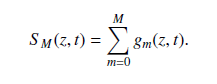
The nonlinear terms are represented through Adomian polynomials, while the transform formulation is converted into a recursive decomposition scheme that generates successive solution components.
The researchers also establish a sufficient contraction condition in a Banach space to guarantee convergence of the decomposition series and provide an a posteriori truncation-error estimate for assessing the accuracy of finite approximations.
The technique was examined using three nonlinear problems of increasing complexity. The first involved a nonlinear transport–reaction equation, where the transform and algebraic formulation were corrected and the exact solution was recovered.
The second example considered a cubic nonlinear equation and showed how the decomposition coefficients are generated while also identifying finite-time blow-up when the solution develops a singularity.
The third application treated the inviscid Burgers equation, a genuinely nonlinear partial differential equation involving coupled spatial dynamics and boundary conditions.
For the Burgers equation, the decomposition coefficients were established by induction, the exact characteristic solution was recovered, and explicit truncation errors were calculated to show how approximation accuracy changes as the solution approaches the boundary of the convergence region.
Overall, the study provides a mathematically consistent analytical framework for constructing solutions to nonlinear partial differential equations while explicitly addressing existence, convergence, and approximation error.
The authors also note important limitations: convergence may remain local, singularities can restrict the validity of the series, and the computational cost of generating high-order Adomian polynomials increases for more complicated nonlinearities.
📖 Read the full article here:
https://doi.org/10.46481/jnsps.2027.3668
Published in: Journal of the Nigerian Society of Physical Sciences