Can removing mathematically “negligible” sets restore the topology of spacetime when strong causality fails?
This study investigates whether the manifold topology of spacetime can be recovered from the Alexandrov topology by discarding sets regarded as negligible, such as measure-zero or nowhere-dense sets.
The researchers show that when strong causality fails, the deficit between the Alexandrov topology and the manifold topology generally cannot be repaired simply by removing negligible sets.
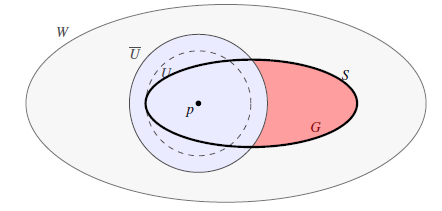
Using ideal topological spaces, the study proves that if a codense ideal contains no nonempty open set, then recovering the finer topology imposes strong restrictions on the original coarser topology.
For regular topologies, these restrictions imply that a strictly coarser topology cannot be restored through negligible-set refinement.
The study further characterises the regions that must be discarded for successful reconstruction.
Such a region must be open in both relevant topologies, and in the spacetime setting it must be a union of chronological diamonds.
The authors introduce the concept of repair cost, defined as the infimum of the spacetime volume that must be discarded to recover the manifold topology from chronological information.
They show that this repair cost is at least as large as the volume of the chronology-violating set.
However, for an explicit Lorentzian cylinder, the repair cost is zero even though the infimum is not attained, meaning that arbitrarily small regions can restore the topology, but no zero-volume region can do so.
Overall, the findings show that causal-topological defects cannot generally be eliminated by ignoring measure-zero sets and provide a quantitative way to describe the minimum volume required for spacetime-topology reconstruction.
📖 Read the full article here:
https://doi.org/10.46481/jnsps.2026.3786
Published in: Journal of the Nigerian Society of Physical Sciences