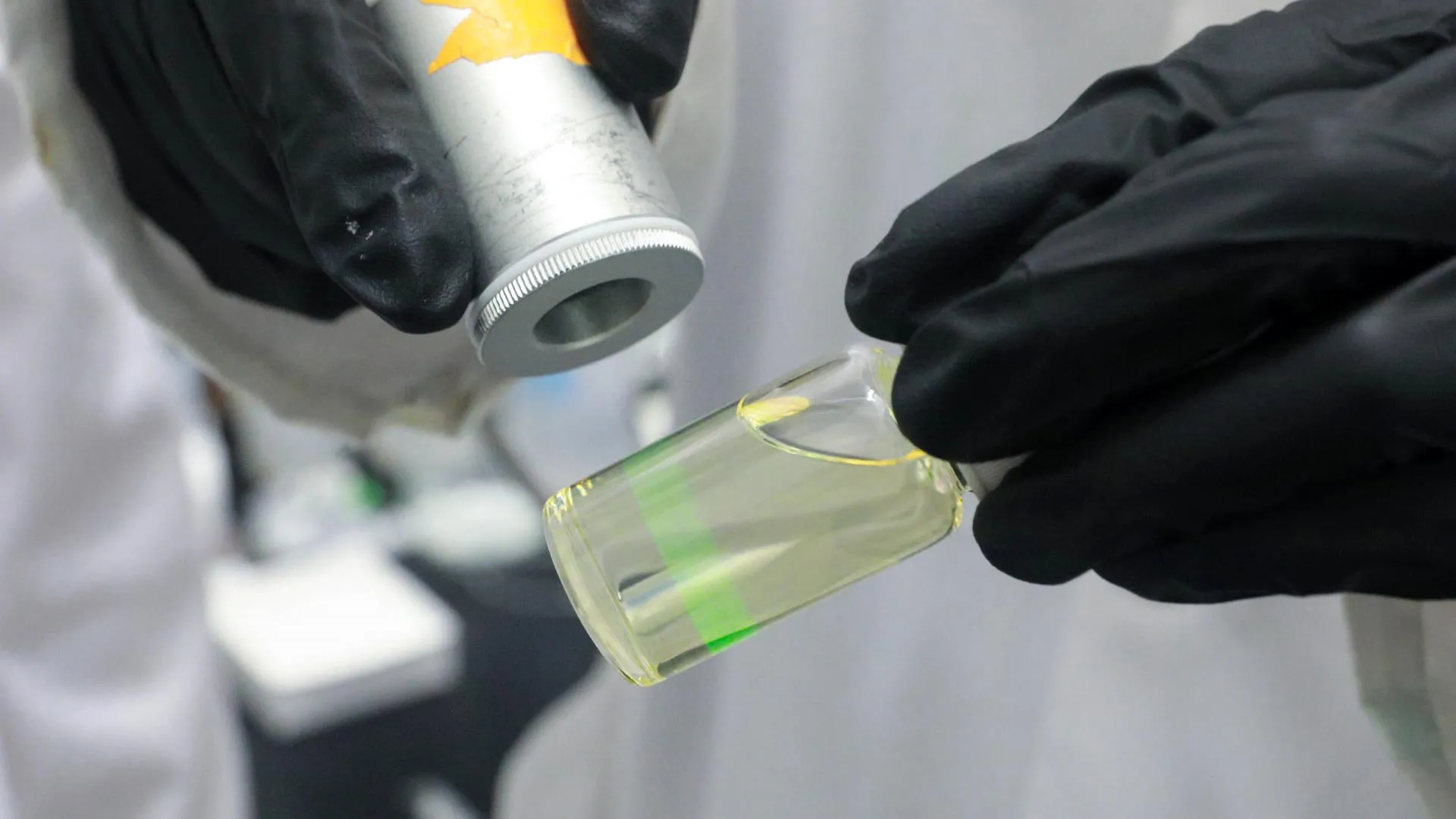
Researchers at the University of Toronto have developed a new class of light-emitting nanoparticles capable of detecting chemicals at extremely low concentrations while also distinguishing between molecules that are nearly identical in structure.
The technology relies on dye-sensitized upconversion nanoparticles that absorb low-energy light and emit higher-energy light.
This unusual behavior could make chemical detection more sensitive, less expensive and easier to perform with simple laser equipment.
Potential applications include identifying impurities in pharmaceutical manufacturing and detecting trace contaminants in groundwater.
Turning Low-Energy Light Into Higher-Energy Light
Most fluorescent molecules absorb relatively high-energy light and emit lower-energy light.
The new nanoparticles work differently.
They can absorb low-energy photons, such as those from near-infrared light, and convert that energy into higher-energy visible light.
For example, researchers can illuminate the particles with near-infrared light from a relatively inexpensive laser and produce bright green luminescence.
This process is known as upconversion.
Why Upconversion Makes Detection Easier
One major advantage of upconversion is that it can reduce background noise.
In conventional fluorescence measurements, the sample itself may also emit light after excitation.
This background fluorescence can obscure weak signals from the molecule researchers are trying to detect.
With the new nanoparticles, the excitation light and emitted light occur at very different energies.
That makes it easier to separate the useful signal from unwanted background.
Professor Kai Huang, senior author of the study, compared the effect to looking at stars at night rather than during the day.
The stars are always present, but they become much easier to see when the bright background is removed.
Lanthanide Ions Drive the Light Conversion
The nanoparticles contain ions of ytterbium and erbium, elements belonging to the lanthanide family.
When incoming infrared light reaches the particle, organic dyes on its surface first absorb the energy.
That energy is then transferred to ytterbium ions.
The ytterbium acts as an energy relay, passing the energy toward erbium ions.
The erbium then performs the upconversion process and releases higher-energy green light.
The Old Design Had a Major Limitation
Previous dye-sensitized nanoparticles faced an important trade-off.
Packing more ytterbium into a particle can improve energy capture.
But if the ytterbium concentration becomes too high, the ions begin absorbing not only the incoming energy but also some of the energy that should have escaped as emitted light.
This effect is known as back-energy transfer.
Instead of producing brighter emission, too much ytterbium can therefore trap the energy inside the nanoparticle.
That limited how much researchers could improve the brightness of earlier designs.
Researchers Redesigned Both the Chemistry and Shape
The Toronto team addressed the problem by changing both the chemical composition and the geometry of the nanoparticles.
Traditional versions used a host matrix containing sodium, yttrium and fluorine.
The researchers instead designed a matrix made from lithium, lutetium and fluorine, known as LiLuF₄.
They also replaced the familiar flat hexagonal particle geometry with a more three-dimensional diamond-like structure.
A Layered Nanoparticle Creates an Energy Tunnel
The new particle contains several layers.
It has a dense core surrounded by an inner shell and then an outer shell.
The concentration of ytterbium changes gradually across those layers, becoming denser toward the center.
This gradient encourages light energy to move primarily inward toward the erbium ions rather than leaking backward.
The researchers describe the structure as creating a kind of one-directional energy pathway through the nanoparticle.
Computer Simulations Guided the Design
The final structure was not selected through trial and error alone.
Researchers used extensive computational modeling before manufacturing the particles.
They applied Monte Carlo simulations and density functional theory to model how energy would move through different materials, arrangements and geometries.
This allowed the team to virtually test many possible nanoparticle designs before selecting those most likely to work experimentally.
Undergraduate researcher Weixiang Ben led much of the computational analysis.
The Nanoparticles Became Dramatically Brighter
The redesigned nanoparticles produced substantially stronger light emission than earlier systems.
Lead author Jiaze Wu estimated that the particles emitted roughly 150 times more light than non-dye-sensitized upconversion nanoparticles.
They were also about 50 times brighter than some highly optimized conventional structures tested under comparable excitation conditions.
That increase in brightness is important because only a small number of nanoparticles may need to bind to a target molecule for the signal to become detectable.
Detecting Chemicals at Very Low Concentrations
High brightness allows the nanoparticles to function as extremely sensitive chemical probes.
Even when only a small quantity of the target chemical is present, particles bound to those molecules can still emit enough light to be detected.
This could be particularly useful in situations where researchers are searching for trace quantities of a contaminant or impurity.
Environmental monitoring is one possible application.
Pollutants in groundwater may exist at extremely low concentrations within large volumes of water.
Highly sensitive optical probes could potentially make those contaminants easier to detect.
Distinguishing Molecules That Look Almost Identical
Sensitivity is only part of the advance.
The nanoparticles can also distinguish between structural isomers.
Structural isomers contain the same types and numbers of atoms but arrange those atoms differently.
That difference in arrangement can completely change the biological or chemical behavior of a molecule.
Being able to distinguish one isomer from another is therefore extremely important in areas such as drug manufacturing.
Spotting the Wrong Molecule in a Drug Batch
Wu gives the example of pharmaceutical production.
A manufacturing process might successfully produce the desired drug most of the time but accidentally generate a structurally different isomer in a portion of the batch.
Even if the two molecules contain exactly the same atoms, the incorrect isomer might behave differently in the body.
It could reduce the effectiveness of the drug or potentially contribute to unwanted side effects.
Detecting such impurities currently often requires expensive analytical equipment.
The nanoparticle approach could potentially achieve similar detection using low-cost lasers and a very small sample.
Why Molecular Selectivity Matters
Many chemical sensors are highly sensitive but struggle to distinguish closely related molecules.
Others can identify molecular structure precisely but require expensive laboratory instruments.
The new nanoparticles combine two useful properties:
high sensitivity and molecular selectivity.
That combination could make them especially useful when researchers need to find very small quantities of a specific compound surrounded by chemically similar substances.
Possible Uses in Pharmaceutical Manufacturing
Drug production requires strict quality control.
Even small quantities of unintended molecules can matter when medicines are manufactured on large scales.
A sensor capable of rapidly identifying structural impurities could potentially help manufacturers test samples more frequently or detect problems earlier in the production process.
Because the particles respond optically, they might eventually provide a simpler alternative for some screening tasks.
However, the technology remains at an early research stage and has not yet replaced established pharmaceutical analytical methods.
Environmental Monitoring Could Also Benefit
The same underlying principle could be adapted to environmental sensing.
Researchers frequently need to detect contaminants that occur at extremely low concentrations.
A nanoparticle designed to bind selectively to a particular pollutant could potentially produce a bright optical signal when that pollutant is present.
Because the nanoparticle chemistry can be customized, the researchers believe different versions could eventually be designed for different target molecules.
A Platform Rather Than a Single Sensor
One of the most important aspects of the work is that the system is not restricted to detecting one specific compound.
The researchers describe the nanoparticle architecture as a platform that could potentially be adapted by changing the molecules attached to its surface.
Different surface chemistries could be designed to bind different targets.
That could allow one underlying optical technology to support many different chemical sensing applications.
The Technology Is Still at Proof-of-Concept Stage
Despite the strong laboratory results, the nanoparticles are not yet ready for large-scale commercial use.
Researchers still need to develop efficient manufacturing techniques capable of producing the particles in large quantities while maintaining their precise chemical composition and layered structure.
Huang says the team is already working on this challenge but describes commercialization as a long-term process.
Mass Production Is the Next Major Challenge
Producing nanoscale materials consistently can be difficult.
Small changes in size, composition or surface chemistry can influence optical performance.
A commercial sensor would therefore require manufacturing methods that generate extremely uniform particles at large scale.
Researchers would also need to examine long-term stability, cost, integration with sensing equipment and performance in complex real-world samples.
These steps will determine whether the laboratory technology can eventually become a practical analytical tool.
A New Direction for Chemical Detection
The study demonstrates how carefully controlling energy transfer inside a nanoparticle can dramatically improve its optical performance.
By redesigning both the crystal chemistry and internal architecture, the researchers created particles that channel energy efficiently toward the ions responsible for light emission.
The result is a brighter optical signal and much greater sensitivity.
Combined with the ability to distinguish structurally similar molecules, this could create new approaches to chemical analysis.
From Nanoparticle Physics to Safer Manufacturing
The work connects fundamental materials science with practical challenges in medicine and environmental protection.
At the nanoscale, the research focuses on how light energy moves between individual ions.
At the application level, that same energy-transfer control could eventually help scientists identify an unwanted molecule in a drug batch or detect trace pollution in water.
The nanoparticles are still a proof of concept, but the researchers believe their design provides a foundation for highly customizable molecular sensors.
If scalable manufacturing can be achieved, these light-emitting particles could eventually provide a simpler and highly sensitive way of identifying chemical differences that are currently expensive or difficult to detect.
Journal reference
Jiaze Wu, Joshua Fung-A-Fat, Weixiang Ben, Liping Song, Shupei Yu, Weichu Xu, Niko Hildebrandt, Kai Huang and Gang Han. “Breaking the Sensitization-Passivation Trade-Off in Dye-Sensitized Upconversion Nanoparticles through LiLuF₄-Enabled Directional Energy Transfer.” Journal of the American Chemical Society, 2026, 148(35), 37789.