How do the geometry and topology of a metric graph influence its spectral gap, and what happens to that gap when the graph is modified?
This study investigates the first nonzero eigenvalue, or spectral gap, of compact metric graphs equipped with the Kirchhoff Laplacian, with particular attention to diameter bounds, cycles, graph perturbations, and spectral rigidity.
The spectral gap is an important quantity because it reflects how geometric structure influences processes such as heat diffusion, wave propagation, mixing, and stability on networks.
The researchers first examine the diameter-based lower bound λ₁(G) ≥ π²/D², where D is the diameter of the graph.
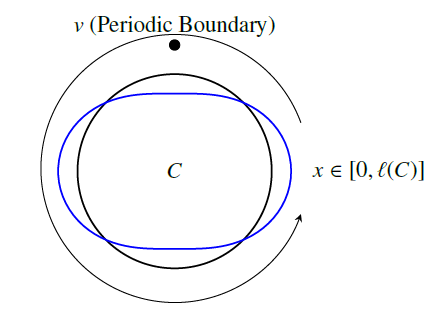
A key finding is that equality in this diameter expression is not limited to interval graphs. For a single cycle of total length ℓ, the study derives the exact spectral gap λ₁(C) = 4π²/ℓ².
Because the diameter of the cycle is ℓ/2, this gives λ₁(C) = π²/D², showing that a non-interval graph can also attain the same diameter-based value.
The study also examines the structure of first eigenfunctions in the equality case. Under the stated normalization and concentration assumptions, the first eigenfunction along a diameter-realizing path has cosine form and vanishes almost everywhere outside that path.
The analysis further shows that any connected component attached outside such a diameter path can meet it only at the midpoint under the stated equality conditions.
Beyond diameter bounds, the paper investigates how basic graph operations affect the spectrum.
Edge subdivision was shown to preserve the entire spectrum of the Kirchhoff Laplacian. Splitting an edge into several smaller edges without changing its total length therefore changes only the combinatorial representation, not the underlying metric geometry or eigenvalues.
The study also analyses pendant edges. Adding a pendant edge can reduce the spectral gap, while contracting a pendant edge cannot decrease it.
More specifically, contraction of a pendant edge increases the first nonzero eigenvalue when a first eigenfunction of the contracted graph is nonzero at the attachment vertex. Equality can occur only when every first eigenfunction vanishes at that vertex.
The authors further establish continuity under the addition of a shrinking pendant edge. As the length of the added edge approaches zero, the spectral gap of the perturbed graph approaches that of the original graph.
Another important result concerns Rayleigh quotients. Even when two admissible functions are mutually orthogonal in both the L² and energy senses, the Rayleigh quotient of their sum is not the sum of the individual Rayleigh quotients.
Instead, under orthogonality, it becomes a weighted average of the two values. This shows that additive reasoning cannot generally be used when constructing variational estimates from sums of functions.
Overall, the study shows that the spectral gap of a metric graph is controlled not only by combinatorial topology but also by metric geometry, edge lengths, eigenfunction localization, and the variational structure of the Laplacian.
The findings also demonstrate that cycles do not automatically force a strict increase above the diameter expression and that seemingly simple graph operations can have very different spectral effects.
The authors suggest extending this work to simultaneous or repeated graph perturbations and to rigidity and stability questions for other self-adjoint vertex conditions, including Robin, Dirichlet, and more general vertex couplings.
📖 Read the full article here:
https://doi.org/10.46481/jnsps.2027.3840
Published in: Journal of the Nigerian Society of Physical Sciences