Can deep learning accurately distinguish visually similar rice varieties, and how much do dataset size and image resolution affect classification performance?
This study evaluated deep-learning approaches for classifying 20 rice varieties using three custom-built convolutional neural network architectures and four transfer-learning models: MobileNetV2, VGG16, ResNet50, and DenseNet121.
The researchers used the Bangladesh rice dataset and compared model performance using both the original image set and a larger combined dataset that incorporated augmented training images.
The aim was to address two common challenges in image-based rice classification: limited training data and poor model generalization.
The models were evaluated using accuracy, precision, recall, and F1-score, allowing both the custom CNNs and pretrained transfer-learning models to be compared under the same experimental setting.
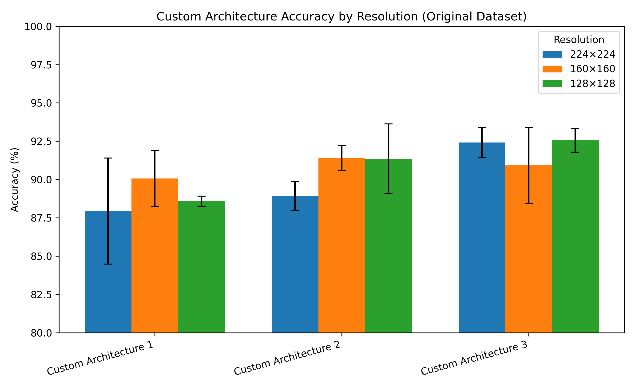
On the original dataset, ResNet50 achieved the highest overall accuracy at 95.18%, while among the custom CNNs, Custom Architecture 3 performed best with 92.41%.
When the augmented images were added to create the combined training dataset, performance improved across all models.
Custom Architecture 1 produced the highest overall accuracy on the combined dataset, reaching 98.51%, compared with 87.94% when trained only on the original dataset.
Among the transfer-learning models, VGG16 performed best on the combined dataset with an accuracy of 97.87%, followed by ResNet50 at 96.85%.
The results therefore show that increasing the amount of training data through augmentation had a strong positive effect on rice-variety classification.
The improvement was particularly notable for Custom Architecture 1, which gained more than 10 percentage points in accuracy when trained on the larger dataset.
The study also examined how image resolution influenced the three custom CNN architectures.
Three resolutions were tested: 224×224, 160×160, and 128×128 pixels.
With the combined dataset, all three custom architectures achieved their best performance at the highest resolution of 224×224 pixels.
However, with the smaller original dataset, the relationship between resolution and accuracy was less consistent, indicating that the benefit of higher-resolution images depends partly on the amount of training data available.
These findings suggest that model complexity, dataset size, and image resolution interact strongly in determining classification performance.
A deeper or more complex architecture does not automatically perform best when the available training data are limited.
Overall, the study demonstrates that both custom CNNs and transfer-learning models can achieve high accuracy in multi-class rice classification, particularly when training data are expanded through augmentation.
The findings also highlight the importance of matching model capacity to dataset size and suggest that larger training datasets combined with high-resolution images can improve the reliability of automated rice-variety identification.
Such systems could support applications in rice quality assurance, variety verification, adulteration detection, and agricultural inspection.
The authors recommend further research into why some models benefit more from data augmentation than others and how automatic rice-variety classification can be made more precise and robust for real-world use.
📖 Read the full article here:
https://doi.org/10.46481/jnsps.2027.3432
Published in: Journal of the Nigerian Society of Physical Sciences