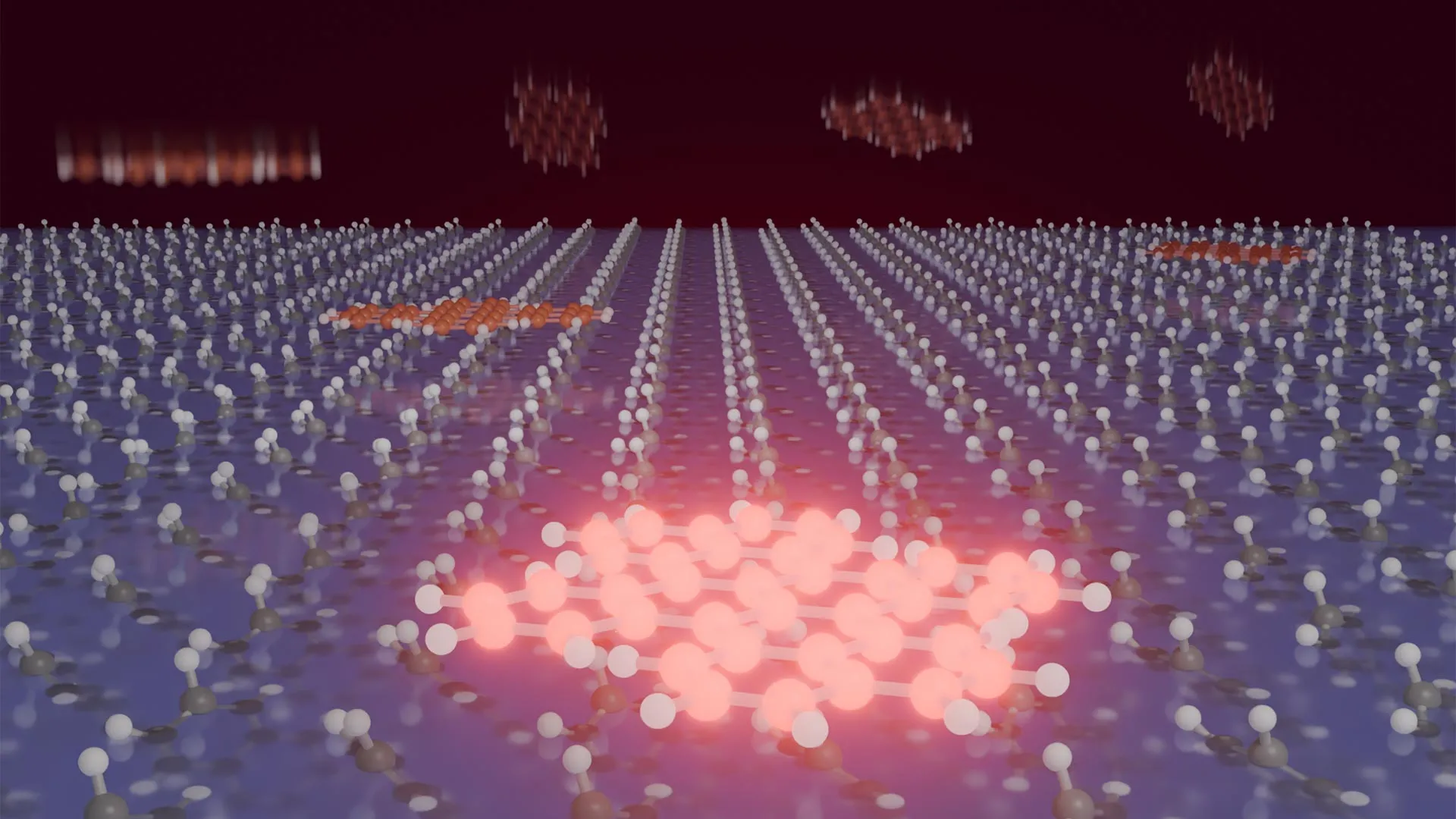
Researchers at the Max Planck Institute for the Science of Light (MPL) in Germany have demonstrated that individual molecules attached to a solid surface can retain their quantum optical coherence at the fundamental limit permitted by their natural energy decay.
The achievement addresses a longstanding challenge in quantum physics. Although individual molecules can interact with light in highly controlled ways, placing them on a surface usually exposes them to environmental disturbances that interfere with their quantum properties.
Led by Professor Vahid Sandoghdar, the research team developed a method for preparing exceptionally clean crystal surfaces and depositing individual molecules onto them under carefully controlled conditions.
The molecules maintained optical coherence at the Fourier limit, meaning that their optical transitions were no longer significantly broadened by additional environmental disturbances.
The findings, published in Science, provide a new experimental approach for investigating molecule–surface interactions and could support future developments in quantum sensing, quantum communication and molecular-scale technologies.
𝐖𝐡𝐲 𝐈𝐧𝐝𝐢𝐯𝐢𝐝𝐮𝐚𝐥 𝐌𝐨𝐥𝐞𝐜𝐮𝐥𝐞𝐬 𝐌𝐚𝐭𝐭𝐞𝐫 𝐢𝐧 𝐐𝐮𝐚𝐧𝐭𝐮𝐦 𝐏𝐡𝐲𝐬𝐢𝐜𝐬
Many quantum technologies depend on controlling how individual atoms and molecules interact with light.
These systems can act as quantum emitters, producing individual photons through transitions between their energy states.
A photon is a quantum of electromagnetic radiation, and the ability to generate and control single photons is important for several proposed quantum technologies.
For example, individual quantum emitters may help transmit quantum information between distant systems or serve as components in quantum information-processing devices.
However, these applications require the emitters to maintain stable and predictable optical properties.
Even small disturbances in the surrounding environment can interfere with the quantum states that researchers are trying to control.
𝐓𝐡𝐞 𝐂𝐡𝐚𝐥𝐥𝐞𝐧𝐠𝐞 𝐨𝐟 𝐊𝐞𝐞𝐩𝐢𝐧𝐠 𝐐𝐮𝐚𝐧𝐭𝐮𝐦 𝐄𝐦𝐢𝐭𝐭𝐞𝐫𝐬 𝐒𝐭𝐚𝐛𝐥𝐞
To investigate a single quantum emitter, scientists need to keep it in a well-defined position for extended periods.
One established approach involves trapping atoms or molecules in a vacuum, where interactions with the surrounding environment can be carefully controlled.
Another involves embedding emitters within solid materials that provide a stable physical environment.
Both methods have contributed to advances in quantum optics.
However, they also present limitations when researchers want to access or manipulate individual emitters directly.
Placing molecules on a solid surface could offer greater experimental flexibility, particularly when combined with instruments capable of probing matter at atomic dimensions.
The difficulty is preserving the molecules' quantum properties after they have been deposited.
𝐖𝐡𝐲 𝐒𝐮𝐫𝐟𝐚𝐜𝐞𝐬 𝐀𝐫𝐞 𝐏𝐫𝐨𝐛𝐥𝐞𝐦𝐚𝐭𝐢𝐜 𝐟𝐨𝐫 𝐐𝐮𝐚𝐧𝐭𝐮𝐦 𝐄𝐱𝐩𝐞𝐫𝐢𝐦𝐞𝐧𝐭𝐬
A solid surface is not necessarily a quiet environment for a molecule.
Its atomic structure, local electric fields, defects and contaminants can influence the behaviour of molecules resting on it.
These interactions may change the energy of a molecule's optical transitions or cause those energies to fluctuate over time.
Such fluctuations can reduce optical coherence and broaden the spectral lines associated with light absorption or emission.
For experiments that require precise quantum control, these disturbances are a serious limitation.
Even when a surface appears clean under ordinary laboratory conditions, microscopic contamination can affect the behaviour of an individual molecule.
The MPL researchers therefore focused on preparing a surface clean enough to minimise these unwanted interactions.
𝐀 𝐂𝐫𝐲𝐬𝐭𝐚𝐥 𝐓𝐡𝐚𝐭 𝐂𝐚𝐧 𝐂𝐥𝐞𝐚𝐧 𝐈𝐭𝐬𝐞𝐥𝐟
The research team developed a surface-preparation method based on a physical process known as sublimation.
Sublimation occurs when a solid changes directly into a gas without passing through the liquid state.
Certain organic crystals undergo gradual sublimation at room temperature.
The researchers recognised that this behaviour could be used to remove contaminated surface layers.
Rather than relying entirely on conventional cleaning techniques, they allowed the uppermost layers of the crystal to evaporate.
As those layers disappeared, contaminants associated with them were removed, exposing a cleaner surface underneath.
This provided a way to prepare the crystal for highly sensitive quantum optical experiments.
𝐇𝐨𝐰 𝐭𝐡𝐞 𝐑𝐞𝐬𝐞𝐚𝐫𝐜𝐡𝐞𝐫𝐬 𝐏𝐫𝐞𝐩𝐚𝐫𝐞𝐝 𝐭𝐡𝐞 𝐒𝐮𝐫𝐟𝐚𝐜𝐞
The team placed a small organic crystal inside a vacuum chamber equipped with a cryostat, an instrument designed to maintain extremely low temperatures.
Initially, the crystal was allowed to sublime gradually.
The uppermost layers evaporated, helping remove surface contamination and expose a fresh crystalline surface.
Once the cleaning process was complete, the researchers cooled the crystal to temperatures only a few kelvin above absolute zero.
At these temperatures, sublimation became negligible, allowing the clean surface to remain stable during the experiment.
The team then used a specially fabricated miniature oven to evaporate molecules onto the cooled crystal.
The molecules settled on the surface, where their optical properties could be investigated individually.
𝐖𝐡𝐲 𝐄𝐱𝐭𝐫𝐞𝐦𝐞 𝐂𝐨𝐨𝐥𝐢𝐧𝐠 𝐖𝐚𝐬 𝐄𝐬𝐬𝐞𝐧𝐭𝐢𝐚𝐥
Temperature strongly influences the movement and vibrations of atoms and molecules.
At higher temperatures, thermal motion can introduce fluctuations that disturb quantum states.
Cooling a system reduces many of these thermally driven processes.
In the MPL experiment, the crystal was cooled to only a few degrees above absolute zero, corresponding to approximately −273.15°C at the theoretical zero-temperature limit.
This helped suppress unwanted thermal disturbances while preserving the prepared surface.
The combination of surface cleanliness and low temperature created conditions suitable for examining extremely narrow molecular optical transitions.
𝐖𝐡𝐚𝐭 𝐈𝐬 𝐐𝐮𝐚𝐧𝐭𝐮𝐦 𝐂𝐨𝐡𝐞𝐫𝐞𝐧𝐜𝐞?
Quantum coherence describes the preservation of a definite phase relationship between quantum states.
A molecule can occupy different energy states, and quantum mechanics allows combinations of these states to behave as coherent superpositions.
The phase relationship between the states influences how the molecule interacts with light.
When environmental disturbances disrupt that relationship, the molecule loses coherence through a process known as decoherence.
For quantum optical experiments, coherence is particularly important because it affects the stability and precision of optical transitions.
A molecule with a long optical coherence time can maintain a well-defined phase relationship for longer, making its interaction with light more predictable.
𝐖𝐡𝐲 𝐂𝐨𝐡𝐞𝐫𝐞𝐧𝐜𝐞 𝐓𝐢𝐦𝐞 𝐌𝐚𝐭𝐭𝐞𝐫𝐬
Researchers often evaluate the quality of a quantum emitter by examining how long its optical coherence persists.
This duration is known as the coherence time.
Longer coherence times are generally desirable for experiments that depend on precise optical interactions.
However, coherence cannot last indefinitely in an excited emitter that spontaneously releases energy into its surroundings.
Even in an exceptionally quiet environment, spontaneous emission imposes a fundamental restriction.
The challenge is to minimise additional sources of decoherence so that the emitter approaches this natural physical limit.
𝐔𝐧𝐝𝐞𝐫𝐬𝐭𝐚𝐧𝐝𝐢𝐧𝐠 𝐭𝐡𝐞 𝐅𝐨𝐮𝐫𝐢𝐞𝐫 𝐋𝐢𝐦𝐢𝐭
The Fourier limit describes the minimum spectral linewidth associated with the finite lifetime of an excited quantum state.
When a molecule absorbs energy from light, it may enter an excited electronic state.
That state typically persists for a limited time before the molecule releases energy, often by emitting a photon.
Because the excited state has a finite lifetime, its optical transition cannot have an infinitely narrow frequency distribution.
This relationship between the duration of a signal and its frequency spread is connected to Fourier analysis.
For an ideal emitter whose optical coherence is limited only by spontaneous emission, the spectral linewidth reaches its natural minimum.
Such an optical transition is described as Fourier-limited or lifetime-limited.
𝐖𝐡𝐲 𝐭𝐡𝐞 𝐅𝐨𝐮𝐫𝐢𝐞𝐫 𝐋𝐢𝐦𝐢𝐭 𝐈𝐬 𝐒𝐢𝐠𝐧𝐢𝐟𝐢𝐜𝐚𝐧𝐭
In ordinary experimental environments, quantum emitters often experience additional disturbances.
Local electric-field fluctuations, molecular motion, interactions with surrounding atoms and other sources of noise can alter their optical transition frequencies.
These effects increase the observed spectral linewidth beyond the natural lifetime limit.
Consequently, coherence may disappear much faster than it would in an ideal environment.
According to the researchers, environmental disturbances can shorten coherence times by factors of hundreds or even thousands.
Reaching the Fourier limit therefore indicates that additional decoherence has been reduced sufficiently for the natural excited-state lifetime to become the dominant restriction.
It does not mean that coherence lasts forever. Instead, it means the emitter has reached the best optical coherence permitted by its spontaneous-emission lifetime under the relevant conditions.
𝐌𝐨𝐥𝐞𝐜𝐮𝐥𝐞𝐬 𝐨𝐧 𝐭𝐡𝐞 𝐒𝐮𝐫𝐟𝐚𝐜𝐞 𝐑𝐞𝐚𝐜𝐡𝐞𝐝 𝐭𝐡𝐞 𝐋𝐢𝐦𝐢𝐭
After preparing the crystal and depositing molecules onto it, the researchers examined their optical transitions.
The measurements showed that the surface-adsorbed molecules could exhibit Fourier-limited optical linewidths.
This meant that their optical coherence was not substantially degraded by additional environmental noise.
The result was particularly important because the molecules were resting directly on a solid surface rather than being isolated in a vacuum or embedded within a bulk material.
The team demonstrated that carefully prepared surfaces can support individual molecular quantum emitters without introducing the severe decoherence normally associated with surface environments.
𝐖𝐡𝐚𝐭 𝐭𝐡𝐞 𝐑𝐞𝐬𝐮𝐥𝐭 𝐑𝐞𝐯𝐞𝐚𝐥𝐬 𝐀𝐛𝐨𝐮𝐭 𝐒𝐮𝐫𝐟𝐚𝐜𝐞 𝐍𝐨𝐢𝐬𝐞
The experiment provides evidence that surface-related decoherence can be substantially suppressed.
A molecule placed on a contaminated or unstable surface may experience fluctuating interactions that alter its optical transition.
By preparing a clean crystalline surface and maintaining it at cryogenic temperatures, the researchers reduced these disturbances.
The resulting molecular transitions approached the natural linewidth imposed by the excited-state lifetime.
This demonstrates that the presence of a surface does not necessarily prevent a molecule from exhibiting highly coherent quantum optical behaviour.
The quality and stability of the surface are critical.
𝐍𝐚𝐧𝐨–𝐄𝐥𝐞𝐜𝐭𝐫𝐨𝐧 𝐕𝐨𝐥𝐭 𝐎𝐩𝐭𝐢𝐜𝐚𝐥 𝐓𝐫𝐚𝐧𝐬𝐢𝐭𝐢𝐨𝐧𝐬
The research concerns optical transitions with exceptionally narrow energy linewidths, on the scale of nano–electron volts.
An electron volt is a unit of energy commonly used in atomic and molecular physics.
One nano–electron volt is one-billionth of an electron volt.
Such narrow linewidths indicate that the transition frequency is highly well-defined.
This level of spectral precision is valuable when investigating subtle interactions between molecules and their surroundings.
It also provides a sensitive way to examine how the local environment affects a quantum emitter.
𝐓𝐡𝐞 𝐒𝐮𝐫𝐟𝐚𝐜𝐞 𝐒𝐭𝐢𝐥𝐥 𝐈𝐧𝐟𝐥𝐮𝐞𝐧𝐜𝐞𝐬 𝐭𝐡𝐞 𝐌𝐨𝐥𝐞𝐜𝐮𝐥𝐞𝐬
Achieving Fourier-limited optical coherence does not mean that the molecules are completely unaffected by the crystal.
The researchers also investigated how interactions with the surface influenced molecular behaviour.
They found that the surface could encourage molecules to adopt particular orientations.
It could also modify their energy levels.
These effects are important because a molecule's orientation and electronic structure influence how it absorbs and emits light.
The results show that a clean surface can provide both a stable environment for quantum coherence and a means of influencing molecular properties.
𝐇𝐨𝐰 𝐒𝐮𝐫𝐟𝐚𝐜𝐞𝐬 𝐂𝐚𝐧 𝐂𝐡𝐚𝐧𝐠𝐞 𝐌𝐨𝐥𝐞𝐜𝐮𝐥𝐚𝐫 𝐄𝐧𝐞𝐫𝐠𝐲 𝐋𝐞𝐯𝐞𝐥𝐬
Molecules possess discrete electronic energy levels.
Transitions between these levels determine which frequencies of light they can absorb or emit.
When a molecule interacts with a nearby surface, its local environment can alter those energy levels.
For example, interactions with the crystal may shift the energy required for an optical transition.
Such changes can provide information about the strength and nature of molecule–surface interactions.
Because the researchers achieved exceptionally narrow optical transitions, their method offers a sensitive way to investigate these effects.
𝐏𝐨𝐬𝐬𝐢𝐛𝐥𝐞 𝐄𝐟𝐟𝐞𝐜𝐭𝐬 𝐨𝐧 𝐌𝐨𝐥𝐞𝐜𝐮𝐥𝐚𝐫 𝐒𝐡𝐚𝐩𝐞 𝐚𝐧𝐝 𝐕𝐢𝐛𝐫𝐚𝐭𝐢𝐨𝐧
The experiments also produced indications that interactions with the surface may influence molecular geometry or vibrational behaviour.
Molecules are not completely rigid objects.
Their atoms can move relative to one another through different vibrational modes.
These vibrations contribute to molecular spectra and can affect how molecules interact with light.
Changes in molecular orientation, shape or vibration may therefore alter the optical response of a molecule resting on a surface.
Further investigations will be needed to establish the precise mechanisms responsible for the effects observed in this experiment.
𝐖𝐡𝐲 𝐃𝐢𝐫𝐞𝐜𝐭 𝐀𝐜𝐜𝐞𝐬𝐬 𝐭𝐨 𝐈𝐧𝐝𝐢𝐯𝐢𝐝𝐮𝐚𝐥 𝐌𝐨𝐥𝐞𝐜𝐮𝐥𝐞𝐬 𝐈𝐬 𝐕𝐚𝐥𝐮𝐚𝐛𝐥𝐞
One advantage of positioning molecules on a surface is that researchers can potentially interact with them using extremely sharp experimental probes.
These instruments can investigate matter with spatial resolution approaching individual atomic dimensions.
Such direct access is more difficult when an emitter is deeply embedded within a solid material.
The MPL technique therefore offers an opportunity to combine precise quantum optical measurements with local mechanical or electronic manipulation.
This combination could help scientists investigate how a molecule's environment affects its quantum behaviour.
𝐂𝐨𝐦𝐛𝐢𝐧𝐢𝐧𝐠 𝐐𝐮𝐚𝐧𝐭𝐮𝐦 𝐎𝐩𝐭𝐢𝐜𝐬 𝐖𝐢𝐭𝐡 𝐀𝐭𝐨𝐦𝐢𝐜 𝐅𝐨𝐫𝐜𝐞 𝐌𝐢𝐜𝐫𝐨𝐬𝐜𝐨𝐩𝐲
One technique the researchers hope to incorporate is atomic force microscopy (AFM).
AFM uses a sharp probe to investigate surfaces by measuring extremely small forces between the probe and the material.
It can provide detailed information about surface structure and interactions at nanometre or even atomic scales.
When combined with quantum optical measurements, AFM could allow researchers to investigate how local forces influence the properties of individual molecular emitters.
For example, carefully controlled changes in the local environment could reveal how a molecule's optical transition responds to nearby structures.
The research team intends to explore this possibility in future experiments.
𝐓𝐡𝐞 𝐑𝐨𝐥𝐞 𝐨𝐟 𝐒𝐜𝐚𝐧𝐧𝐢𝐧𝐠 𝐓𝐮𝐧𝐧𝐞𝐥𝐥𝐢𝐧𝐠 𝐌𝐢𝐜𝐫𝐨𝐬𝐜𝐨𝐩𝐲
The researchers also plan to investigate the use of scanning tunnelling microscopy (STM).
STM uses a sharp conducting tip positioned extremely close to a suitable surface.
When a voltage is applied, electrons can tunnel quantum mechanically between the tip and the surface.
The resulting current is highly sensitive to the separation between them.
This allows researchers to examine electronic properties and surface structures with exceptional spatial precision.
Combining STM with coherent molecular emitters could provide new ways to investigate local electronic interactions.
Such experiments may also help researchers understand how nearby charges or electric fields influence molecular optical transitions.
𝐓𝐨𝐰𝐚𝐫𝐝 𝐍𝐚𝐧𝐨𝐦𝐞𝐭𝐫𝐞-𝐒𝐜𝐚𝐥𝐞 𝐐𝐮𝐚𝐧𝐭𝐮𝐦 𝐂𝐨𝐧𝐭𝐫𝐨𝐥
Professor Sandoghdar explained that the team's future work will focus on combining the surface-preparation method with AFM and STM.
The objective is to achieve local control over individual quantum emitters at nanometre scales.
A nanometre is one-billionth of a metre.
At these dimensions, researchers could investigate how extremely small changes in a molecule's surroundings affect its optical and quantum properties.
This would extend the current achievement from preserving coherence towards actively manipulating individual molecular systems.
However, the proposed level of local control remains a goal for future experiments rather than a capability established by the present study.
𝐏𝐨𝐭𝐞𝐧𝐭𝐢𝐚𝐥 𝐀𝐩𝐩𝐥𝐢𝐜𝐚𝐭𝐢𝐨𝐧𝐬 𝐢𝐧 𝐐𝐮𝐚𝐧𝐭𝐮𝐦 𝐂𝐨𝐦𝐦𝐮𝐧𝐢𝐜𝐚𝐭𝐢𝐨𝐧
Quantum communication relies on transmitting information using quantum states, often carried by individual photons.
For some proposed communication systems, stable quantum emitters are important because they can provide photons with predictable optical properties.
Environmental noise can cause emitted photons to differ in frequency or other characteristics, reducing their suitability for certain quantum interference experiments.
Molecules with Fourier-limited optical transitions are therefore scientifically interesting as potential sources of coherent photons.
The MPL experiment demonstrates an important optical property that may be useful for future research in this area.
It does not, however, establish a complete quantum communication device.
𝐏𝐨𝐬𝐬𝐢𝐛𝐥𝐞 𝐈𝐦𝐩𝐥𝐢𝐜𝐚𝐭𝐢𝐨𝐧𝐬 𝐟𝐨𝐫 𝐐𝐮𝐚𝐧𝐭𝐮𝐦 𝐂𝐨𝐦𝐩𝐮𝐭𝐢𝐧𝐠
Quantum computing requires physical systems whose quantum states can be prepared, controlled and measured with high precision.
Individual molecules are among the systems being investigated for quantum information applications.
Their electronic and molecular properties offer several possibilities for interacting with light and the surrounding environment.
However, maintaining coherence is a major challenge.
The demonstration that surface-adsorbed molecules can retain lifetime-limited optical coherence removes one important obstacle to studying these systems.
Further research would be required to determine how such molecules could be integrated into practical quantum computing architectures.
𝐌𝐨𝐥𝐞𝐜𝐮𝐥𝐞𝐬 𝐚𝐬 𝐒𝐞𝐧𝐬𝐢𝐭𝐢𝐯𝐞 𝐐𝐮𝐚𝐧𝐭𝐮𝐦 𝐏𝐫𝐨𝐛𝐞𝐬
The exceptionally narrow optical transitions observed in the experiment could also be valuable for investigating small environmental changes.
A molecule's optical transition frequency can respond to interactions with nearby charges, electric fields and surrounding materials.
When the natural linewidth is very narrow, subtle changes in the local environment may become easier to resolve spectroscopically.
This makes coherent molecules potentially useful as sensitive probes of nanoscale physical interactions.
Future experiments could investigate whether such systems can be developed into practical quantum sensors.
𝐖𝐡𝐲 𝐭𝐡𝐞 𝐑𝐞𝐬𝐞𝐚𝐫𝐜𝐡 𝐈𝐬 𝐈𝐦𝐩𝐨𝐫𝐭𝐚𝐧𝐭 𝐟𝐨𝐫 𝐒𝐮𝐫𝐟𝐚𝐜𝐞 𝐒𝐜𝐢𝐞𝐧𝐜𝐞
Surface science examines how atoms and molecules behave at the boundaries between materials and their surroundings.
These interfaces are important in many physical and chemical processes.
However, studying individual molecular interactions with a surface can be difficult because the same interactions may disturb the properties being measured.
The MPL method provides an unusually stable platform for examining these effects through highly precise optical measurements.
Researchers may be able to distinguish subtle changes in molecular energy levels and orientation while maintaining exceptionally narrow optical transitions.
This could improve understanding of molecule–surface interactions at the quantum level.
𝐖𝐡𝐚𝐭 𝐭𝐡𝐞 𝐄𝐱𝐩𝐞𝐫𝐢𝐦𝐞𝐧𝐭 𝐃𝐨𝐞𝐬 𝐍𝐨𝐭 𝐘𝐞𝐭 𝐃𝐞𝐦𝐨𝐧𝐬𝐭𝐫𝐚𝐭𝐞
Although the result represents an important experimental advance, several limitations remain.
The measurements were conducted under carefully controlled vacuum and cryogenic conditions.
The study does not establish that the same level of optical coherence can be maintained on ordinary surfaces at room temperature.
It also does not demonstrate a functioning quantum computer, communication network or commercial quantum sensor.
The principal achievement is the preservation of lifetime-limited optical coherence in individual molecules adsorbed onto a prepared solid surface.
Developing practical technologies will require further investigation into stability, scalability, integration and methods for controlling individual emitters.
𝐖𝐡𝐚𝐭 𝐂𝐨𝐦𝐞𝐬 𝐍𝐞𝐱𝐭?
The researchers plan to extend their method by integrating quantum optical measurements with scanning probe microscopy.
Combining the prepared molecular surfaces with AFM and STM could allow more detailed investigations of local interactions and eventually provide greater control over individual emitters.
Further experiments may also clarify how surface-induced changes in molecular orientation, energy levels and vibrations influence optical behaviour.
These investigations could help scientists understand the relationship between molecular structure, surface interactions and quantum coherence.
The long-term objective is to develop techniques that allow individual molecular quantum systems to be both highly coherent and locally controllable.
𝐀 𝐍𝐞𝐰 𝐄𝐱𝐩𝐞𝐫𝐢𝐦𝐞𝐧𝐭𝐚𝐥 𝐏𝐥𝐚𝐭𝐟𝐨𝐫𝐦 𝐟𝐨𝐫 𝐌𝐨𝐥𝐞𝐜𝐮𝐥𝐚𝐫 𝐐𝐮𝐚𝐧𝐭𝐮𝐦 𝐏𝐡𝐲𝐬𝐢𝐜𝐬
Researchers at the Max Planck Institute for the Science of Light have demonstrated that individual molecules on a solid surface can exhibit optical coherence limited primarily by their natural excited-state lifetime.
Their approach used the controlled sublimation of an organic crystal to expose a clean surface, followed by cryogenic cooling and the deposition of individual molecules.
Under these conditions, the molecules reached the Fourier limit, overcoming the additional optical decoherence that has traditionally complicated experiments involving surface-adsorbed quantum emitters.
The team also observed how the crystal surface influenced molecular orientation and energy levels, with indications of possible effects on molecular geometry and vibrations.
The findings establish a promising experimental platform for investigating molecule–surface interactions while preserving highly coherent optical transitions.
By combining this approach with atomic force microscopy and scanning tunnelling microscopy, researchers hope to achieve more precise control over individual molecules and investigate quantum behaviour at nanometre scales.
The work provides a foundation for future research into molecular quantum emitters, nanoscale sensing and technologies that depend on precise interactions between matter and light.
𝐉𝐨𝐮𝐫𝐧𝐚𝐥 𝐑𝐞𝐟𝐞𝐫𝐞𝐧𝐜𝐞
Masoud Mirzaei, Alexey Shkarin, Burak Gurlek, Johannes Zirkelbach, Ashley J. Shin, Irena Deperasińska, Boleslaw Kozankiewicz, Tobias Utikal, Stephan Götzinger and Vahid Sandoghdar.
“Nano–electron volt Fourier-limited transition of a single surface-adsorbed molecule.”
Science, 2026, 392(6805), 1384.