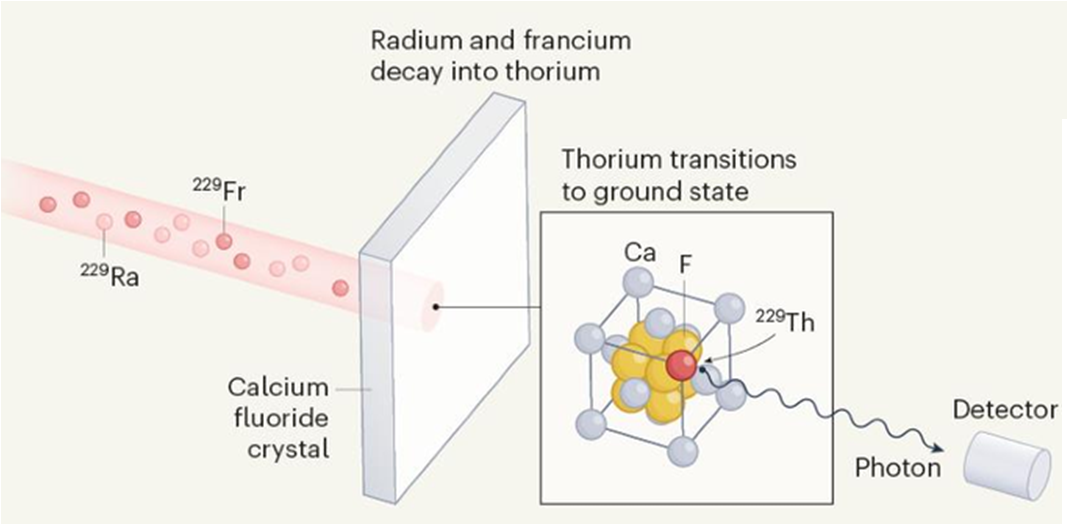
What if scientists could measure time using the nucleus of an atom rather than the movement of its electrons? In October 2026, research teams in Vienna, Austria, and Beijing, China, independently developed the world's first operating nuclear clocks, marking a major milestone in precision measurement. Conventional atomic clocks measure specific energy transitions involving electrons, while these new devices use an energy transition within the nucleus of thorium-229. The challenge has been that nuclear transitions are extremely difficult to excite and measure precisely. By embedding thorium-229 in calcium fluoride crystals and using specialised laser systems, the researchers demonstrated a new way to probe this transition. This achievement represents an important step towards a new generation of clocks based on nuclear physics.
Why is this discovery important? Atomic clocks already underpin technologies such as satellite navigation, telecommunications, scientific measurements and the synchronisation of digital networks. Nuclear clocks could eventually offer advantages because atomic nuclei are generally less sensitive than electron energy levels to certain external disturbances. This could potentially improve measurement stability and open new opportunities for testing fundamental physical theories. Researchers are also interested in whether exceptionally precise nuclear measurements could help investigate subtle changes in fundamental constants or detect possible signals associated with dark matter. The October 2026 demonstrations used thorium-229, whose unusually accessible nuclear transition makes laser-based measurement possible. However, these early devices should not yet be regarded as more accurate than the best existing atomic clocks in every respect. Their ultimate precision, stability, practical size and performance still require substantial development.
Beyond timekeeping, this innovation could eventually influence geodesy, precision navigation, fundamental physics and highly sensitive measurement systems. For example, improved clocks could help scientists investigate tiny differences in the passage of time caused by gravity, contributing to more precise studies of Earth's gravitational field. The technology may also provide new ways to test the laws governing matter and energy. Although practical applications remain under development, this breakthrough illustrates how advances in quantum physics can lead to entirely new measurement technologies. Sometimes, the next revolution in science begins by changing how we measure something as familiar as time!