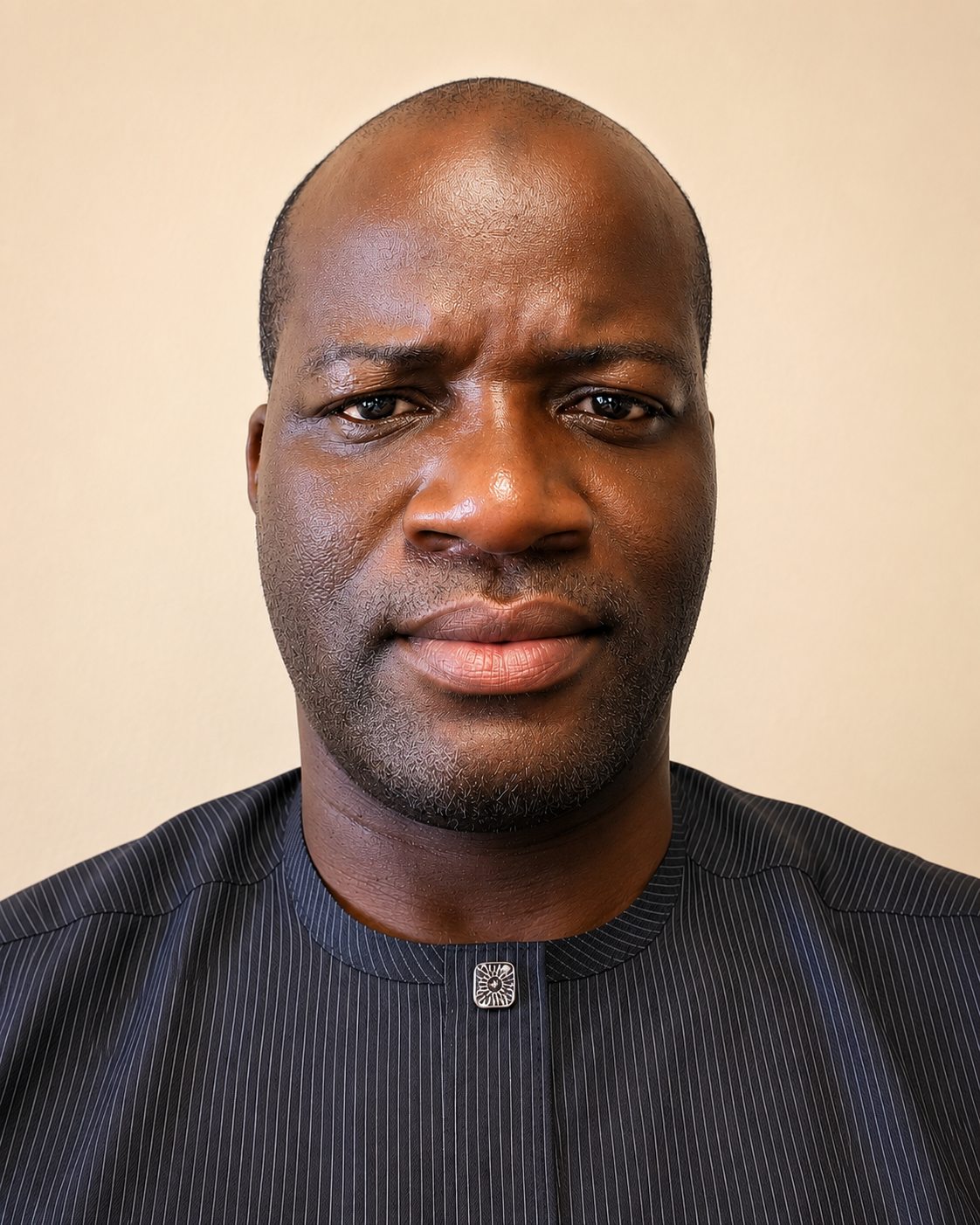
The Nigerian Society of Physical Sciences is pleased to celebrate 𝐃𝐫. 𝐀𝐦𝐮𝐬𝐚𝐭 𝐑𝐚𝐦𝐨𝐧𝐢 𝐎𝐥𝐚𝐰𝐚𝐥𝐞 as our Spotlight Member of the Week. How solar-energy systems can be made more efficient when sunlight, temperature, shading, and environmental conditions are constantly changing and how physics, mathematical modelling, and computational methods can be transformed into practical solutions for the energy challenges faced by developing countries, are important questions that lie at the centre of Dr. Amusat’s scientific journey.
Dr. Amusat Ramoni Olawale is a physicist, renewable-energy researcher, and academic whose career reflects a strong commitment to teaching, research, scientific innovation, and the practical application of physics. He began his academic journey with a National Diploma in Mechanical Engineering before progressing into physics, earning his Bachelor’s, Master’s, and Doctor of Philosophy degrees from the University of Maiduguri. He currently serves as a Senior Lecturer in the Department of Physics, Faculty of Physical Sciences, University of Maiduguri.
His research focuses on solar photovoltaic systems, maximum power point tracking, renewable-energy conversion and optimisation, wind-turbine design, computational fluid dynamics, mathematical modelling, energy systems, and applied theoretical physics. His work brings together fundamental physical principles and computational techniques to solve problems connected with energy production, efficiency, system performance, and sustainability. A major part of his research explores how solar photovoltaic systems can operate more efficiently under real environmental conditions. Solar panels do not always operate under uniform sunlight. Changes in temperature, cloud cover, irradiance, and partial shading can reduce their ability to generate maximum power.
He has contributed to this area through mathematical modelling, MATLAB/Simulink simulation, photovoltaic parameter estimation, and optimisation-based MPPT techniques. His studies include mathematical modelling of photovoltaic modules, maximum-power prediction under field conditions, and the use of intelligent optimisation methods to improve the performance of partially shaded photovoltaic arrays. More recently, his research has examined hybrid optimisation methods for extracting important parameters from single- and double-diode photovoltaic models under changing climatic conditions. This type of research is important because accurate photovoltaic models help scientists and engineers understand how solar modules behave before systems are deployed on a larger scale. The mission behind his work is clear: to contribute to more efficient, reliable, and sustainable energy systems through the application of physics, computation, and optimisation. His scientific interests also extend beyond solar energy.
Dr. Amusat has contributed to research on wind-energy systems, including horizontal-axis wind-turbine blade design and computational fluid dynamics analysis of airfoils. Computational Fluid Dynamics, or CFD, allows researchers to simulate how air or other fluids move around structures such as turbine blades. By studying properties such as lift, drag, pressure, and flow behaviour, researchers can evaluate and improve turbine performance before costly physical prototypes are produced. His collaborative research also includes hydrokinetic power modelling, energy-distribution systems, theoretical and computational physics, photovoltaic device simulation, environmental applications, groundwater studies, and geophysical assessment of renewable-energy resources. This breadth reflects the increasingly interdisciplinary nature of modern physics and demonstrates how physical science can connect with engineering, environmental science, materials research, and sustainable development.
Dr. Amusat has authored and co-authored numerous peer-reviewed journal articles and conference papers in national and international publications. His research record reflects sustained engagement with renewable energy, computational modelling, theoretical physics, and applied scientific problems. Beyond research publications, Dr. Amusat is deeply involved in teaching and academic service. Since joining the University of Maiduguri, he has served in several academic and administrative responsibilities. He currently serves as Departmental SIWES Coordinator and has also coordinated Diploma and Science Laboratory Technology programmes.
Earlier in his academic career, he served as an Assistant Departmental Examination Officer. These responsibilities reflect his involvement not only in research, but also in student development, academic organization, and the connection between university education and practical professional experience. His academic journey demonstrates that the work of a scientist extends beyond the laboratory. Teaching, mentorship, research supervision, collaboration, and academic service all contribute to building stronger scientific communities and preparing the next generation of researchers.
His personal motto is:
“Knowledge becomes meaningful when it is transformed into solutions that improve lives and contribute to the development of society.”
This statement closely reflects the philosophy behind his research: scientific knowledge achieves greater value when it moves beyond theory and contributes to solving practical problems.
Outside his academic and research responsibilities, Dr. Amusat enjoys reading and playing table tennis. which provides him with opportunities for continuous learning and intellectual development and helps him maintain an active and balanced lifestyle. Looking ahead, his long-term scientific dream is to build an internationally relevant research profile that connects fundamental physics with practical solutions to energy and environmental challenges. He hopes to advance intelligent solar photovoltaic optimisation, renewable-energy conversion, solar thermal systems, energy storage, hybrid-energy systems, and exergy analysis. A central part of this vision is to develop solutions that are not only scientifically sound but also economically relevant to Nigeria and other developing regions.
The Nigerian Society of Physical Sciences proudly celebrates Dr. Amusat Ramoni Olawale for his contributions to renewable-energy research, photovoltaic optimisation, computational physics, wind-energy modelling, mathematical modelling, teaching, and academic service. His journey shows that impactful science can emerge when fundamental physics is combined with computation, innovation, and a clear determination to solve practical problems that affect society.