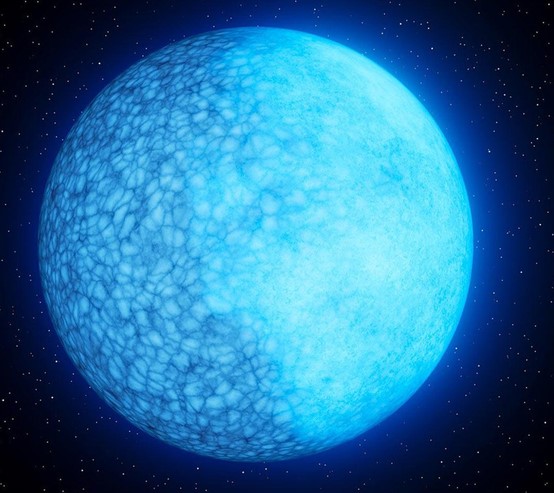
Astronomers have reported an extraordinary finding involving a white dwarf star known as WD J1330+6435, located approximately 280 light-years from Earth in the constellation Draco. The discovery was reported on 16 October 2026, following research into the unusual colours of white dwarf stars. White dwarfs are the dense remnants of stars that have exhausted their nuclear fuel and shed their outer layers. Although most white dwarfs appear white, this particular object is predicted to have a yellowish-green, or chartreuse, appearance. The finding challenges the familiar assumption that stars generally appear white, yellow, orange, or blue depending on their temperatures.
🔬 WHAT MAKES THIS DISCOVERY REMARKABLE?
The unusual colour is associated with the star’s atmospheric chemistry and extreme density. Researchers believe that rocky material from its former planetary system fell onto the star, enriching its outer layers with elements such as sodium, calcium, and lithium. Under the extraordinary conditions within the white dwarf’s atmosphere, interactions between sodium and surrounding helium broaden the wavelengths of light absorbed by sodium. This changes the balance of light escaping from the star, producing the predicted greenish appearance. The researchers also investigated other white dwarfs with unusual colours, demonstrating that stellar appearance depends not only on temperature but also on chemical composition and atmospheric conditions. Their findings were published in RAS Techniques and Instruments.
🌍 WHY DOES THIS MATTER TO SCIENCE?
This discovery highlights the importance of spectroscopy, which allows scientists to investigate the chemical composition and physical conditions of distant celestial objects by analysing their light. It also demonstrates how evidence can challenge established scientific expectations and lead to a deeper understanding of the Universe. Just as geologists study minerals, rocks, and their chemical signatures to reconstruct Earth's history, astronomers examine starlight to understand the evolution of stars and planetary systems. Science reminds us that the Universe still holds remarkable secrets, and every new discovery creates an opportunity to ask better questions, investigate evidence, and expand human knowledge. 🌠