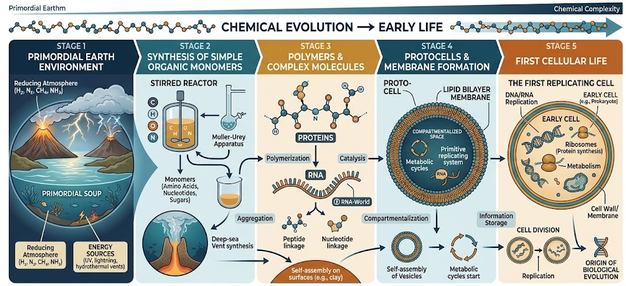
The origin of life is one of the major unanswered questions in science. Scientists have developed substantial evidence explaining how living organisms changed and diversified after life appeared, but the question of how the first life originated from non-living matter remains unresolved. This problem is often described as the abiogenesis problem. Abiogenesis refers to the hypothesis that life arose naturally from non-living chemical substances under conditions that existed on the early Earth. The early Earth contained simple molecules and minerals, and its oceans, atmosphere, volcanic environments, hydrothermal systems, and other settings provided sources of energy and chemical reactions. However, the presence of these substances does not by itself explain how they became a living system. Living organisms are highly organized systems that require genetic information, metabolism, membranes, and mechanisms for reproduction. One of the major difficulties is therefore explaining how relatively simple chemical compounds could gradually become organized into systems capable of maintaining themselves, reproducing, and undergoing evolution. Scientists have proposed several possible environments and chemical pathways, but no single explanation has yet demonstrated the complete transition from non-living chemistry to the first true living system.
A major abiogenesis gap concerns the origin of the molecules and structures necessary for life. Modern organisms contain complex biological molecules such as nucleic acids, proteins, lipids, and carbohydrates, each of which performs important functions. DNA and RNA store or transmit genetic information, proteins perform many biological functions, and lipids can form membranes that separate the internal contents of a cell from its surroundings. The challenge is to understand how these components could have formed and become organized under early Earth conditions. For example, scientists have investigated whether simple organic molecules could have been produced naturally through reactions involving gases, minerals, water, volcanic activity, lightning, ultraviolet radiation, or hydrothermal systems. Laboratory experiments have shown that some biologically important organic compounds can form under certain conditions. However, producing individual organic molecules is different from producing a complete system capable of self-replication, metabolism, information storage, and inheritance. Another important question is how these different components could have become linked in a coordinated system. Scientists have proposed hypotheses such as the RNA world hypothesis, which suggests that RNA-like molecules may have played an early role in both information storage and chemical catalysis. Other research focuses on metabolism-first models, lipid or protocell systems, hydrothermal environments, and mineral surfaces. These hypotheses provide useful explanations for particular stages of the origin of life, but significant uncertainties remain about how the individual stages were connected.
The difficulty of explaining the origin of life does not mean that science has no understanding of the subject. Rather, it means that important gaps remain between established chemical processes and the emergence of the first evolving living system. Once self-replicating systems capable of variation and inheritance existed, the principles of natural selection could begin to operate, allowing populations to change over generations. This distinction is important because biological evolution and the origin of life are related but different scientific questions. Evolution explains how life changes after self-reproducing organisms already exist, whereas abiogenesis addresses the earlier transition from non-living chemistry to the first life. Scientists continue to investigate this transition using evidence from geology, geochemistry, biology, chemistry, planetary science, and experimental studies. Geological evidence provides information about the environmental conditions of the early Earth, while laboratory experiments test whether particular chemical reactions could have occurred naturally. Studies of meteorites and extraterrestrial environments also help scientists understand whether organic compounds may have been produced or delivered to the early Earth from space. Despite considerable progress, there is currently no universally accepted, complete pathway that demonstrates exactly how the first living system emerged from non-living matter. The origin of life therefore remains an active area of scientific research, with many competing hypotheses being tested and refined.