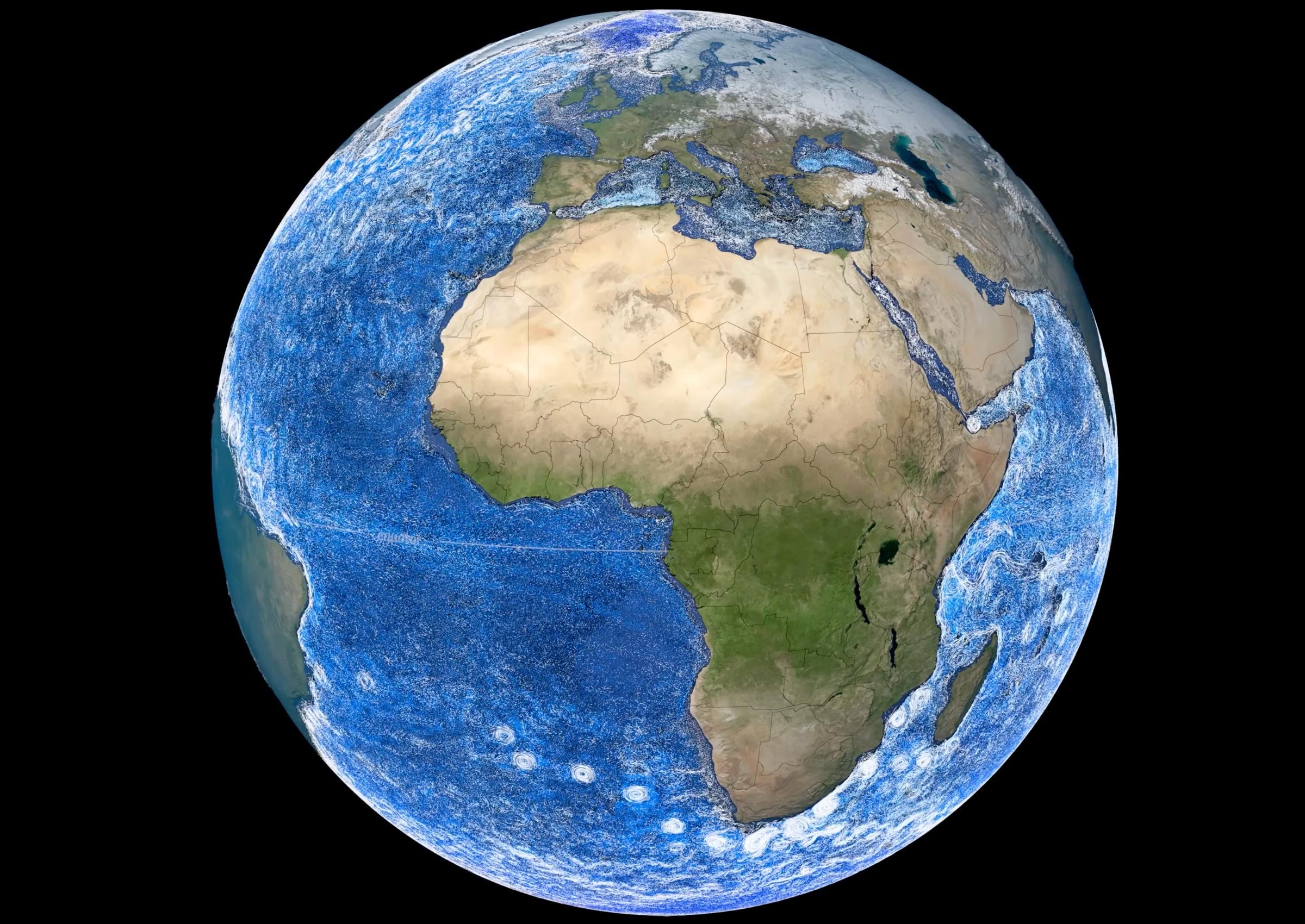
Ancient seafloor sediments reveal that a major pathway carrying warm, salty Indian Ocean water into the Atlantic nearly shut down millions of years ago — yet the Atlantic’s overturning circulation became stronger rather than weaker.
Scientists have long suspected that the Agulhas Leakage plays an important role in sustaining the Atlantic Ocean’s vast overturning circulation.
Near the southern tip of Africa, part of the warm, salty water flowing through the Indian Ocean escapes around the continent and enters the South Atlantic. Because salty water is relatively dense, this influx has been thought to help support the formation of deep water farther north and, in turn, strengthen the Atlantic Meridional Overturning Circulation, or AMOC.
But geological evidence from millions of years ago has revealed a surprising exception.
Researchers studying the late Pliocene, roughly 3.6 to 2.6 million years ago, found that Agulhas Leakage weakened dramatically while the AMOC intensified. The result challenges the idea that a strong flow of salty Indian Ocean water is always necessary to maintain vigorous Atlantic overturning.
The study, led by researchers at Utrecht University, was published in Nature Geoscience on August 3, 2026.
A vast circulation system that redistributes heat
The AMOC is a large-scale system of Atlantic currents that transports warm surface waters northward and returns colder, denser waters toward the south at depth.
Because it redistributes enormous amounts of heat, the circulation is an important component of the climate system.
One proposed contributor to its strength is the delivery of salt from the Indian Ocean through Agulhas Leakage.
At the southern edge of Africa, much of the Agulhas Current turns back toward the Indian Ocean. But some of its warm and salty water escapes into the Atlantic.
This interocean exchange has long been viewed as a potential source of salt that can eventually influence Atlantic water density and overturning.
The logic appears straightforward: all else being equal, increasing salinity makes seawater denser and therefore more prone to sinking.
The new geological reconstruction shows that the relationship is not always so simple.
The late Pliocene offered a natural experiment
Lead author Suning Hou and colleagues examined ocean conditions during the late Pliocene, covering approximately 3.6 million to 2.58 million years ago.
This interval included major changes in global climate and offered researchers a chance to investigate how the Agulhas system and the Atlantic overturning circulation responded under conditions very different from those of today.
Rather than attempting to infer ancient circulation from a single location, the researchers combined multiple lines of evidence.
They reconstructed changes near southern Africa and compared those results with ocean surface and deep-water records elsewhere along the AMOC pathway. Climate-model simulations were then used to test whether the emerging basin-wide pattern was physically consistent.
Tiny fossils reveal where an ocean front once sat
A key part of the reconstruction came from sediment cores recovered from the Agulhas Plateau south of Africa.
The sediments preserve microscopic fossils known as dinoflagellate cysts, or dinocysts.
Different dinoflagellate species thrive under different temperature and oceanographic conditions. Their fossil remains can therefore act as indicators of where particular water masses and ocean fronts were located millions of years ago.
The researchers combined these fossils with organic biomarkers, chemical traces preserved in the sediment that provide additional information about past ocean temperatures.
Together, these indicators allowed the team to reconstruct movements of the Southern Ocean subtropical front.
That front is important because its latitude influences how easily Indian Ocean water can pass around southern Africa and enter the Atlantic.
Moving the front north squeezed the Agulhas pathway
The analysis showed that the subtropical front migrated northward during part of the late Pliocene.
As it shifted, the pathway available for Agulhas Leakage narrowed.
Between approximately 3.6 and 3.3 million years ago, the volume of water — and therefore the amount of salt — entering the Atlantic through the Agulhas system progressively declined.
Under the conventional picture, a major reduction in this salt supply might be expected to weaken Atlantic overturning.
Instead, the opposite happened.
The AMOC strengthened as the salt supply declined
Records from elsewhere in the Atlantic showed that the overturning circulation intensified during the same interval in which Agulhas Leakage was decreasing.
That finding created an apparent contradiction.
If Agulhas salt transport were a dominant control on the AMOC under all climate conditions, the two systems should have moved broadly together.
Yet the geological record showed them moving in opposite directions.
Agulhas Leakage weakened.
The AMOC strengthened.
The researchers therefore concluded that the usual causal connection between the two systems had effectively become disconnected during the late Pliocene.
Why the finding matters
The discovery does not mean that Agulhas Leakage has no influence on Atlantic circulation.
Instead, it suggests that its importance depends on the broader state of the climate system.
The AMOC is influenced by many interacting factors, including ocean temperature, salinity, winds, freshwater input, sea ice, basin geometry, and connections between different oceans.
Under one set of conditions, salt supplied from the Indian Ocean may substantially influence overturning.
Under another, different processes may dominate.
The late Pliocene appears to have been one of those exceptional periods.
The result therefore challenges a simple cause-and-effect interpretation in which more Agulhas Leakage automatically means stronger Atlantic overturning and less leakage necessarily means weaker overturning.
The entire Atlantic appears to have reorganized
The researchers compared their Agulhas reconstruction with ocean records distributed along the Atlantic circulation system.
The combined evidence pointed not to a small regional anomaly but to a broader reorganization of Atlantic circulation.
Their study indicates that the northward movement of the subtropical front reduced Agulhas Leakage while changes elsewhere in the basin supported stronger overturning. Climate-model experiments were consistent with this large-scale interpretation.
This broader perspective was essential because a change observed at one sediment site can sometimes reflect local ocean conditions rather than a basin-wide shift.
By bringing together multiple records and numerical simulations, the researchers were able to place the southern African changes within the behavior of the wider Atlantic system.
Ancient oceans do not perfectly mirror the modern world
The researchers caution that conditions during the late Pliocene were not identical to those today.
Continental geometry, ocean gateways, Arctic freshwater influences, ice sheets, and background climate conditions have all changed over millions of years.
That means the ancient episode cannot simply be treated as a direct prediction of what will happen to the modern AMOC.
Instead, it provides something equally valuable: evidence that the relationship between two major components of ocean circulation can change depending on the climate state.
A mechanism that appears essential under present-day conditions may have played a much smaller role at another point in Earth’s history.
A warning against overly simple ocean rules
Ocean circulation is governed by a network of interacting processes rather than a single control.
The new study illustrates why paleoclimate records are so useful for testing theories that may appear well established from modern observations alone.
The late Pliocene effectively supplied scientists with a natural experiment that cannot be reproduced in the modern ocean.
And the result was unexpected.
During a period when the transport of salty Indian Ocean water into the Atlantic declined, the Atlantic overturning circulation did not weaken with it.
It grew stronger.
The findings therefore suggest that the AMOC can be sustained — and even intensified — under conditions in which Agulhas Leakage is substantially reduced.
That does not overturn everything scientists know about Atlantic circulation.
But it does reveal that one of the system’s most familiar relationships is not universal.
Journal reference
Suning Hou, Alejandra Cartagena-Sierra, Ning Tan, Carolien M. H. van der Weijst, Malte Stockhausen, Fenghao Liu, Melissa A. Berke, Isla S. Castañeda, Aidan Starr, Francien Peterse, Francesca Sangiorgi, Anna S. von der Heydt, Appy Sluijs, and Peter K. Bijl. “Disconnection of the late Pliocene Agulhas Leakage from Atlantic Meridional Overturning Circulation.” Nature Geoscience, 3 August 2026. The DOI and publication details were verified against the Utrecht University research record; the DOI redirects to the corresponding Nature Geoscience article page.