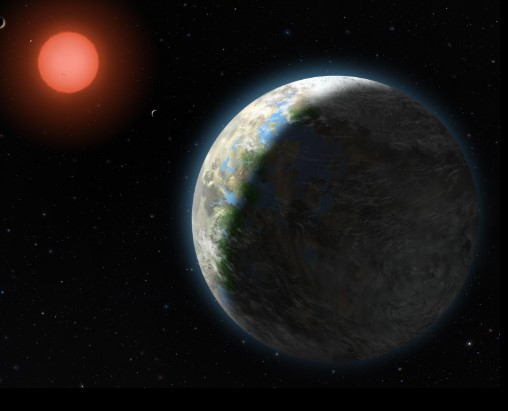
The search for life beyond Earth has taken another exciting turn. Scientists have detected an atmosphere surrounding a rocky, Earth-like planet located about 48 light-years away from our solar system. This discovery is significant because an atmosphere is one of the key ingredients that can make a planet habitable. On Earth, our atmosphere regulates temperature, protects us from harmful radiation, and contains the gases necessary for life. Finding a similar feature on another world raises intriguing questions about what might exist there.
Using advanced space telescopes and sophisticated observation techniques, researchers were able to analyse the starlight passing through the planet's atmosphere. The data revealed the presence of gases that could provide clues about the planet's environment, climate, and potential ability to support life. While scientists have not found direct evidence of living organisms, the existence of an atmosphere suggests that conditions may be more favourable than previously thought. Every new discovery like this helps researchers narrow their search and better understand where life could emerge in the universe.
The finding also reminds us how vast and mysterious the cosmos remains. Forty-eight light-years may sound distant, but in astronomical terms it is relatively close, making the planet an exciting target for future studies. As next-generation telescopes become more powerful, scientists hope to detect signs of water vapor, oxygen, methane, or other potential biosignatures that could indicate biological activity. For now, the question "Are we alone?" remains unanswered, but discoveries like this bring humanity one step closer to solving one of the greatest mysteries of all time.