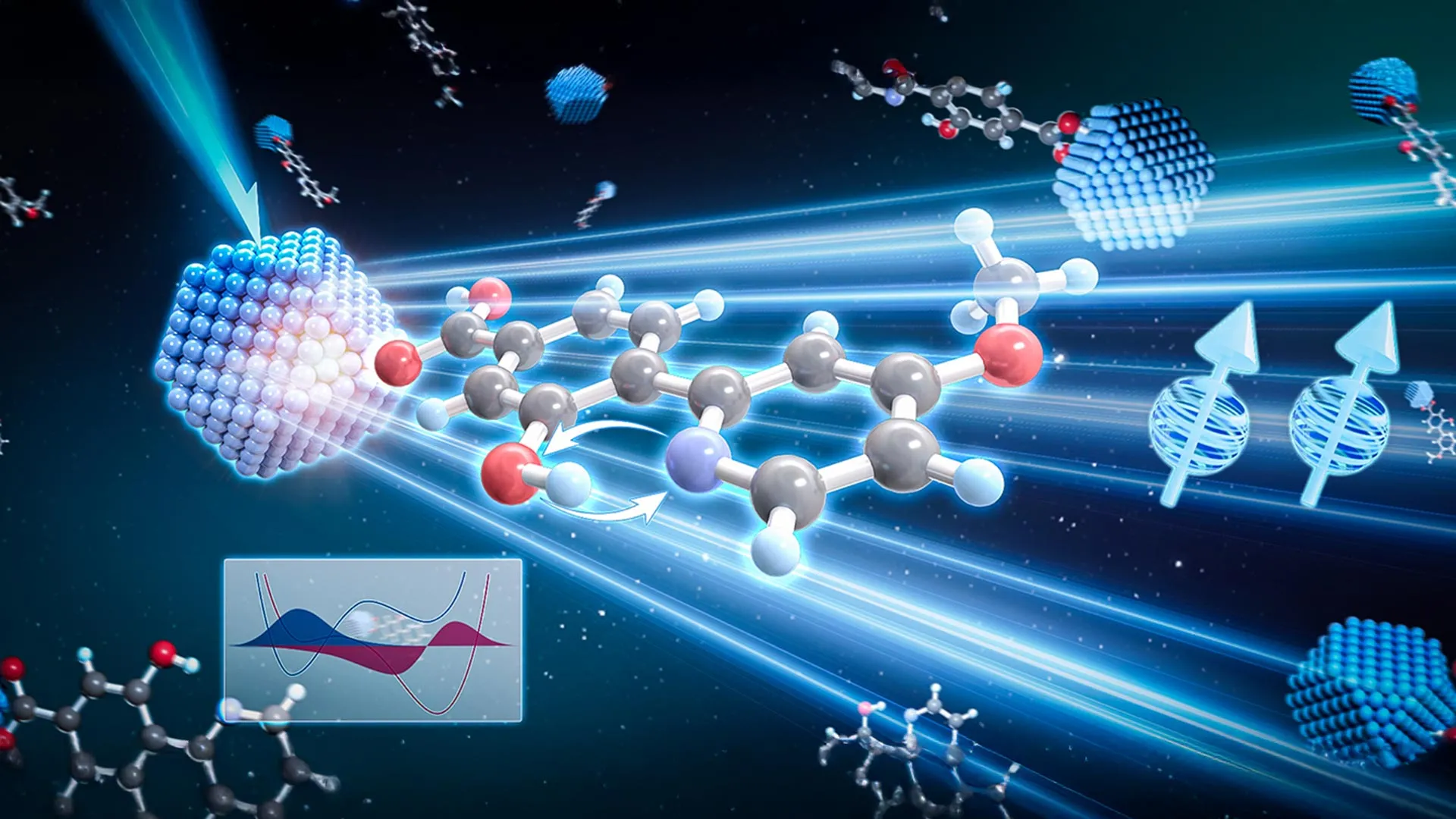
Scientists have discovered a quantum-driven mechanism that can greatly improve how energy moves between tiny semiconductor particles and nearby molecules.
Researchers at the Dalian Institute of Chemical Physics, Chinese Academy of Sciences, found that a temporary proton movement can act like a shuttle, helping coordinate electron motion and dramatically increasing triplet energy transfer. The discovery could open new ways to control energy flow in materials used for solar cells, lasers, photochemistry, and catalysis.
The study was published in Nature Materials.
How Protons and Electrons Work Together
In many natural and artificial systems, electrons and protons move together during important chemical and energy processes. One well-known example is proton-coupled electron transfer, which plays a major role in photosynthesis, respiration, nitrogen fixation, and energy conversion.
Researchers have also studied proton-linked singlet energy transfer. However, much less was known about how proton movement could affect triplet energy transfer, a key process in light-driven chemistry and advanced materials.
Triplet energy transfer is important because it helps move energy through molecules and materials in ways that can influence light emission, solar energy conversion, and chemical reactions.
A Proton Shuttle That Boosts Energy Flow
The research team, led by Prof. Kaifeng Wu, studied energy transfer from ZnSe-based colloidal quantum dots to nearby phenol-pyridine molecular acceptors attached to their surfaces.
When the quantum dots absorbed light, they entered an excited state. A hole moved from the quantum dot to the phenol group, while a proton shifted from phenol to pyridine. Then, an electron moved from the quantum dot to the phenoxyl radical, while the proton returned to its original position.
Although the proton ended up where it started, its brief movement helped coordinate the entire energy-transfer process. This created what the researchers call proton shuttle-assisted triplet energy transfer, or PS-TET.
Compared with a similar molecule that lacked the proton shuttle, the system with the shuttle showed much faster and more efficient triplet energy transfer.
Quantum Tunneling at Room Temperature
One of the most surprising findings was that the transfer rate changed very little with temperature. This suggests that the proton was not moving mainly through ordinary heat-driven motion.
Instead, the researchers found evidence that the proton moved through quantum tunneling, a strange quantum effect in which a particle passes through an energy barrier rather than going over it in the classical way.
Calculations supported this explanation, showing that proton vibrational wavefunction overlap helped guide the system toward efficient energy movement.
This means quantum effects can be used to control energy and charge transfer in materials even at room temperature.
Why the Discovery Matters
The discovery could help scientists design better materials for technologies that depend on excited molecular states.
In some systems, stronger triplet energy transfer could improve photoredox reactions, environmental catalysis, and light-driven chemical processes. In other technologies, such as certain organic solar cells and lasers, unwanted triplet states can reduce performance. In those cases, suppressing the proton shuttle could help limit triplet formation.
The study gives researchers a new way to tune energy flow: create a proton shuttle when triplet transfer is useful, or remove it when triplet states are unwanted.
By revealing how a tiny proton movement can control large energy-transfer effects, the work provides a new strategy for designing advanced quantum materials and next-generation molecular technologies.
Journal Reference:
Wang, Z., Zhu, J., & Wu, K. (2026). Proton shuttle-assisted triplet energy transfer. Nature Materials, 25(7), 1190. https://doi.org/10.1038/s41563-026-02535-4