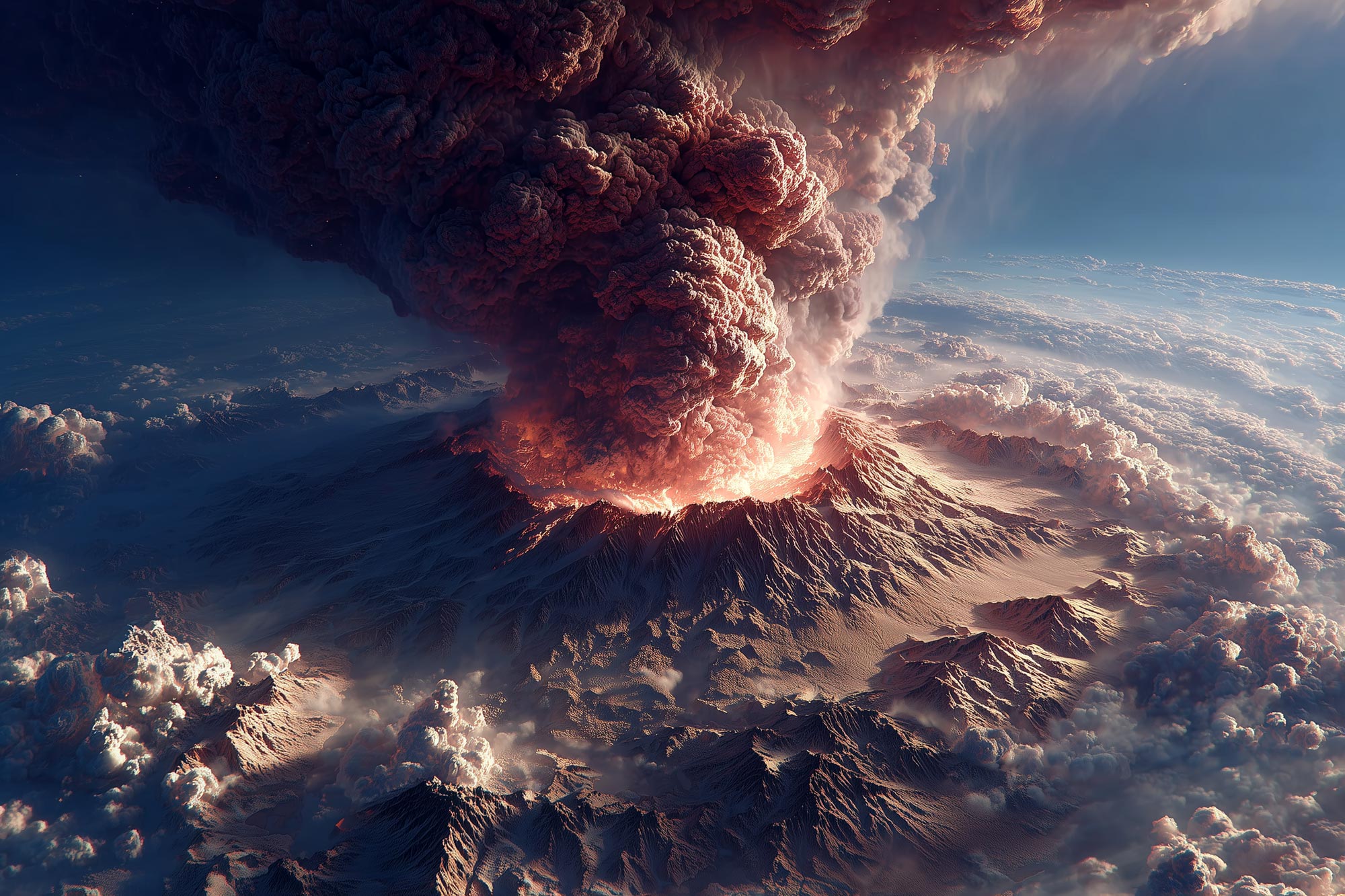
Some of the Holocene’s most powerful volcanic eruptions may have done far more than briefly dim the Sun. New evidence suggests they could have triggered self-reinforcing changes in sea ice, ocean circulation, and rainfall that kept large parts of the Northern Hemisphere unusually cold for decades or even centuries.
A major volcanic eruption can cool Earth remarkably quickly.
When enough sulfur reaches the upper atmosphere, it forms tiny sulfate aerosols that reflect incoming sunlight back into space. Surface temperatures fall, sometimes producing dramatic effects for several years.
Scientists have long understood this short-term volcanic cooling. What has been much harder to explain is why the relatively stable climate of the Holocene was repeatedly interrupted by prolonged cold episodes lasting far longer than volcanic aerosols themselves remain in the atmosphere.
Researchers led by Alice R. Paine of the University of Basel now argue that major explosive eruptions may provide the missing trigger.
Their study, published in Nature Communications, brings together nearly 12,000 years of volcanic, glacier, ice-core, and paleoclimate evidence. The results reveal a striking temporal relationship between major eruptions and periods of glacier expansion, suggesting that volcanic shocks could push the climate system into self-reinforcing cold states that persist long after the volcanic aerosols disappear.
A mystery hidden inside the Holocene
The Holocene began approximately 11,700 years ago following the end of the last major glacial period.
Compared with the dramatic climate swings of earlier ice-age intervals, it has generally been regarded as relatively stable. Yet that stability was repeatedly interrupted by abrupt episodes of cooling, altered rainfall patterns, ecological disruption, and glacier growth.
Researchers have identified roughly 22 major Holocene glacier advances associated with these cooler intervals.
For years, scientists proposed several possible explanations. Changes in solar activity may have contributed. Large releases of icebergs into the North Atlantic could have disrupted ocean circulation. Internal reorganizations of atmospheric and ocean currents were also considered.
But no single mechanism had convincingly explained the timing and persistence of the repeated cold periods.
Paine and her colleagues investigated whether explosive volcanism could have supplied the initial disturbance.
The challenge was not simply to show that volcanoes cause cooling — that is already well established — but to determine whether eruptions could initiate changes capable of lasting for centuries.
Reconstructing nearly 12,000 years of volcanic activity
To test the idea, the researchers assembled a broad record of major explosive eruptions throughout the Holocene.
Their compilation included 51 significant eruptions, many of them associated with volcanically active regions around the Pacific Ring of Fire.
Reconstructing eruptions from thousands of years ago is difficult. Volcanoes can erupt repeatedly, burying earlier deposits, while erosion and geological processes can remove evidence altogether.
The researchers therefore combined several types of records.
Volcanic deposits provided geological evidence of eruptions. Greenland and Antarctic ice cores preserved layers of sulfate deposited after volcanic material entered the atmosphere. Radiometric dating helped constrain the ages of volcanic rocks, while organic material trapped within ash layers provided additional chronological information.
The team then compared this volcanic timeline with records of major glacier advances.
Many of those advances are preserved in moraines — ridges of rocks and sediments pushed forward by glaciers and abandoned when the ice later retreated.
These geological markers allowed researchers to estimate when glaciers reached particularly large extents.
More than 80 percent of glacier advances overlapped with major eruptions
The comparison revealed a striking pattern.
Only four of the 22 Holocene glacier advances identified by the researchers did not fall within the dating uncertainties of a known major eruption. The study reports that more than 80 percent occurred close in time to at least one substantial Northern Hemisphere eruption.
The association became even more compelling when the researchers focused on the largest eruptions.
Their statistical analysis found that the relationship between glacier advances and eruptions of magnitude 7 or greater was significant at the 99 percent confidence level.
To test whether the apparent relationship could have emerged by chance, the researchers used Monte Carlo statistical simulations.
The simulations supported the conclusion that the clustering of major eruptions and glacier advances was unlikely to be random.
That does not mean every cold period can be attributed exclusively to a volcano.
Instead, the results suggest that powerful eruptions may often have acted as catalysts — delivering the initial shock that pushed an already sensitive climate system toward a prolonged colder state.
Sulfur, not lingering ash, provides the first cooling pulse
The process begins high in the atmosphere.
Explosive eruptions can inject sulfur-bearing gases into the stratosphere. There, the sulfur forms sulfate aerosols capable of spreading over enormous areas.
These particles increase Earth's reflectivity, reducing the amount of solar energy reaching the surface.
The resulting cooling can begin rapidly.
Volcanic ash is visually dramatic, but much of it falls from the atmosphere relatively quickly. Fine sulfate aerosols are far more important for widespread volcanic climate forcing because they can persist much longer and spread across broad regions.
But even sulfate aerosols do not normally remain in the atmosphere for centuries.
That means something else must prolong the climate response.
The new study suggests the answer lies in feedbacks involving ice, oceans, and the atmosphere.
The eruption may only start the chain reaction
Once volcanic aerosols cool the Northern Hemisphere, Arctic sea ice can begin to expand.
That expansion creates an important feedback.
Dark ocean water absorbs a large fraction of incoming sunlight. Bright sea ice reflects much more of it back into space.
As ice spreads across a larger area, the planet absorbs less solar energy, reinforcing the original cooling.
Sea ice also acts as a barrier between the relatively warm ocean and the colder atmosphere above it. Greater ice coverage can reduce exchanges of heat and moisture, further changing regional climate conditions.
The study argues that this expanding sea ice can then influence Atlantic Ocean circulation.
Ocean circulation can lock in the cooling
The Atlantic transports large quantities of heat from lower latitudes toward the north.
If volcanic cooling and expanding sea ice alter high-latitude ocean conditions, that northward heat transport can weaken.
A reduction in oceanic heat delivery can then reinforce cooling around the North Atlantic and surrounding regions.
This creates a much slower response than the original atmospheric disturbance.
The volcanic aerosols may vanish after a few years, but oceans and sea ice have much greater thermal and dynamical inertia. Once they have shifted into a different state, they can maintain altered climate conditions for decades or longer.
Previous climate-model research has similarly shown that clusters of volcanic eruptions can produce prolonged Holocene cold periods through ocean–sea-ice feedbacks.
The new geological synthesis strengthens that picture by showing how often major eruptions coincided with glacier advances across the Holocene.
Tropical rainfall patterns may shift as well
The repercussions can extend far beyond the Arctic and North Atlantic.
If the Northern Hemisphere cools relative to the Southern Hemisphere, Earth's tropical rain belt can migrate southward.
This belt of intense tropical rainfall is associated with the Intertropical Convergence Zone, where warm, moisture-rich air rises and produces heavy precipitation.
A southward shift can change rainfall patterns across wide regions.
The researchers found paleoclimate evidence consistent with such a reorganization during major Holocene cold events, alongside expanded sea ice and weakened Atlantic circulation.
The result is not simply a colder climate.
It is a broader restructuring of the coupled atmosphere–ocean system, potentially bringing major hydrological changes to distant regions.
A self-reinforcing climate “snowball”
The mechanism proposed by the researchers involves several processes amplifying one another.
Volcanic sulfur causes the initial cooling.
Sea ice expands.
Greater ice cover reflects more sunlight.
Ocean-to-atmosphere heat transfer changes.
Atlantic circulation can weaken.
The tropical rain belt shifts.
Glaciers begin advancing.
Once these processes interact, the climate response can continue even after the volcanic particles that started the sequence have disappeared.
Paine described the interaction as a “snowball effect.”
The crucial idea is that the volcano does not have to continuously cool Earth for hundreds of years.
It only has to push the climate system strongly enough for slower internal feedbacks to take over.
Not every giant eruption produces the same climate response
Eruption size alone does not determine how strongly a volcano affects climate.
The amount of sulfur reaching the stratosphere is critical.
So is the height of the eruption plume, the volcano's geographical location, atmospheric circulation at the time, and the background state of the climate system.
A physically enormous eruption may produce a smaller climate effect than expected if relatively little sulfur reaches and remains in the upper atmosphere.
Conversely, an eruption with a particularly large stratospheric sulfur injection can have an outsized climatic impact.
The study therefore emphasizes that volcanic magnitude and climate forcing are related but are not interchangeable measures.
Why this is different from the “Year Without a Summer”
One of the most famous examples of volcanic climate disruption followed the 1815 eruption of Mount Tambora in present-day Indonesia.
The following year, 1816, became known as the “Year Without a Summer.”
Cold and abnormal weather contributed to crop failures and food shortages across several regions.
But the most dramatic impacts of that event were relatively short-lived.
The prolonged Holocene cold episodes examined in the new study represent something different.
In those cases, volcanic forcing may have initiated changes in sea ice and ocean circulation capable of maintaining cooling long after the direct atmospheric influence of the eruption had faded.
The distinction is important.
One mechanism is primarily the direct radiative effect of volcanic aerosols.
The other begins with that same effect but then recruits slower parts of the Earth system, allowing the consequences to persist for generations.
Volcanoes may have been catalysts rather than continuous drivers
This interpretation changes how large eruptions are viewed in paleoclimate research.
Rather than treating volcanic eruptions only as brief interruptions to climate, the researchers suggest that especially powerful events — or clusters of eruptions — can sometimes function as triggers for much longer reorganizations.
The volcano supplies the push.
The climate system supplies the persistence.
That could explain how a forcing lasting only a few years is associated with glacier advances and climatic changes spanning many decades or centuries.
The Nature Communications paper concludes that explosive volcanism probably played a much greater and more persistent role in Holocene climate variability than previously recognized.
Could a future super-eruption do the same thing?
The findings naturally raise a modern question: could an enormous eruption push today's climate into a similarly long cold period?
The researchers caution that the answer remains uncertain.
The Holocene events they examined occurred under climate conditions substantially different from those of the present.
Human greenhouse-gas emissions have now warmed the atmosphere and oceans, reduced ice cover, and altered the background energy balance of the planet.
A future major eruption would therefore act on a climate system unlike the one that experienced many of the ancient cold episodes.
Some feedbacks might become weaker.
Others could behave differently or produce unexpected responses.
That uncertainty makes it difficult to use ancient volcanic events as straightforward predictions of what would happen today.
A volcanic eruption would not cancel modern global warming
The study also should not be interpreted as evidence that a future volcanic eruption could provide a lasting solution to anthropogenic climate change.
Volcanic aerosols can temporarily reduce incoming solar energy, but they do not remove the carbon dioxide accumulating in the atmosphere.
Modern greenhouse warming and volcanic cooling operate through different physical mechanisms and on different timescales.
A major eruption could temporarily mask some warming at the surface, but greenhouse gases would continue exerting their underlying influence.
What the new research reveals is something subtler: extreme volcanic events can sometimes activate internal feedbacks capable of extending their climatic influence far beyond the lifetime of the eruption itself.
Ancient eruptions changed more than the sky
The study provides a new explanation for one of the Holocene's persistent climate puzzles.
Large eruptions did not need to fill the atmosphere with volcanic material for centuries to create century-scale effects.
Instead, they may have destabilized a network of interacting systems.
A pulse of volcanic sulfur cooled the surface.
Sea ice expanded.
Ocean circulation weakened.
Rainfall patterns shifted.
Glaciers advanced.
Each part of the system helped reinforce the others, allowing a short-lived geological event to leave an extraordinarily long climatic footprint.
The findings suggest that some of Earth's most powerful ancient eruptions were not simply spectacular disasters lasting days, months, or years.
Under the right conditions, they may have pushed the climate into a different state — one whose effects remained visible for centuries after the skies had cleared.
Journal reference
Alice R. Paine, James U. L. Baldini, Charlie L. Rex, Michael Sigl, Francesco S. R. Pausata, and Richard J. Brown. “Evidence for volcanic forcing of Holocene cold events.” Nature Communications, 17, Article 6950 (2026), published May 28, 2026. The DOI was verified against the official Nature Communications article and the University of Basel publication record and resolves to this exact publication.