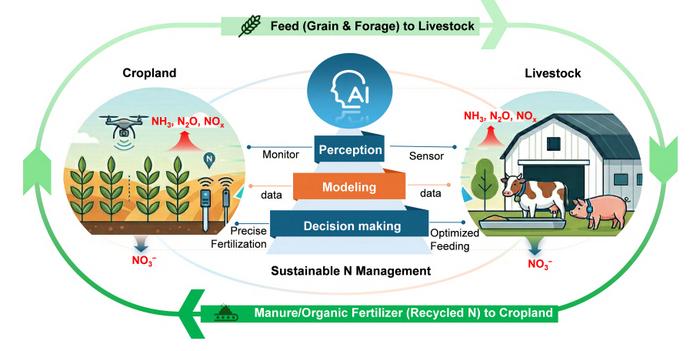
Artificial intelligence could help transform the way farms manage nitrogen by connecting crop production, livestock feeding, manure recycling, and environmental monitoring into one coordinated system.
A new perspective published in Nitrogen Cycling suggests that AI may help agriculture use nitrogen more efficiently while reducing pollution and greenhouse gas emissions.
Nitrogen fertilizers have greatly improved global food production, but poor nitrogen management remains a major environmental problem. When nitrogen is not used efficiently, it can contribute to air pollution, soil acidification, groundwater contamination, and the release of nitrous oxide, a powerful greenhouse gas.
One major challenge is the separation between crop farming and livestock production. In many regions, manure builds up around intensive livestock farms, while crop farms elsewhere continue to depend heavily on synthetic fertilizers. This creates a broken nutrient cycle, where one area has excess nitrogen and another still needs it.
The authors argue that artificial intelligence could help repair this gap by tracking nitrogen movement across the whole agricultural system. Instead of treating crops, animals, manure, and environmental losses as separate issues, AI could analyze them as connected parts of one cycle.
The proposed framework has three major parts.
First, AI-powered observation systems could collect data from satellites, drones, soil sensors, animal wearables, computer vision, and livestock housing monitors. These tools could help scientists and farmers see how nitrogen moves through fields, animals, manure storage, and the surrounding environment.
Second, the researchers recommend combining data-driven AI with scientific models based on physical, biological, and chemical processes. Methods such as physics-informed neural networks and knowledge-guided machine learning could improve predictions while still respecting important scientific rules, including nitrogen mass balance.
Such systems could help estimate how much fertilizer crops need, how much nitrogen animals retain, how much is lost from manure, and how much nitrous oxide may be released into the atmosphere.
Third, agricultural large language models could turn complex scientific results into clear and practical advice for farmers. These tools could recommend the right fertilizer source, amount, timing, and placement. They could also help optimize animal feed and identify opportunities to move manure from nitrogen-rich livestock regions to croplands that need nutrients.
The long-term goal is to develop a whole-farm intelligent agent that can coordinate crop fertilization, livestock nutrition, and manure recycling at the same time.
The paper notes that early agricultural AI systems have already shown promise, with some reporting reductions in fertilizer or feed nitrogen use while maintaining or improving productivity.
However, the researchers also point out important challenges. Agricultural data are often scattered across different institutions and platforms. Some AI models are difficult to explain, and advanced tools may be too expensive for smallholder farmers.
To address these barriers, the authors suggest approaches such as federated learning, edge computing, and lower-cost digital tools. These could improve privacy, accessibility, and inclusion, especially for farmers with limited resources.
The researchers conclude that AI could become a central tool for circular agriculture, helping farms produce more food while reducing nitrogen losses. However, success will require collaboration among agronomists, animal scientists, biogeochemists, computer scientists, farmers, and policymakers.
If properly developed, artificial intelligence could help close agriculture’s broken nitrogen loop and support a cleaner, more efficient, and more sustainable food system.
Journal Reference:
Zhang, X., Wei, C., Zhang, S., & Gu, B. (2026). Artificial intelligence empowers sustainable agricultural nitrogen management. Nitrogen Cycling, 2, e022. https://doi.org/10.48130/nc-0026-0009