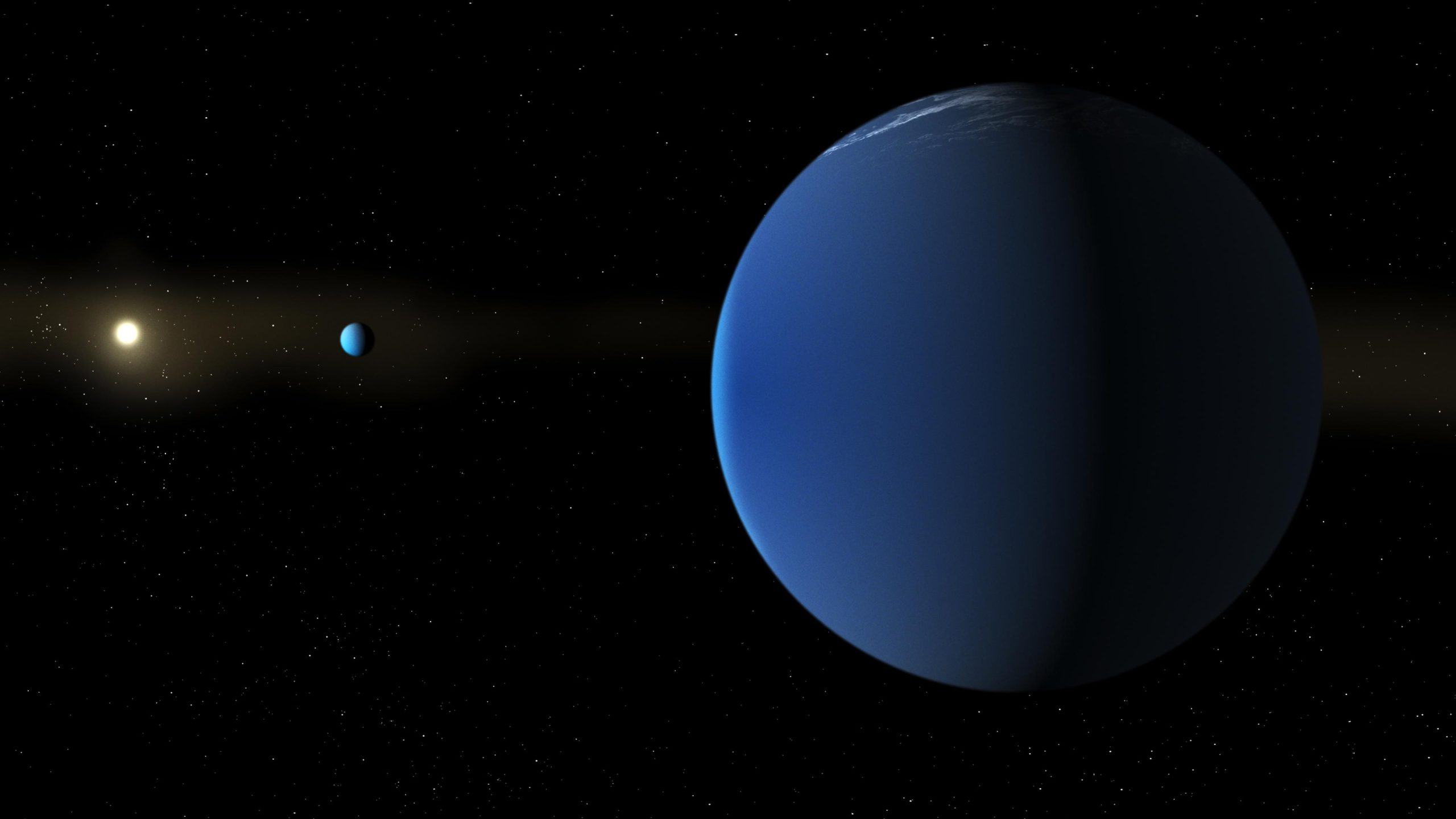
Astronomers have discovered two giant exoplanets so light and airy that they are less dense than cotton candy.
The planets, named TOI-791 b and TOI-791 c, belong to a rare group known as super-puff planets. These worlds are roughly the size of Jupiter, but they contain only a small fraction of Jupiter’s mass, making them some of the least dense giant planets ever measured.
The discovery was made by an international research team led by the University of Oxford, in collaboration with scientists from Université Côte d’Azur/Observatoire de la Côte d’Azur and the University of Birmingham. The findings were published in the Monthly Notices of the Royal Astronomical Society.
The two planets orbit an F7-type dwarf star called TOI-791, located about 1,110 light-years from Earth in the southern constellation Volans.
What makes these planets extraordinary is their extremely low density. TOI-791 b has a density of only 0.038 grams per cubic centimetre, while TOI-791 c has a density of 0.047 grams per cubic centimetre. By comparison, Jupiter’s average density is about 1.33 grams per cubic centimetre, making it dozens of times denser than these newly confirmed worlds.
Even cotton candy, with a density of around 0.05 grams per cubic centimetre, is denser than both planets.
Scientists believe the planets may have formed together from the same disk of gas and dust around their young star. This makes them planetary “siblings.” They are also locked in a rare gravitational rhythm known as a 5:3 mean-motion resonance. This means that for every five orbits completed by the inner planet, the outer planet completes almost three.
Because the planets pull on each other as they orbit, their transits across the face of their star do not happen at perfectly regular times. These small timing changes helped astronomers estimate the planets’ masses and confirm their unusually low densities.
The planets were first identified as candidates through the Planet Hunters TESS citizen-science project, which uses data from NASA’s Transiting Exoplanet Survey Satellite. Volunteers flagged the possible planets in 2019 and 2023, and astronomers later used several ground-based telescopes to confirm their properties.
One important facility was the ASTEP telescope in Antarctica. Its location allowed researchers to observe the planets during long periods of continuous darkness. Each transit lasted more than 11 hours, making them among the longest planetary transits ever fully recorded from the ground.
Super-puff planets remain mysterious. Scientists are still trying to understand how planets can grow so large while staying so light. One possible explanation is that they have enormous atmospheres rich in hydrogen and helium, which greatly expand their visible size without adding much mass.
Future observations, possibly with the James Webb Space Telescope, could reveal the chemical makeup of their atmospheres. This may help scientists determine how these unusual planets formed and why they are so different from the giant planets in our own solar system.
The discovery of TOI-791 b and TOI-791 c gives astronomers a rare opportunity to study two super-puff planets in the same system, offering new clues about the formation and evolution of some of the strangest worlds in the galaxy.
Journal Reference:
Dransfield, G., Petit, A. C., Triaud, A. H. M. J., Guillot, T., Schmider, F.-X., Abe, L., Agabi, A., Barkaoui, K., Baycroft, T. A., Bendjoya, P., Brahm, R., Collins, K. A., Edwards, B., Evans, P., Freckelton, A. V., Grieves, N., Howell, S. B., Mallia, F., Mekarnia, D., Psaridi, A., et al. (2026). ASTEP confirmation of a pair of long-period Jupiter-sized planets with extremely low densities transiting TOI-791. Monthly Notices of the Royal Astronomical Society. https://doi.org/10.1093/mnras/stag864