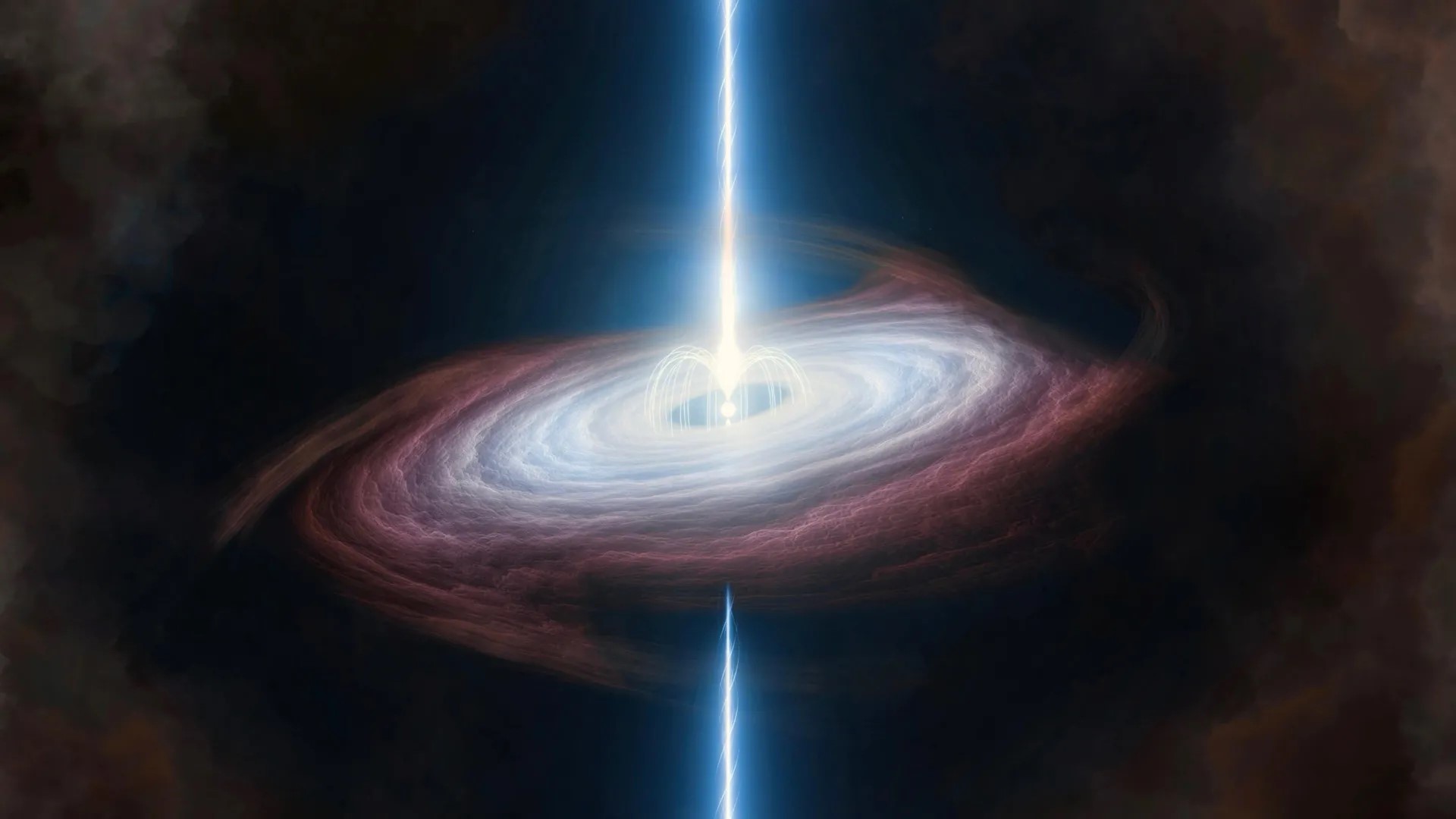
Astronomers have observed what appears to be the birth of a magnetar for the first time, offering direct evidence that these highly magnetic neutron stars can power some of the brightest stellar explosions in the universe.
The discovery came from an unusual signal detected in the light of a distant supernova. Researchers found a repeated “chirping” pattern in the explosion’s brightness, a feature that revealed the presence of a newly formed magnetar at the heart of the blast. The findings were published in Nature.
Magnetars are rare neutron stars with extremely powerful magnetic fields. They form when the core of a massive star collapses after the star reaches the end of its life. While ordinary neutron stars are already incredibly dense, magnetars are even more extreme because of their intense magnetic fields and rapid rotation.
Solving the Puzzle of Superluminous Supernovae
The discovery helps explain the mystery behind superluminous supernovae, which are stellar explosions that shine at least 10 times brighter than ordinary supernovae.
Since these unusually bright explosions were first identified in the early 2000s, astronomers have debated what keeps them glowing so intensely for such a long time. One leading explanation was proposed in 2010 by UC Berkeley theoretical astrophysicist Dan Kasen, together with Lars Bildsten, and independently by Stanford Woosley of UC Santa Cruz.
Their theory suggested that when a massive star collapses, its core may form a magnetar instead of a black hole. As the newborn magnetar spins rapidly, its powerful magnetic field injects extra energy into the expanding cloud of supernova debris. This added energy can keep the explosion shining far brighter and longer than expected.
Until now, however, astronomers had not directly confirmed that a magnetar had actually formed inside such an explosion.
A Supernova With a Strange “Chirp”
The key evidence came from a supernova discovered in December 2024, named SN 2024afav. The explosion occurred about one billion light-years away from Earth.
After its discovery, the Las Cumbres Observatory, a global network of 27 telescopes, monitored the supernova for more than 200 days. Around 50 days after the explosion, the supernova reached peak brightness. But instead of fading smoothly, its light began to rise and fall in a repeated pattern.
Researchers observed four distinct bumps in the light curve. Even more unusual, the time between the bumps became shorter and shorter, creating a pattern similar to the rising pitch of a bird’s chirp.
Graduate student Joseph Farah of UC Santa Barbara and Las Cumbres Observatory led the analysis. He and his colleagues concluded that the signal was strong evidence for a newly born magnetar hidden inside the supernova.
Einstein’s Theory Helps Explain the Signal
The team found that the unusual chirping pattern could be explained by Einstein’s general theory of relativity.
According to their model, some material thrown outward by the explosion later fell back toward the newborn magnetar, forming a disk of matter around it. This disk was likely tilted relative to the magnetar’s spin.
Because the magnetar was spinning rapidly, it dragged nearby space-time along with it, causing the tilted disk to wobble. This effect is known as Lense–Thirring precession, a prediction of general relativity.
As the disk wobbled, it periodically blocked and reflected light from the magnetar, producing repeated flashes. Over time, the disk moved inward and the wobbling became faster, causing the flashes to arrive closer together. This created the chirping signal seen in the supernova’s light.
The researchers tested other possible explanations, including ordinary Newtonian motion and magnetic effects, but only Lense–Thirring precession matched the timing of the signal.
This makes the discovery especially important because it is the first time general relativity has been required to explain the mechanics of a supernova.
A Powerful Newborn Engine
The team estimated that the newly formed neutron star spins once every 4.2 milliseconds and has a magnetic field about 300 trillion times stronger than Earth’s magnetic field. These properties strongly point to a magnetar.
Astronomers described the discovery as a “smoking gun” for the magnetar model of superluminous supernovae. It provides the clearest evidence so far that a newly born magnetar can sit at the center of a stellar explosion and power its extraordinary brightness.
However, researchers caution that magnetars may not explain every superluminous supernova. In some cases, the brightness may come from the explosion colliding with surrounding material. Other extremely bright supernovae may also be powered by black holes formed during stellar collapse.
Still, this discovery shows that magnetars are an important part of the story.
More Discoveries May Be Coming
Scientists expect that more supernovae with similar chirping patterns could be found in the future, especially once the Vera C. Rubin Observatory begins its major survey of the night sky.
By detecting more events like SN 2024afav, astronomers may better understand how massive stars die, how magnetars form, and how the universe produces its most powerful explosions.
The discovery marks a major step forward in astrophysics, showing not only the birth of a magnetar but also the role of Einstein’s theory in shaping the final moments of a massive star.
Journal Reference:
Farah, J. R., Prust, L. J., Howell, D. A., Ni, Y. Q., McCully, C., Andrews, M., Kumar, H., Hiramatsu, D., Gomez, S., Wynn, K., Filippenko, A. V., Bostroem, K. A., Berger, E., & Blanchard, P. (2026). Lense–Thirring precessing magnetar engine drives a superluminous supernova. Nature, 651(8105), 321. https://doi.org/10.1038/s41586-026-10151-0