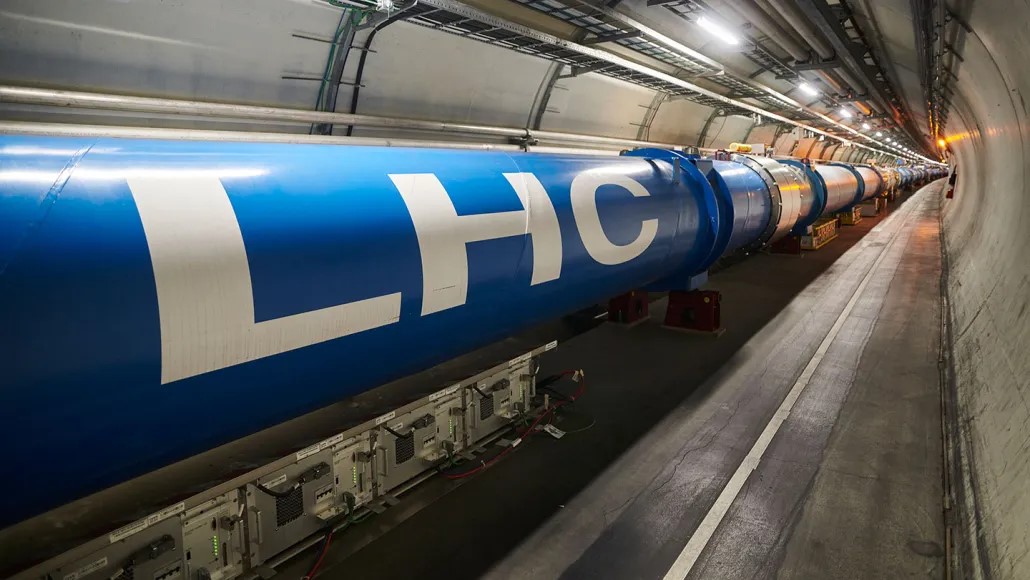
CERN has shut down the Large Hadron Collider, the world’s most powerful particle accelerator, to begin a major transformation that will prepare the machine for a new era of particle physics.
The shutdown began on June 29, 2026, as CERN moved into a long upgrade period aimed at converting the existing Large Hadron Collider, or LHC, into the High-Luminosity Large Hadron Collider. The upgraded machine is expected to begin operations around 2030.
Located underground near Geneva, Switzerland, the LHC is a 27-kilometre circular accelerator that straddles the border between France and Switzerland. Since 2010, it has been smashing protons together at extremely high energies, allowing scientists to investigate the most fundamental building blocks of matter.
The LHC is best known for enabling the discovery of the Higgs boson in 2012. That discovery, announced by the ATLAS and CMS experiments at CERN, confirmed a key part of the Standard Model of particle physics and helped explain how fundamental particles acquire mass.
Now, CERN is preparing the collider for its next major scientific chapter. The High-Luminosity LHC is designed to greatly increase the number of particle collisions produced inside the machine. This increase in “luminosity” will give scientists much more data, making it possible to study rare processes and measure known particles, especially the Higgs boson, with far greater precision.
According to CERN, the upgrade aims to increase the LHC’s integrated luminosity by a factor of 10 compared with its original design. In practical terms, this means the upgraded collider will produce far more collision data, giving researchers a better chance of spotting subtle effects that may point to new physics beyond the Standard Model.
The transformation will involve replacing about 1.2 kilometres of the LHC with new and more advanced equipment. This includes powerful superconducting magnets, improved beam-control systems, and major upgrades to the ATLAS and CMS detectors. These detectors must be prepared to handle the much larger volume of data expected from the High-Luminosity LHC.
When the upgraded collider begins operation, physicists hope it will help answer some of the biggest questions in modern science. These include deeper questions about the Higgs boson, the nature of dark matter, why the universe contains more matter than antimatter, and whether unknown particles or forces exist beyond current theories.
Although the LHC itself will be offline during the upgrade period, scientists will continue to analyse the enormous amount of data already collected from previous runs. CERN has reported that the LHC delivered vast numbers of proton and heavy-ion collisions during its three high-energy runs, producing a scientific legacy that researchers will continue to study for years.
The shutdown marks the end of one phase of the Large Hadron Collider and the beginning of another. After helping confirm the existence of the Higgs boson and opening new windows into the subatomic world, the LHC is now being transformed into a more powerful scientific instrument.
By 2030, the High-Luminosity LHC is expected to begin a new chapter in particle physics, offering scientists a sharper tool for exploring the hidden structure of the universe.