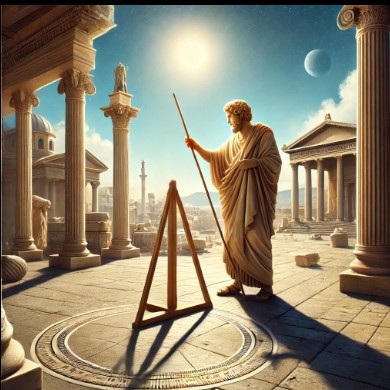
More than 2,200 years ago, long before satellites, telescopes, or space exploration, the Greek scholar Eratosthenes made one of the most remarkable scientific discoveries in history. By carefully observing the Sun and the shadows it cast, he demonstrated that the Earth is not flat but curved. His breakthrough came from comparing observations made in two Egyptian cities—Syene and Alexandria—during the summer solstice.
Eratosthenes noticed that at noon in Syene, the Sun was positioned directly overhead, causing vertical objects to cast no shadow. However, at the exact same moment in Alexandria, a vertical stick produced a measurable shadow. If the Earth were flat, sunlight would strike both cities at the same angle and create identical shadow patterns. The difference in shadow angles could only be explained if the Earth's surface was curved. By measuring the shadow angle, which was about 7.2 degrees, and knowing the distance between the two cities, he was able to calculate the size of the Earth.
The result was astonishing. Eratosthenes estimated the Earth's circumference to be approximately 40,000 kilometers, an incredibly accurate figure considering the limited tools available at the time. Modern measurements place the Earth's circumference at about 40,075 kilometers, proving just how precise his calculations were. His achievement remains a powerful reminder that careful observation and logical reasoning can unlock profound truths about our world. Sometimes, the greatest scientific discoveries begin with something as simple as a shadow.