Can hidden pollution from dumpsites seep into the ground and threaten nearby water sources?
This study used electrical resistivity tomography to investigate possible leachate contamination around selected dumpsites in Calabar, Cross River State, Nigeria.
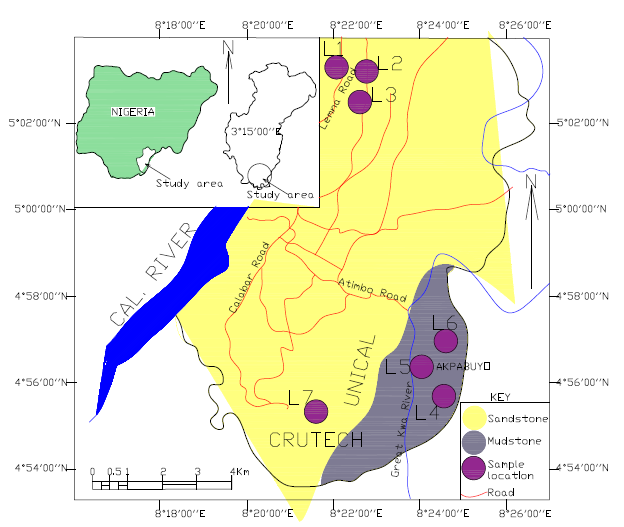
Seven geophysical profiles were surveyed using the Wenner electrode configuration. Five profiles were located close to dumpsites, while two control profiles were positioned 150 m and 170 m away to assess whether contamination had migrated beyond the disposal areas.
The measured subsurface resistance values were converted to apparent resistivity and analysed with Microsoft Excel and RES2DINV software to produce two-dimensional images of the underground conditions.
Leachate was identified through very low resistivity values below 10 Ωm, which indicate conductive zones associated with water containing dissolved contaminants from decomposing waste.
At the Lemna dumpsite, profile 2 showed a low-resistivity zone between depths of approximately 6.38 and 12.4 m, confirming leachate contamination. However, the control profile located 150 m away showed no evidence that the plume had migrated that far.
At CROSPIL Estate, patches of leachate were detected at horizontal distances of 20–25 m and 50–55 m, at depths ranging from 11.0 to 12.4 m. The control profile 170 m away did not show contamination.
The UNICROSS dumpsite also contained a low-resistivity zone below 10 Ωm at depths of approximately 6.35–12.4 m, indicating leachate beneath the site.
Overall, contamination was detected in profiles 2, 4, and 7 at the Lemna, CROSPIL, and UNICROSS dumpsites. Profiles 1, 3, 5, and 6 showed no evidence of leachate.
The findings show that both active and inactive dumpsites can release contaminants into the surrounding subsurface. Persistent leachate accumulation may threaten soil quality, groundwater, surface water, plants, aquatic organisms, and public health.
The researchers recommend that groundwater and borehole water within the affected areas be properly treated before consumption. They also call for regular monitoring, modern waste-management practices, site remediation, and public awareness programmes on the environmental and health risks associated with dumpsites.
📖 Read the full article here:
https://doi.org/10.46481/asr.2026.5.2.499
Published in: African Scientific Reports