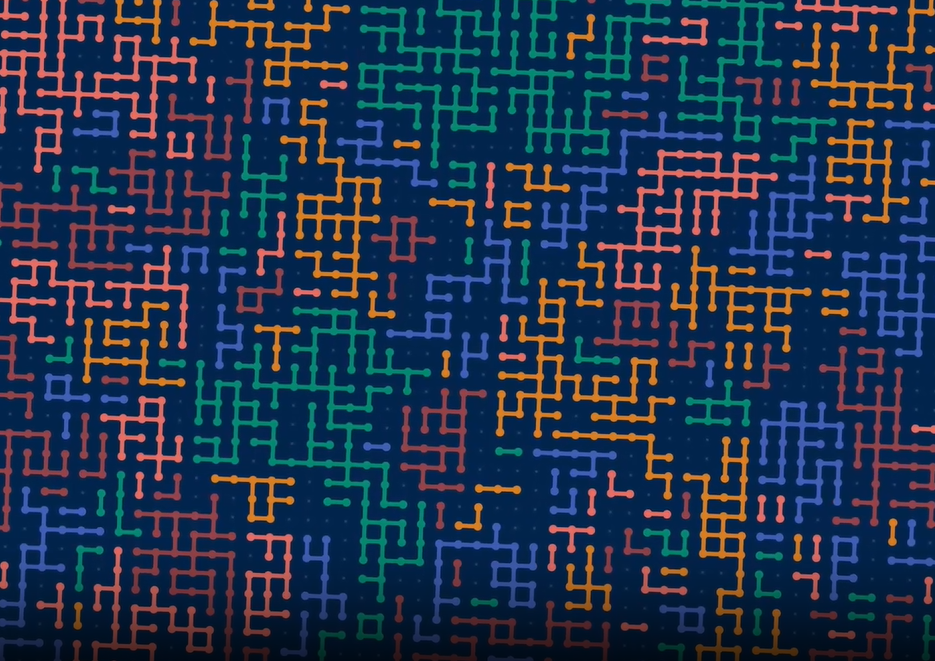
A new mathematical proof shows that a broad class of networks undergoes an abrupt change once a critical threshold is crossed, resolving a long-standing problem about phase transitions in percolation theory.
A team of five mathematicians has solved a decades-old problem in percolation theory, establishing a result that applies to every infinite transitive graph.
The breakthrough was achieved by Sahar Diskin, Philip Easo, Ritvik Ramanan Radhakrishnan, Benny Sudakov and Vincent Tassion. Their work provides a proof of what is known as supercritical sharpness, a key mathematical property describing how networks behave immediately above the point where large-scale connectivity becomes possible.
The result significantly expands mathematicians’ understanding of phase transitions in complex networks and may provide tools for studying related problems in probability, statistical physics and mathematical models of physical systems.
What Is Percolation Theory?
Percolation theory is the mathematical study of how connections or flows develop across a network.
A simple example is water moving through coffee grounds. Similar mathematical ideas can be used to describe the spread of viruses through populations, gas flowing through filters, wildfires moving across landscapes and connectivity in large networks.
In a basic percolation model, a network consists of points connected by possible edges. Each edge is independently declared open or closed according to some probability.
When relatively few edges are open, only small, isolated connected regions appear. But as the probability of an open edge increases, the system eventually reaches a critical probability.
Once that threshold is crossed, the network can undergo a dramatic phase transition in which large connected structures suddenly emerge.
This behaviour is mathematically analogous to physical phase transitions such as water freezing or a material becoming magnetized.
The Sharpness Problem
For decades, mathematicians have sought to understand how quickly the change occurs around the critical probability.
One central prediction, known as the sharpness conjecture, says that the transition should happen very rapidly.
Below the critical point, connected regions should remain relatively small and isolated. Above the threshold, by contrast, the network should quickly become dominated by very large connected structures.
Sharpness had previously been established for regular lattice systems during the 1980s.
However, extending the result to much broader classes of networks proved considerably more difficult.
Beyond Regular Grids
In 1996, mathematicians Itai Benjamini and Oded Schramm began studying percolation on a much broader family of networks known as transitive graphs.
In a transitive graph, every point in the network has essentially the same structural surroundings. A square lattice is one example, but transitive graphs also include loops, branching tree-like structures and much more complicated mathematical networks.
Researchers eventually demonstrated that percolation on many infinite transitive graphs possesses a critical phase transition.
But an important question remained: How sharply does the network change after the critical threshold is crossed?
The subcritical part of the problem — describing behaviour below the threshold — was solved in 2007 by Tonći Antunović and Ivan Veselić.
The supercritical case remained unresolved.
The Remaining ‘Fortress’
Above the critical probability, mathematicians expected the network to behave very differently.
Large finite connected regions that remain isolated from the infinite connected structure should become extremely unlikely. In other words, once the network is sufficiently above the critical point, connectivity should spread so extensively that a large isolated region becomes difficult to maintain.
Proving this rigorously for every infinite transitive graph remained a major challenge.
Earlier proofs worked for lattices, but their techniques were too complicated or too specialized to extend to the more general setting.
The supercritical problem consequently became one of the major remaining questions in the field.
A Breakthrough in Zurich
The five researchers did not initially set out to solve the sharpness problem.
During the second half of 2025, they were investigating how the critical probability of certain graphs changes with the number of edges.
After making limited progress, they shifted their attention toward sharpness.
Their work eventually suggested that the same strategy might prove supercritical sharpness across all infinite transitive graphs.
In December 2025, the group gathered at ETH Zurich and intensively worked through the argument.
By 17 December 2025, they were convinced that the central idea was correct, and by Christmas they had completed the proof.
A Surprisingly Simple Strategy
The proof centres on what happens to a hypothetical large but isolated connected region above the critical probability.
The researchers considered the boundary surrounding such a region.
Along this boundary, some paths could lead back toward the isolated region while others could connect to an infinite connected structure. If these paths met, the supposedly isolated finite region would actually be connected to the infinite network, producing a contradiction.
As the isolated region becomes larger, its boundary also becomes larger, increasing the opportunities for such connections.
The researchers showed that this makes the existence of very large isolated regions overwhelmingly unlikely.
Changing the Order of a Standard Technique
A crucial simplification came from modifying a familiar probability technique called sprinkling.
In the standard approach, researchers temporarily set aside a small number of open edges, analyse the remainder of the system, and later restore those edges.
Because the reserved edges are independent of the structure being analysed, they can help create connections that would otherwise be difficult to study.
The team discovered that changing the order of the argument — analysing the “sprinkled” edges first — made the proof dramatically simpler.
That modification also strengthened the method enough for it to apply to every infinite transitive graph.
What the New Proof Establishes
The result demonstrates that if the probability of an edge being open lies anywhere above the critical threshold, even by a very small amount, the percolation system rapidly becomes dominated by its large-scale connected structure.
The authors later posted their paper as a preprint.
According to the report, the proof applies to percolation on any infinite transitive graph, resolving the long-standing supercritical sharpness problem.
Researchers have praised the argument for combining familiar mathematical ingredients in an unexpectedly powerful way.
Why the Result Matters Beyond Percolation
Percolation theory provides one of mathematics' simplest rigorous models of phase transitions.
Real physical phase transitions — including freezing, melting and magnetization — can involve highly complicated interactions. Percolation allows mathematicians and physicists to study some of the same underlying ideas in a cleaner mathematical setting.
The new techniques could therefore influence the analysis of other network models and more complicated systems associated with physical processes.
Possible future applications include networks whose points are not structurally identical and mathematical models connected with phenomena such as freezing and quantum materials.
An Important Question Still Remains
Despite the breakthrough, major questions in percolation theory remain unresolved.
One particularly important problem concerns three-dimensional lattices, which more closely resemble many real physical systems.
Researchers still want to determine precisely what occurs at the critical probability itself.
The new proof establishes what happens above the threshold, but the exact behaviour at the critical point in some important three-dimensional systems remains an open question.
For mathematicians working in probability and graph theory, however, the solution of supercritical sharpness represents a major step.
A conjecture that resisted proof for decades has now been resolved through an argument researchers have described as both powerful and unusually simple.
Research reference
Sahar Diskin, Philip Easo, Ritvik Ramanan Radhakrishnan, Benny Sudakov and Vincent Tassion.
Research on supercritical sharpness for percolation on infinite transitive graphs.