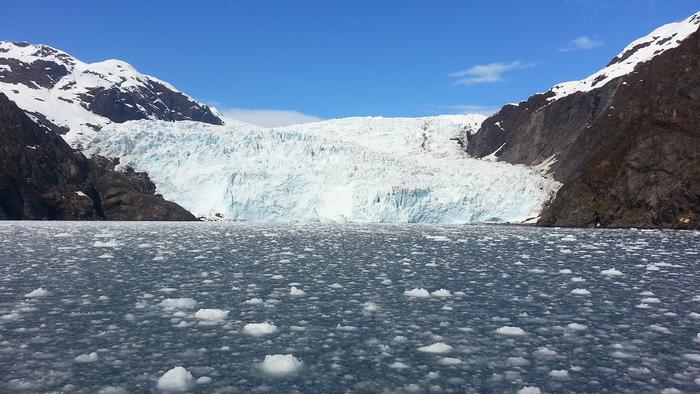
Melting icebergs in the northeastern Pacific Ocean may weaken one of the most important ocean current systems on Earth, according to new research from the University of California, Davis.
The study, published in Nature Communications, shows that freshwater from melting icebergs far from the Atlantic can still influence the Atlantic Meridional Overturning Circulation, or AMOC. This massive ocean system acts like a conveyor belt, moving warm, salty water from the tropics toward the North Atlantic and helping regulate global climate.
AMOC is responsible for a major share of ocean heat transport across the equator. Because it redistributes heat and energy around the planet, any weakening of the system can affect weather patterns, rainfall, ocean temperatures, and climate stability.
For years, scientists believed that melting icebergs in the North Atlantic were the main cause of AMOC weakening during the last ice age. These events, known as Heinrich stadials, were linked to major climate changes, including cooling in the Northern Hemisphere and warming around Antarctica.
However, newer evidence suggests that North Atlantic iceberg melting may have happened after AMOC had already weakened. This means the North Atlantic meltwater may not have been the original trigger.
To investigate further, researchers used paleoclimate evidence and supercomputer simulations to recreate conditions from about 19,000 years ago, during a major deglaciation event known as Heinrich stadial 1.
At that time, sea levels were much lower than today, a thick ice sheet covered North America, and atmospheric carbon dioxide levels were far below modern values. The simulations showed that freshwater from iceberg discharge in the northeastern Pacific could travel across the global ocean and reach the North Atlantic regions where deep water forms.
Once there, the freshwater diluted the dense salty water that helps drive AMOC. This weakened the circulation, caused subsurface warming, and may have triggered further iceberg melting in the North Atlantic.
According to lead author Chijun Sun, the surprising finding is that North Pacific meltwater could independently weaken AMOC. This offers a new explanation for what may have triggered Heinrich stadials during Earth’s past climate shifts.
The study also has modern importance. Scientists generally agree that AMOC is likely to weaken by the end of this century, and some studies have warned of the possibility of a major collapse. A weaker AMOC could reduce rainfall in regions such as Central America, the Amazon, and West Africa, while also affecting ice sheets and ocean ecosystems.
The findings show that AMOC is not influenced only by what happens in the North Atlantic. It may also respond to freshwater entering the ocean from distant regions, including the Pacific.
This research highlights how connected Earth’s climate system is. Iceberg melt in one part of the world can influence ocean circulation and climate patterns thousands of kilometres away.
Journal Reference:
Sun, C., et al. (2026). North Pacific iceberg discharge events trigger Atlantic Meridional Overturning Circulation weakening during Heinrich stadials. Nature Communications. https://doi.org/10.1038/s41467-026-75199-y