Can mathematical graph colouring help design safer and more efficient traffic-light schedules when traffic conditions are uncertain?
This study develops a neutrosophic graph-colouring framework for modelling traffic-light systems under uncertainty, indeterminacy, and incomplete information.
Unlike classical graphs, which treat relationships as either present or absent, single-valued neutrosophic graphs assign truth-membership, indeterminacy-membership, and falsity-membership values to vertices and edges. This allows uncertain traffic conflicts to be represented more flexibly.
The researchers introduce new definitions of neutrosophic chromatic numbers based on α-, β-, and γ-cuts, as well as strong α-, β-, and γ-cuts. They also examine chromatic numbers using neutrosophic independent vertex sets and investigate their behaviour under graph-union operations.
The cut-based approach converts a neutrosophic graph into a crisp graph at selected uncertainty thresholds. By varying these thresholds, the colouring behaviour of the network can be analysed under different levels of truth, indeterminacy, and falsity.
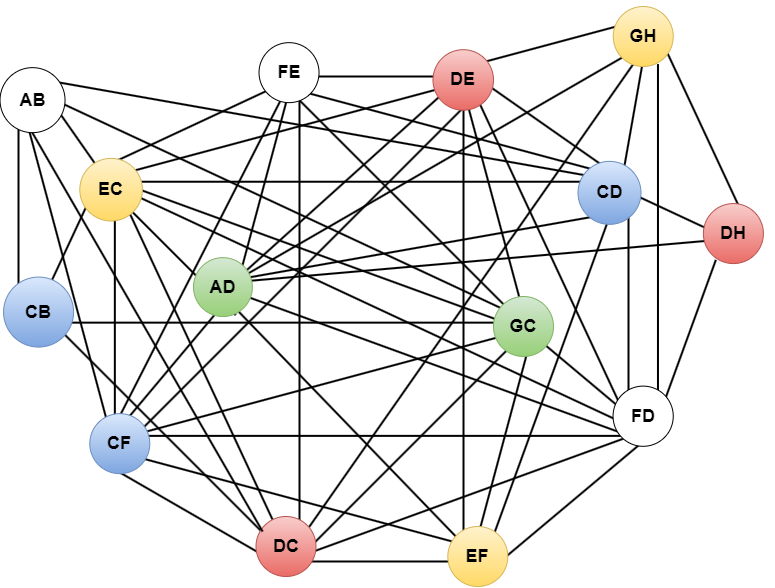
The framework was demonstrated using a traffic-light system consisting of three connected intersections. Individual traffic movements were represented as vertices, while incompatible movements that could not safely receive green signals simultaneously were represented by neutrosophic edges.
Traffic flows were classified into low, medium, and high categories using overlapping neutrosophic intervals. The overlaps were designed to capture uncertainty near the boundaries between traffic-volume categories.
In the model, each colour corresponds to a compatible group of traffic movements that can operate during the same signal phase. The chromatic number therefore represents the minimum number of signal phases required to manage the network without conflicts.
The analysis found that each of the three individual intersection graphs had a chromatic number of 5. When the three intersections were combined into an integrated neutrosophic graph, the resulting chromatic number also remained 5.
This means that, under the proposed model, the integrated traffic network can be managed using five signal phases.
The study shows how neutrosophic graph colouring can support traffic scheduling when conflict relationships are uncertain rather than completely deterministic.
By grouping compatible traffic movements into common phases, the approach could help reduce potential conflicts, improve traffic-flow coordination, shorten unnecessary waiting times, and support intelligent traffic-management decisions.
The authors also note that the framework could be extended beyond traffic control to scheduling, resource allocation, communication networks, transportation planning, and other optimisation problems involving uncertain or incomplete information.
📖 Read the full article here:
https://doi.org/10.46481/jnsps.2026.3505
Published in: Journal of the Nigerian Society of Physical Sciences