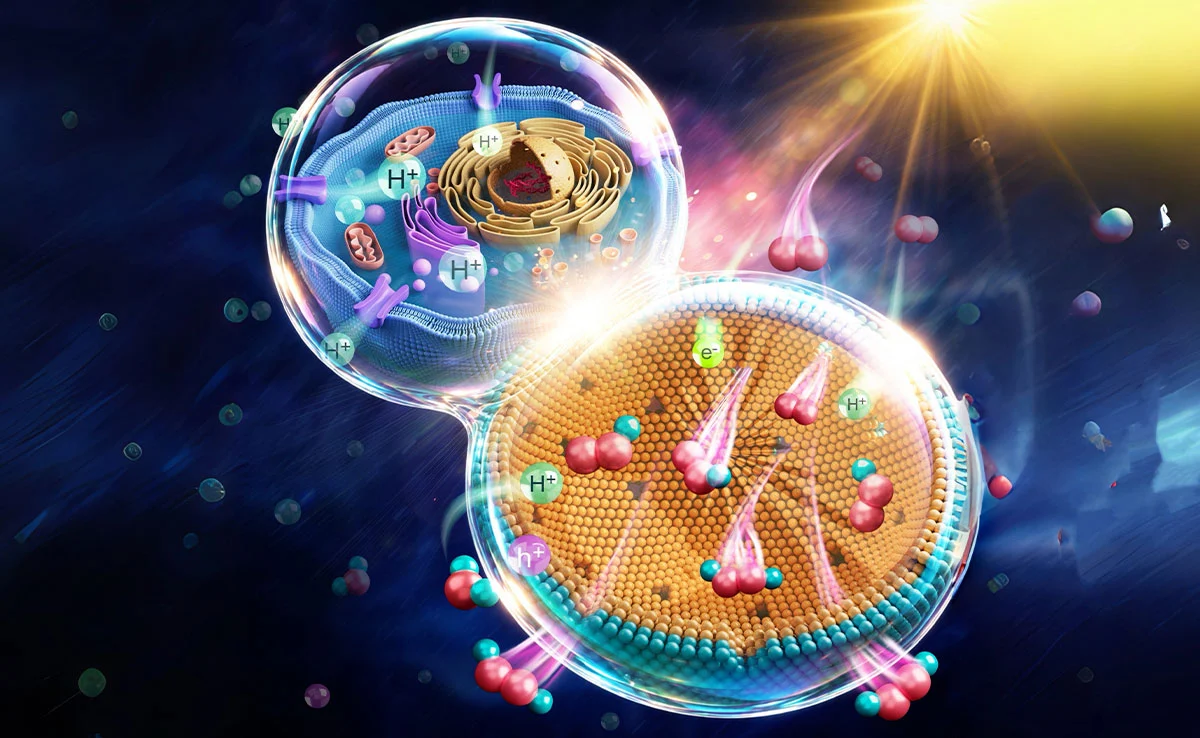
Scientists have developed a tiny cell-inspired nanoreactor that can improve artificial photosynthesis and efficiently produce hydrogen peroxide using visible light.
The research was led by Can Li of the Dalian Institute of Chemical Physics, Chinese Academy of Sciences, in collaboration with Jian Liu’s group at Inner Mongolia University. The findings were published in the Journal of the American Chemical Society.
Living cells are highly efficient because they organize chemical reactions inside carefully structured compartments. Different molecules are positioned in specific locations, allowing reactions to occur in a controlled and coordinated way.
Inspired by this natural design, the researchers created a hollow CdS@polydopamine nanoreactor that imitates some of the organization found in cells. The structure combines nanoscale confinement with a special proton-relay system, helping chemical reactions proceed more efficiently.
The nanoreactor has two important cell-like features.
The first is a dynamic catechol/o-benzoquinone redox pair within the polydopamine shell. This system acts like a proton relay, repeatedly accepting and donating protons. By doing so, it accelerates proton-coupled electron transfer, an important process in photocatalytic reactions.
The second feature is the nanoreactor’s hollow and porous structure. Its outer shell surrounds a tiny internal cavity, creating a confined space where reactants can gather, light can be trapped, and mass movement can be better controlled.
Together, these features help balance two key reactions involved in hydrogen peroxide production: oxygen reduction and water oxidation.
Under visible-light illumination in water, the nanoreactor achieved a hydrogen peroxide photosynthesis rate of 3.24 mmol gcat⁻¹ h⁻¹ and a solar-to-chemical conversion efficiency of 1.2%.
To understand how the system worked, the researchers used spectroscopy, photochemical measurements, finite element simulations, and theoretical calculations. Their results showed that the nanoreactor operates through a biomimetic mechanism and follows a Z-scheme heterojunction pathway, which supports efficient charge separation and reaction performance.
The team also placed the material inside an environmentally friendly sodium alginate hydrogel. This created a solid, recyclable photocatalyst that could continue producing hydrogen peroxide under natural sunlight.
Hydrogen peroxide is widely used in disinfection, chemical production, environmental treatment, and energy-related processes. Producing it through sunlight-driven artificial photosynthesis could offer a cleaner and more sustainable alternative to conventional methods.
The study shows how copying the design principles of living cells can help scientists build more efficient artificial systems. By combining biological inspiration with nanotechnology, the work opens new possibilities for artificial photosynthesis, energy catalysis, and synthetic chemistry.
Journal Reference:
Li, H., Ji, M., He, J., Deng, D., Zhao, J., Liu, J., & Li, C. (2026). Biomimetic Redox-Mediated Proton Relay in Nanoreactors for Photocatalysis. Journal of the American Chemical Society. https://doi.org/10.1021/jacs.6c08170