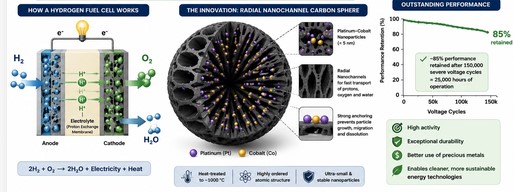
The rapid growth of data centres, electric vehicles and other energy-intensive technologies is increasing the demand for reliable and efficient electricity. In response, researchers are exploring cleaner technologies capable of converting fuels directly into electricity. A team led by scientists at Washington University in St. Louis has developed a new nanostructured catalyst that could make hydrogen fuel cells more efficient, durable and practical. The research, published in Nature Nanotechnology on 6 August 2026, addresses one of the major challenges facing fuel-cell technology: developing catalysts that can maintain high performance over long periods while using precious metals such as platinum more efficiently. Fuel cells generate electricity by combining hydrogen and oxygen, producing water and heat as by-products. However, the catalysts responsible for accelerating these reactions can degrade during operation, reducing performance and increasing costs. The researchers therefore designed a special carbon-based structure capable of stabilizing extremely small platinum-cobalt nanoparticles and maintaining their activity under demanding conditions. The work demonstrates how advances in materials science, nanotechnology and physical chemistry can contribute to the development of next-generation energy technologies.
The key innovation is a specially engineered porous, hollow carbon sphere containing radial nanochannels. These microscopic channels provide a structured environment that keeps platinum-cobalt nanoparticles small, evenly distributed and stable, even when the catalyst is exposed to high temperatures. This is important because conventional platinum nanoparticles can dissolve, migrate or grow larger during fuel-cell operation, causing their performance to decline. The new carbon architecture helps overcome the traditional trade-off between catalyst activity and durability. Remarkably, the researchers were able to heat the catalyst to about 1,000°C to produce a highly ordered atomic structure while keeping the nanoparticles smaller than 5 nanometres and preventing them from clumping together. In performance tests, the material retained about 85% of its performance after 150,000 severe voltage cycles, which the researchers estimate could correspond to roughly 25,000 hours of operation. The open nanochannels also facilitate the movement of protons, oxygen and water through the electrode, supporting efficient electrochemical reactions. These findings demonstrate the powerful role of nanoscale engineering in controlling the structure and performance of materials used for energy conversion.
The potential implications extend beyond laboratory demonstrations. More durable and efficient fuel-cell catalysts could help advance hydrogen-powered transportation, stationary electricity generation and other energy-intensive applications. The researchers particularly highlight the possibility of using fuel cells to provide electricity for data centres, which require enormous amounts of power for computing and cooling. Instead of relying entirely on electricity from the grid, future data centres could potentially generate part of their power directly through fuel cells using hydrogen or other fuels. Although further development and real-world testing will be necessary before the technology can be widely deployed, the research represents an important step toward addressing the challenges of catalyst cost, stability and efficiency. It also illustrates how Physical Sciences research—especially materials science, nanotechnology, chemistry and physics—can provide solutions to emerging global energy challenges. As the world seeks cleaner and more reliable energy systems, innovations that improve the efficiency and lifetime of energy-conversion materials could become increasingly important. This breakthrough reminds us that manipulating matter at the nanoscale can have consequences at a much larger scale—from improving individual fuel cells to potentially supporting the energy infrastructure of tomorrow.