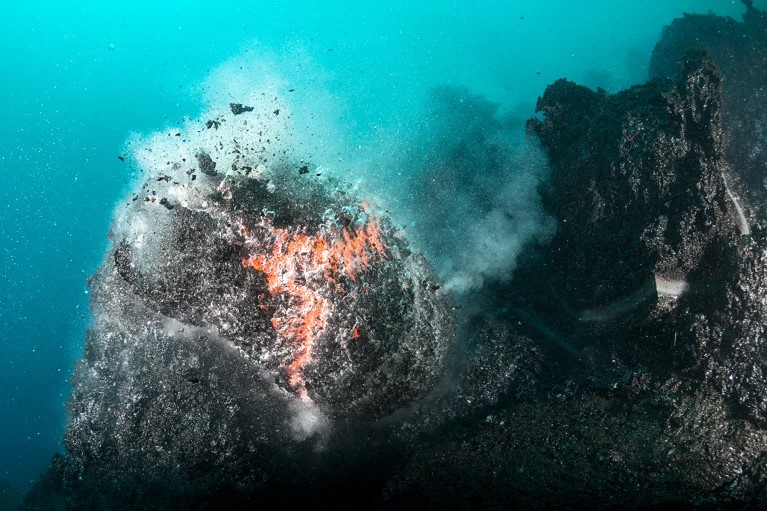
Ocean Floor Witnessed Splitting Apart for the First Time, Releasing Lava
Geophysicists have observed the ocean floor spreading apart in real time for the first time, capturing a dramatic event that released a huge volume of lava and created new seafloor beneath the Indian Ocean.
Using more than 20 instruments placed across a 100-kilometre section of the Southeast Indian Ridge, researchers recorded the seafloor moving by several metres over just a few days. The event released more than 160 million cubic metres of lava onto the ocean floor and shifted parts of the oceanic crust apart.
The discovery provides the first direct, in-place measurements of how new oceanic crust forms during a sudden seafloor spreading event. The findings were published in Nature.
How New Ocean Floor Is Made
Mid-ocean ridges are long underwater mountain systems where tectonic plates move away from each other. As the plates separate, magma rises from inside Earth, cools, and hardens to form new oceanic crust.
This process is responsible for creating much of the ocean floor. Although scientists have understood the general idea of seafloor spreading for decades, they had never directly observed one of these spreading events as it happened.
The new observations change that.
The research team focused on the Southeast Indian Ridge, a major undersea boundary between the Australian plate and the Antarctic plate. These plates are moving apart by about six centimetres per year, but movement does not always happen smoothly. Some sections can remain locked for long periods before suddenly shifting during bursts of tectonic and volcanic activity.
Catching the Seafloor in Motion
In February 2024, the researchers placed instruments along the ridge to monitor activity. These included underwater microphones called hydrophones, acoustic beacons, and pressure gauges designed to detect earthquakes, seafloor movement, and changes in ocean depth.
The instruments captured a major event following earthquakes on 26 April 2024. Measurements showed that the seafloor moved a total of about 4.2 metres over six days. At its fastest, the spreading reached roughly 5 centimetres per minute before slowing to about 1.2 centimetres per day a week later.
The researchers believe the movement was caused by the deflation of a magma reservoir about 2.5 kilometres wide, located roughly 3.6 kilometres beneath the crust. As magma drained from this reservoir, it erupted onto the seafloor and created new crust.
The amount of lava released was estimated at more than 160 million cubic metres, making the event far larger than expected.
Why the Discovery Matters
The oceanic crust covers nearly two-thirds of Earth’s surface, and mid-ocean ridges are where much of that crust is formed. Yet because these systems lie deep underwater, scientists have had limited direct data on how individual spreading events unfold.
This discovery gives researchers a rare real-time view of how stress builds up and is released along a mid-ocean ridge. The event likely released strain that had accumulated over several decades.
The findings also show that undersea observatories can capture fast geological processes that were once nearly impossible to monitor directly. Scientists say future studies of other mid-ocean ridges could reveal whether similar spreading events happen elsewhere and how often they occur.
By witnessing the ocean floor split apart and release lava, researchers have gained a clearer understanding of one of the fundamental processes that shapes Earth’s surface.