How do different graph products relate to one another within the structural hierarchy of graph theory?
This study investigates subgraph relationships among several standard graph products, including Cartesian, lexicographic, tensor, modular, co-normal, strong, homomorphic, and rooted products.
By comparing the defining adjacency conditions of these products, the authors establish a series of inclusion results that clarify how one graph product can be embedded within another.
The findings show that the Cartesian product is a subgraph of the lexicographic, co-normal, and strong products. The lexicographic product is also shown to be a subgraph of the co-normal product.
The study further proves that the tensor product is a subgraph of the lexicographic, modular, strong, and co-normal products, while the strong product is a subgraph of both the lexicographic and co-normal products.
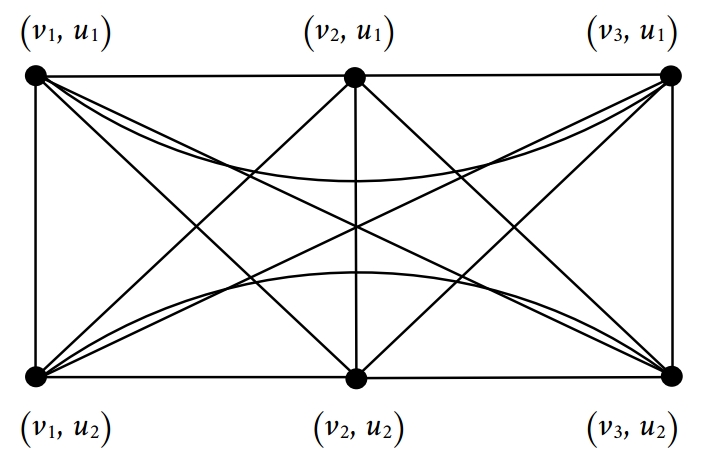
In addition, the rooted product is established as a subgraph of the Cartesian, lexicographic, co-normal, and strong products. Illustrative examples are provided to visualize these relationships clearly.
This work contributes to algebraic graph theory, structural graph analysis, graph product theory, network modelling, and future studies involving generalized graph structures such as weighted graphs, fuzzy graphs, and soft graphs.
📖 Read the full article here:
https://doi.org/10.46481/jnsps.2026.3346
Published in: Journal of the Nigerian Society of Physical Sciences