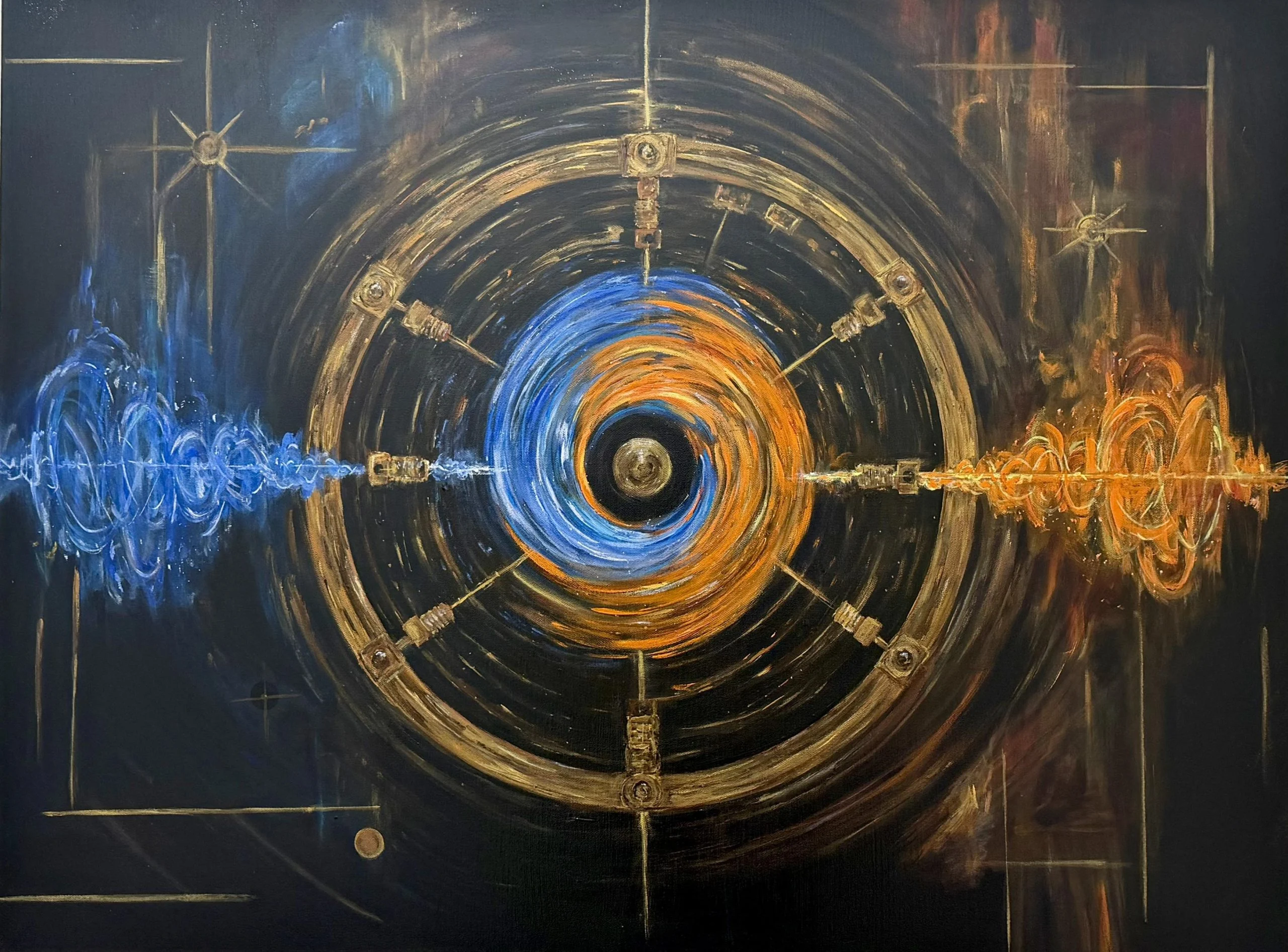
Scientists have recreated a famous black hole energy effect in the laboratory, using a specially engineered system that imitates extreme rotation without physically spinning.
The work is based on an idea proposed more than 50 years ago by physicist Sir Roger Penrose. He suggested that energy could, in theory, be extracted from a rapidly spinning black hole. In this scenario, a particle entering the black hole’s ergosphere could split into two parts: one falling into the black hole and the other escaping with more energy than the original particle had.
Physicist Yakov Zel’dovich later extended this idea to waves. He predicted that when a wave interacts with a fast-rotating object, it could draw energy from that rotation and emerge stronger than before.
Now, researchers at the Advanced Science Research Center at the CUNY Graduate Center have demonstrated a laboratory version of this effect using electromagnetic waves and synthetic rotation. Their findings were published in Nature.
Instead of building a device that physically spins at extreme speed, the team created a radio-frequency system whose properties change across space and time. This changing pattern makes the system appear to rotate from the perspective of incoming waves, even though no physical object is actually spinning.
To test the idea, the researchers built a ring-shaped network of electronic resonators. By changing the properties of the resonators in a carefully timed sequence, they created a traveling pattern around the ring. Electromagnetic waves entering the system experienced this pattern as though they were interacting with an ultrafast rotating object.
The team found that waves with the right rotational characteristics could extract energy from the system and become stronger. This reproduced the essential physics of the Penrose–Zel’dovich process, showing that a black hole-inspired energy amplification effect can be simulated in a controlled laboratory setting.
The experiment relied on metamaterials, which are engineered structures designed to control how waves move. These materials allowed the researchers to reproduce an extreme physical effect without needing an actual black hole or a mechanically spinning object.
The achievement is important because it creates a new way to study extreme rotational physics in the laboratory. It also opens a platform for exploring links between astrophysics, wave physics, photonics, and quantum science.
The same principle could eventually support new technologies in wireless communication, optics, photonics, and quantum systems. By using synthetic motion to control and amplify waves, scientists may be able to develop new methods for processing information and manipulating light.
This work shows how ideas once limited to black holes and cosmic environments can now be tested in engineered laboratory systems, bringing a 50-year-old theory closer to real-world technological use.
Journal Reference:
Nasari, H., Moussa, H., Kasahara, Y., Thielens, A., & Alù, A. (2026). Observation of Floquet rotational super-radiance. Nature. https://doi.org/10.1038/s41586-026-10725-y