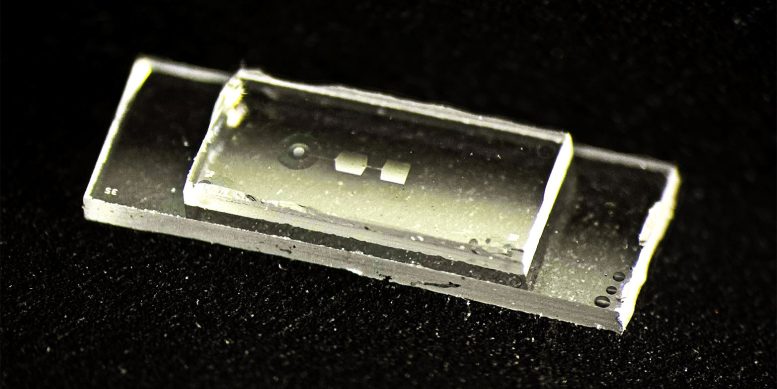
Researchers at ETH Zurich have developed a quantum chip that stores information as tiny mechanical vibrations, similar to how musical notes vibrate through a guitar string.
The vibrations are far too small and too fast to be heard, but they carry quantum information inside microscopic devices known as mechanical resonators. These resonators store energy in packets called phonons, which act as carriers of information in the quantum system.
The chip, developed by a team led by quantum physicist Yiwen Chu, is only a few millimetres wide—about the size of a small fingernail. Despite its tiny size, it demonstrates a new way of building quantum computers by separating the processor from the memory, much like the structure used in ordinary computers.
In classical computers, the central processing unit performs calculations while random access memory temporarily stores data. Most quantum computers do not yet follow this clear separation. Their processing and memory functions are often built into the same hardware, which can make scaling difficult.
The ETH Zurich team created a different architecture. In their system, a superconducting qubit acts as the processor, while mechanical resonators serve as quantum memory. When information is needed, the qubit interacts with specific vibrational modes in the resonators, modifies their quantum state, and then stores the information again.
This approach combines the strengths of both systems. Superconducting qubits can perform fast quantum operations, while mechanical resonators are compact and can hold multiple vibrational modes in a small space. Each mode can act like a separate memory location.
The researchers showed that these vibration-based memories can do more than simply store information. They can also support programmable quantum operations. To test the system, the team carried out two important procedures: the quantum Fourier transform and quantum period finding.
These operations are important building blocks for quantum algorithms. Their successful demonstration shows that mechanical resonators can be used as active parts of a quantum computing architecture, not just passive storage devices.
The work does not mean a practical quantum computer is ready yet. Larger systems will need more memory, better error control, stronger processing power, and reliable operation across many quantum states. However, the study proves that vibration-based quantum memory can function as a real computational resource.
The discovery points toward a future where quantum computers may use compact mechanical components to store and process information more efficiently.
Journal Reference:
Yang, Y., Kladarić, I., Skrabulis, M., Eichenberger, M., Marti, S., Storz, S., Esche, J., García Bellés, R., Kern, M.-E., Omahen, A., Brooks, A., Bild, M., Fadel, M., & Chu, Y. (2026). Mechanical resonator–based quantum computing. Science. https://doi.org/10.1126/science.aef4139