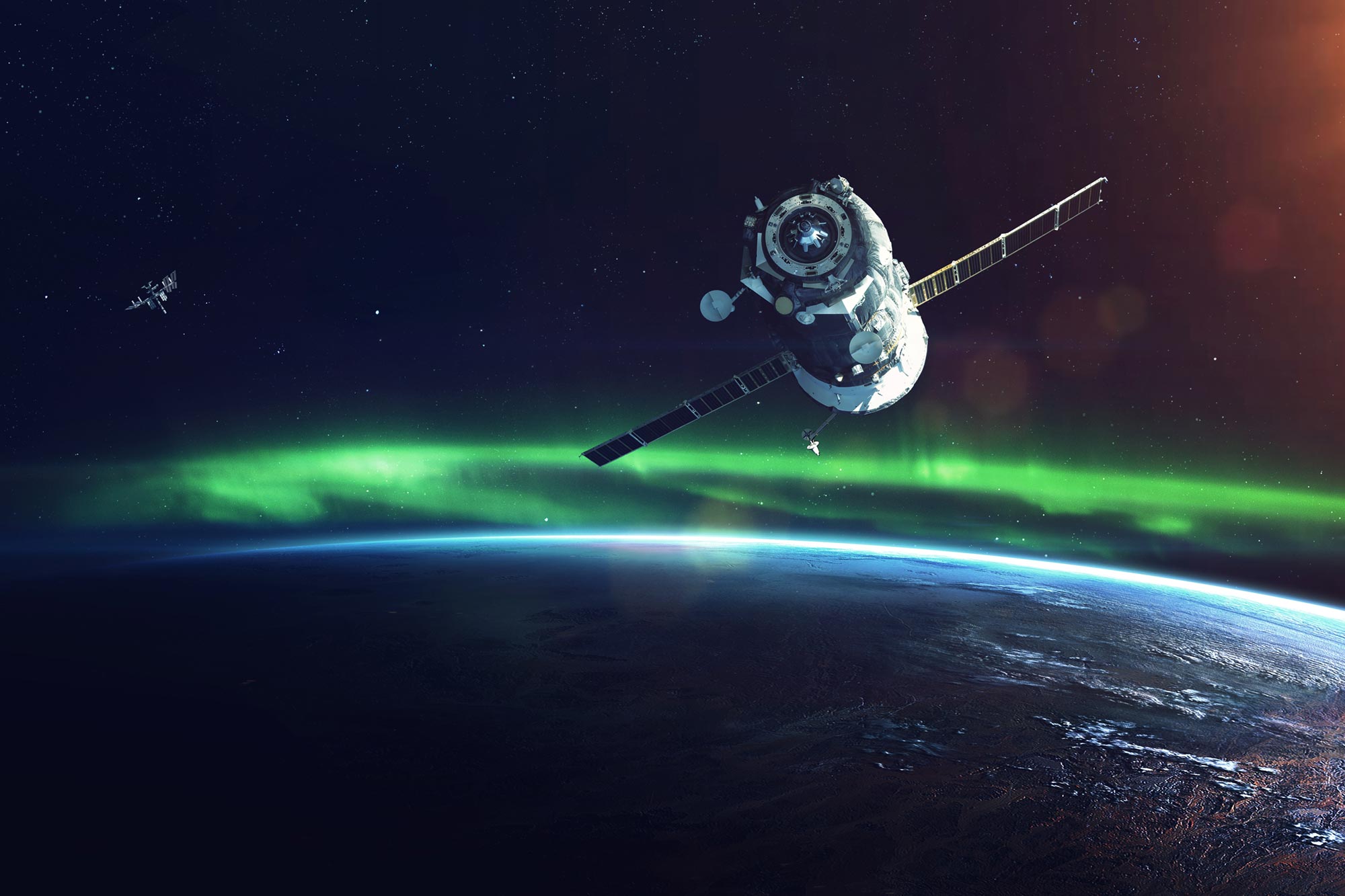
Spacecraft may be making highly organized particle motion in radiation belts look random, raising new questions about how scientists have interpreted more than 60 years of observations.
For decades, scientists studying Earth’s radiation belts have often interpreted the apparent spreading of energetic particles as evidence of diffusion — a process in which particles are gradually scattered by fluctuating electromagnetic fields.
But new research suggests that spacecraft measurements may sometimes tell a deceptively simple story.
Particles moving in a completely organized and predictable way can produce observations that look remarkably similar to random diffusion when viewed with the limited spatial and temporal resolution of a spacecraft. The finding means that two fundamentally different physical processes may leave almost identical signatures in observational data.
The study, published in Physical Review Research, was carried out by an International Space Science Institute research team involving scientists from the University of Birmingham, the Czech Academy of Sciences, the University of Helsinki, and other institutions.
The result does not mean that diffusion is absent from radiation belts. Instead, it reveals a fundamental limitation: spacecraft observations alone may not always be able to distinguish true diffusion from organized, non-diffusive particle motion.
That distinction could have major consequences for models used to understand and predict hazardous space environments.
Radiation belts are filled with dangerous particles
Earth is surrounded by regions known as the Van Allen radiation belts, where charged particles become trapped by the planet’s magnetic field.
Some of these particles reach extremely high energies, creating a hazardous environment for spacecraft.
Radiation-belt particles can damage satellite electronics, interfere with communications, degrade instruments, and increase radiation risks for space missions. Understanding how these particles are accelerated, transported, and lost is therefore an important part of space-weather research.
Earth is not the only object surrounded by radiation belts.
Similar energetic-particle environments occur around Jupiter and Saturn, while radiation belts have also been associated with Jupiter’s moon Ganymede and with ultracool brown dwarfs beyond the Solar System.
For more than six decades, diffusion-based theories have played a central role in explaining how particles move through these environments.
The new research shows why interpreting those observations may be more difficult than previously appreciated.
Predictable motion can look completely random
Imagine a localized group of energetic particles injected into a radiation belt.
The particles do not all orbit the planet at precisely the same speed. Small differences in their drift rates gradually cause the original group to stretch and deform.
Over time, the initially compact particle population develops increasingly thin and complicated structures in phase space.
This process is known as collisionless phase mixing.
Crucially, the motion itself can remain deterministic. The particles are not necessarily being randomly scattered.
But a spacecraft cannot observe every fine detail of the evolving structure.
As it travels through the radiation belt, the spacecraft samples particles at different positions and times. Once the structures become smaller than the observational resolution, their intricate organization becomes effectively invisible.
What remains in the measurements is a smoother signal.
And that smooth signal can look almost exactly like diffusion.
A spacecraft can blur the underlying physics
The researchers found that this observational effect can happen rapidly.
As spacecraft move across neighboring drift shells while energetic particles circle the planet, they sample particle populations with slightly different drift frequencies.
Those differences convert spatial structure into a rapidly changing temporal signal.
Eventually, information about the original organized particle distribution becomes difficult or impossible to recover from the spacecraft measurements.
The study indicates that the effective observational lifetime of some localized structures may be only a few particle drift periods before their fine-scale organization is lost from view.
The spacecraft therefore records something that appears smooth and diffusive even though the underlying particle motion can remain collisionless and organized.
That creates a fundamental ambiguity.
An observation previously interpreted as evidence that particles were randomly scattered by waves could, under some circumstances, instead be produced by ordinary phase mixing.
This does not mean diffusion is wrong
The researchers emphasize an important distinction.
Their results do not show that diffusion does not occur in radiation belts.
Wave-particle interactions and stochastic transport remain important components of radiation-belt physics.
Rather, the problem is that the observational signature commonly associated with diffusion may not uniquely identify it.
Lead author Adnane Osmane of the University of Helsinki explained that some observations can also arise through fundamentally different processes, meaning scientists need to be cautious when inferring the underlying physics from spacecraft measurements alone.
If collisionless phase mixing is mistakenly interpreted as diffusion, estimates of how quickly particles are accelerated, transported, or lost could be biased.
That could eventually affect predictions of long-term radiation-belt behavior.
A decades-old assumption comes under scrutiny
Diffusion-based models have been used extensively since the early decades of space exploration.
Their success helped establish diffusion as one of the standard frameworks for understanding the evolution of energetic particles around Earth.
But radiation belts are not always smooth and uniform.
They can be populated by localized particle injections and other strongly structured events.
The new study addresses a long-standing puzzle: how can highly localized and organized particle populations produce spacecraft observations that appear so compatible with diffusion?
The answer may lie partly in the measurement process itself.
A spacecraft is not simply observing the radiation belt from a stationary vantage point. It is moving through a complicated, evolving environment.
Its trajectory effectively filters what it can see.
Fine-scale spatial organization can therefore disappear from the measured signal even though it still exists physically.
The researchers compare it to Pollock and Rothko
To illustrate the idea, the researchers turned to art.
A Jackson Pollock painting contains a dense network of splashes, lines, and intricate filaments.
A Mark Rothko painting, by contrast, is known for broad areas of color with far smoother visual structure.
Now imagine viewing a Pollock painting from so far away — or with such poor resolution — that its finest lines can no longer be distinguished.
The painting has not actually transformed into a Rothko.
The intricate structure is still there.
But the observer can no longer resolve it.
The same thing can happen in spacecraft measurements, according to the researchers. Highly structured particle distributions may remain present while observational limitations smooth away their fine details, leaving a signal that appears much more random and diffusion-like.
Space and time can become difficult to separate
Another problem arises because a single spacecraft cannot easily determine whether a measured change occurred because the particle population evolved with time or because the spacecraft simply moved into a different location.
Those two possibilities can produce remarkably similar observations.
Corresponding author Miroslav Hanzelka of the Czech Academy of Sciences argues that this is an important limitation of many previous radiation-belt missions.
With only one spacecraft sampling one location at a time, spatial structure and temporal evolution can become difficult to disentangle.
This ambiguity makes it harder to determine whether an observed particle distribution really evolved diffusively or whether the spacecraft was moving through unresolved organized structures.
Satellite constellations could provide the answer
One possible solution is to observe radiation belts from several places simultaneously.
Future missions using constellations of scientific satellites could measure the same particle populations at multiple locations at the same time.
That would allow researchers to compare what different spacecraft see and better distinguish spatial variations from genuine changes occurring over time.
Instead of reconstructing a dynamic three-dimensional environment from a single moving measurement point, scientists could obtain multiple simultaneous perspectives.
Such missions could provide much stronger tests of whether particle transport is actually diffusive.
The implications extend beyond Earth
The findings could also affect how scientists interpret radiation belts elsewhere.
Around Jupiter and Saturn, moons and localized injections can create highly nonuniform particle distributions.
In such environments, assuming that apparent smoothing always results from diffusion may overlook organized particle dynamics.
The problem could become even greater when studying radiation belts around ultracool brown dwarfs, where scientists cannot send spacecraft to directly measure the environment.
If unresolved observations can disguise organized transport as diffusion even around Earth — where decades of spacecraft measurements exist — interpreting distant systems could be considerably more challenging.
The study therefore points to a broader lesson for space physics: observations do not always uniquely reveal the process that created them.
Rethinking decades of radiation-belt observations
The discovery does not invalidate 60 years of spacecraft research.
Instead, it adds another physical mechanism that scientists may need to consider when interpreting the enormous archive of radiation-belt observations collected since the beginning of the space age.
Some signatures attributed to random radial diffusion may indeed result from diffusion.
Others, however, could contain a previously underappreciated contribution from collisionless phase mixing and observational filtering.
Distinguishing between the two will be important because models of particle acceleration and transport depend heavily on identifying the correct physical mechanism.
The study also demonstrates how the act of measurement itself can shape scientists’ picture of a physical system.
A spacecraft may accurately record the particles that pass its instruments, yet still miss the fine-scale organization connecting those measurements.
In that sense, the hidden problem is not necessarily faulty spacecraft data.
It is that different realities can look nearly identical through the spacecraft’s limited window.
And resolving that ambiguity may require an entirely new generation of multi-spacecraft observations.
Journal reference
Adnane Osmane, Xin An, Anton V. Artemyev, Oliver Allanson, Jay Albert, and Miroslav Hanzelka. “Collisionless phase mixing mimics diffusive transport in radiation belt observations.” Physical Review Research, 2026. The article title and authors are confirmed by the American Physical Society’s Physical Review Research records and the University of Birmingham publication announcement.