Scientists have uncovered a surprising mathematical pattern inside the leaves of the Chinese money plant, revealing that nature may use the same kind of spatial logic often found in computer science, city planning, and network design.
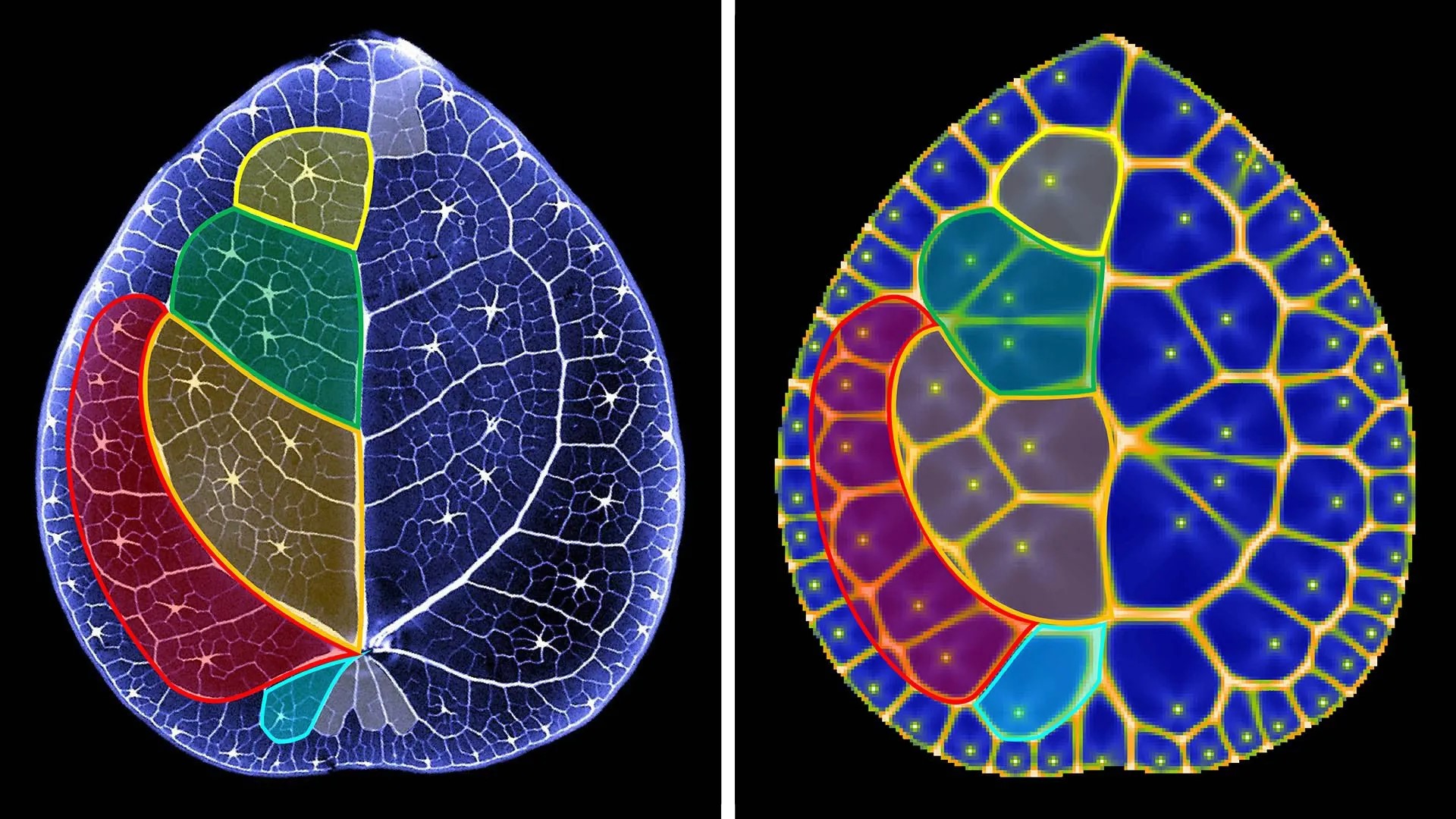
Researchers at Cold Spring Harbor Laboratory found that the leaves of Pilea peperomioides, commonly known as the Chinese money plant, naturally form a pattern called a Voronoi diagram. This geometric structure divides space into regions around central points, ensuring that every location inside a region is closest to its own central point.
Voronoi diagrams are widely used in human-designed systems, including school district planning, telecommunications, computer graphics, and network design. In the Chinese money plant, however, this pattern appears naturally in the arrangement of tiny pores and looping leaf veins.
A Mathematical Pattern Hidden in Leaves
The Chinese money plant is a popular houseplant known for its round, flat leaves. These leaves contain small pores called hydathodes, which are involved in water release. Around these pores, the plant develops a network of looping veins that transport water and nutrients.
When researchers carefully mapped the positions of the hydathodes and the surrounding veins, they discovered that the vein network follows the structure of a Voronoi diagram. Each pore acts like a central point, while the looping veins form boundaries around it.
This means the plant organizes its leaf structure in a mathematically efficient way, without consciously measuring distances or planning its growth.
Nature’s Own Algorithm
To understand how the pattern forms, the researchers worked with Przemysław Prusinkiewicz, a scientist known for his studies of plant growth and vein development. Together, they identified a biological process that acts like a natural algorithm, guiding the formation of the plant’s reticulate, or net-like, veins.
Unlike humans, plants cannot calculate distances directly. Instead, they rely on local biological signals and interactions. These simple local rules can still produce highly organized geometric patterns.
The discovery shows how living organisms can solve complex design problems through growth processes shaped by evolution.
Where Biology Meets Computer Science
The study connects classical geometry, modern plant biology, and computer science. It shows that mathematical ideas used in human technology also appear in living systems.
According to the researchers, this kind of pattern helps explain how plants develop efficient internal networks. Leaf veins must distribute water and nutrients while supporting the structure of the leaf. A Voronoi-like arrangement may help organize this system effectively.
The finding also offers new insight into a long-standing question in plant science: how looping leaf veins form. The Chinese money plant may provide one of the clearest natural examples of this process.
Why the Discovery Matters
The research suggests that plants may use simple biological rules to create complex and efficient structures. Studying these patterns could help scientists better understand plant development, evolution, and the hidden mathematical principles that shape life.
It may also inspire new ideas in design, computing, and engineering, where nature’s solutions can guide human innovation.
The discovery reminds us that even a familiar houseplant can contain elegant mathematical secrets hidden in plain sight.
Journal Reference:
Zheng, C. X., Palit, S., Venezia, M., Blum, E., Pedmale, U. V., Jackson, D., Scarpella, E., Prusinkiewicz, P., & Navlakha, S. (2026). Reticulate leaf venation in Pilea peperomioides is a Voronoi diagram. Nature Communications, 17(1). https://doi.org/10.1038/s41467-026-71768-3