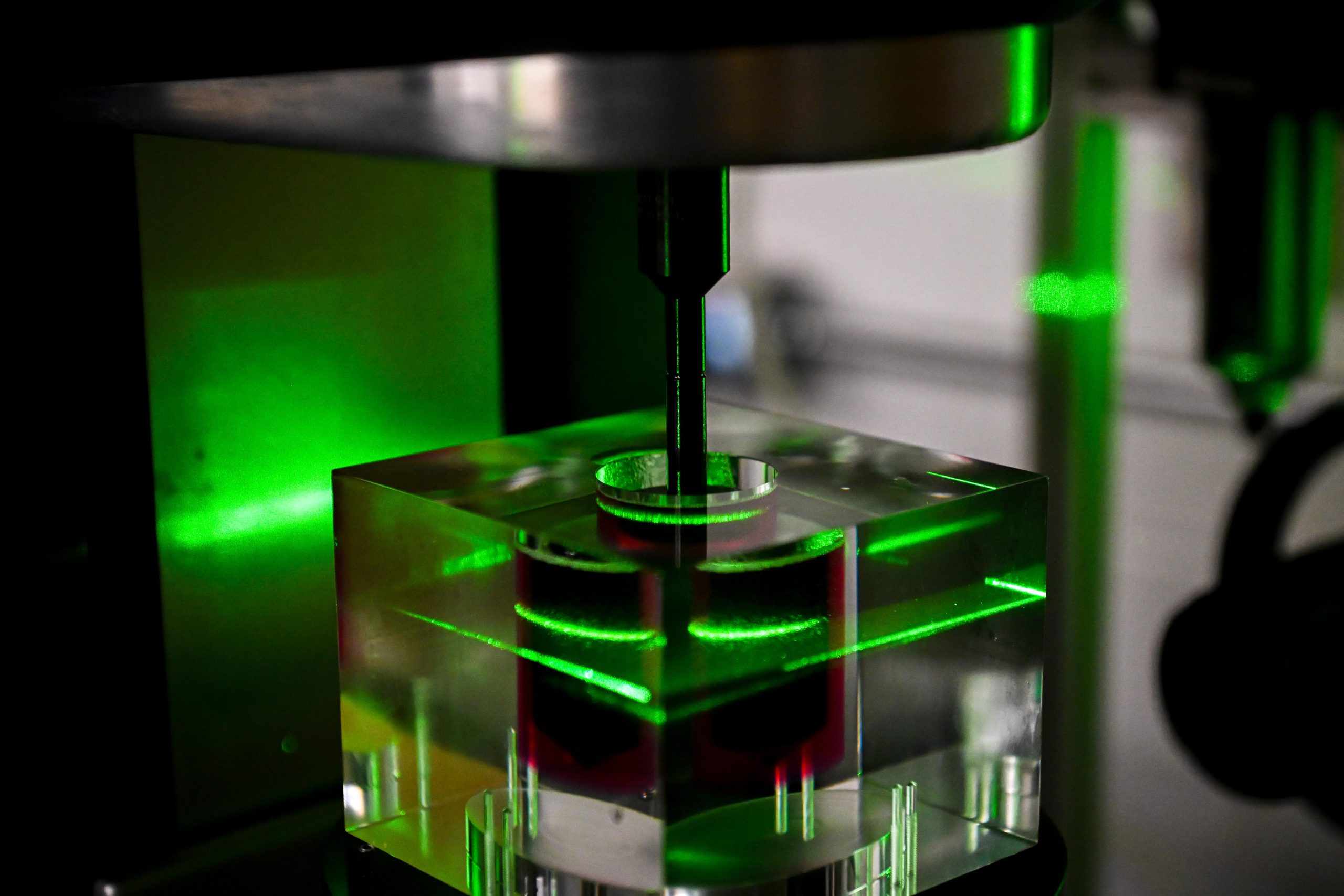
Scientists have discovered that a simple material can store two different kinds of memory at the same time, but those memories can also compete with and erase one another.
The research was carried out by physicists at Penn State University and published in Physical Review Letters. The study focused on a suspension made of small particles mixed into a thick liquid, similar in some ways to materials such as chocolate syrup or fresh concrete.
Materials can sometimes “remember” what has happened to them. A folded sheet of paper, for example, keeps a crease even after it is opened. In more complex materials, memory can be stored in the way microscopic structures rearrange after being stretched, stirred, shaken, or compressed.
The researchers studied non-Brownian suspensions, which contain particles large enough that their motion is not mainly controlled by random thermal movement. This allowed the team to track how the material responded directly to stirring and rocking.
Earlier studies had shown that such suspensions could remember the direction in which they were stirred. Other work showed that they could also remember the amplitude, or strength, of repeated rocking.
In the new experiment, the researchers tested whether both memories could exist together. They first stirred the suspension to imprint a memory of direction, then rocked it back and forth at different intensities to see how the two memories interacted.
When the rocking was gentle, the suspension retained both memories at once. It remembered the original stirring direction while also storing information about the strength of the rocking.
However, when the rocking became stronger, the directional memory began to fade. At a certain intensity, the rocking erased the original memory of direction and returned the material to a more symmetric state. Beyond that point, the rocking itself began creating a new directional memory.
This behavior is similar to the way human memories can interact. A new experience may not simply sit separately from older memories; it can reshape, weaken, or change how earlier memories are recalled.
The researchers suggest that the competition begins when particles inside the suspension encounter one another too frequently. During gentle motion, particle interactions are limited, allowing both memories to survive. But stronger motion increases those encounters, causing one memory to interfere with the other.
The findings may help scientists understand how disordered materials store information and why they have limited memory capacity. Similar memory effects have been observed in soft glasses and granular materials, even though their microscopic behavior is different.
The work could also have broader implications. Understanding material memory may help researchers design responsive materials and improve models of natural systems, including rocks that may retain memories of stress, temperature changes, or vibrations.
The study shows that even simple matter can behave in surprisingly memory-like ways, storing, reshaping, and losing information depending on how it is disturbed.
Journal Reference:
Padamata, S., & Keim, N. C. (2026). Memories of Amplitude and Direction Coexist and Compete in Non-Brownian Suspensions. Physical Review Letters. https://doi.org/10.1103/ckl2-lcpl