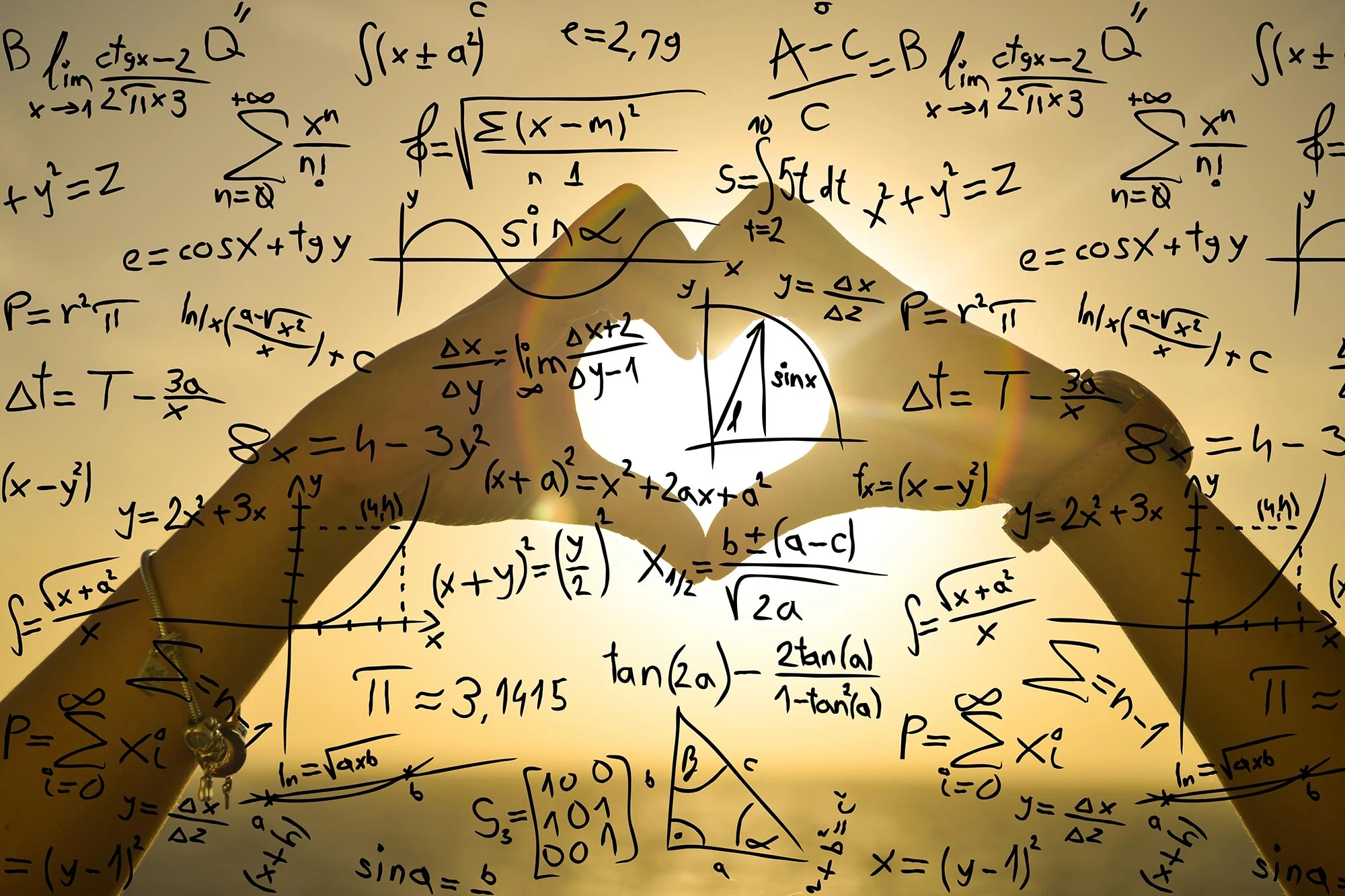
Can love be described with equations? According to decades of research, romantic relationships may follow measurable patterns that mathematics can help explain.
Professor Laurent Pujo-Menjouet of the University of Lyon I has worked with researchers across different fields to study how romantic feelings change over time. His work uses dynamical systems, a branch of mathematics that examines how things evolve when different forces interact.
In his book Love! Valour! Equations!, Pujo-Menjouet brings together mathematics, psychology, literature, cinema, and everyday experience to explore how relationships grow, weaken, recover, or collapse.
The idea is not to predict exactly who someone will fall in love with. Instead, the models try to explain why some relationships remain stable through stress and conflict, while others gradually fall apart.
From Population Models to Romantic Relationships
Surprisingly, some of the mathematical tools now used to study love were originally developed to understand animal populations.
Models such as the Malthus model, predator-prey equations, and the Allee effect have been used to describe how populations grow, decline, or collapse. Researchers later adapted similar ideas to examine how feelings between romantic partners change over time.
In this approach, a relationship is treated like a system affected by attraction, emotional responses, memory, conflict, and external pressure.
The work builds on earlier contributions from researchers such as John Gottman, José Manuel Rey, Sergio Rinaldi, and Steven Strogatz, who helped apply mathematical and psychological models to romantic relationships.
Gottman, often called “Doctor Love,” showed that couple interactions could be coded, measured, and used to predict relationship outcomes. Later models added more realistic features, including delayed emotional reactions, which reflect how people sometimes need time to process conflict.
The Relationship Danger Zone
One key idea in Pujo-Menjouet’s model is that relationships may have a critical emotional threshold. If feelings remain below this level for too long, the relationship may continue declining toward separation.
However, identifying this danger zone could also help couples respond before things become irreversible.
The model does not suggest that arguments automatically destroy relationships. Instead, it focuses on whether couples can recover after conflict, stress, or outside pressure.
In other words, the important issue is not whether couples face problems, but whether they have enough resilience to return to a stable emotional balance afterward.
The model highlights three important factors: attraction between partners, the gradual fading of feelings over time, and how each partner responds emotionally to the other. Together, these factors influence whether a relationship can survive life’s challenges.
Could AI Help Couples Spot Trouble Early?
Future versions of these mathematical models could be combined with artificial intelligence to identify when a relationship is entering a risky state.
Pujo-Menjouet compares this idea to a “relationship GPS.” Such a system would not decide who someone should love, but it could help show where a relationship is heading and suggest when corrective action may be needed.
This could give couples time to rebuild connection, improve communication, or seek support before problems become too severe.
Patterns, Not Certainty
The researchers emphasize that mathematics cannot fully capture the complexity of love. Human relationships are shaped by culture, personality, faith, family, economics, history, and personal choices.
Most existing models are also based largely on Western relationship patterns, meaning they may not apply equally across all societies or generations.
The equations can reveal patterns, risks, and tendencies, but they cannot guarantee the future of a relationship. Commitment, growth, therapy, forgiveness, and daily choices can all change the path.
The study of love through mathematics suggests that romance may not be pure mystery after all. While equations cannot replace human effort, they may help explain how relationships survive, fail, and recover.