How can smart agricultural devices remain secure without draining battery life or requiring extra hardware?
This study investigates stack-protection mechanisms for ARM Cortex-M4 microcontrollers used in agricultural Internet of Things systems in Nigeria.
Stack-based attacks, including buffer-overflow and return-oriented programming attacks, can compromise lightweight edge devices that monitor soil moisture, temperature, humidity, and other farm-related environmental data.
To address this risk, the authors simulated six configurations: no protection, Memory Protection Unit, Stack Canary, Shadow Stack under Mask, Control-Flow Integrity, and a Hybrid MPU–Shadow Stack mechanism.
The Python-based simulation modelled 500 sensor readings and 100 simulated attack attempts for each protection method, evaluating security effectiveness, performance overhead, energy impact, and battery-life suitability.
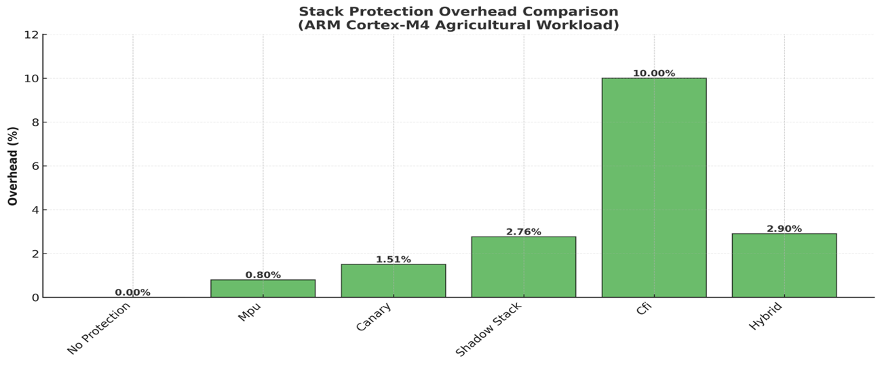
The Hybrid MPU–SuM mechanism prevented all simulated attacks within the defined threat model while producing only 2.90% performance overhead and a 2.83% reduction in estimated battery life. It also maintained battery longevity above the required operational target for rural agricultural deployments.
Although Control-Flow Integrity also achieved complete simulated attack prevention, its 10.00% overhead made it less suitable for latency-sensitive and duty-cycled sensor workloads.
This research contributes to edge computing security, agricultural IoT protection, embedded-system resilience, ARM Cortex-M4 security, stack-level defence, and sustainable smart-farming infrastructure.
📖 Read the full article here:
https://doi.org/10.46481/asr.2026.5.2.436
Published in: African Scientific Reports